
Outdoor heaters, radiant heaters and patio heaters operated with LPG are becoming increasingly popular. You can find the right pressure regulator/pressure reducer by reading this article.
How do I find the right pressure regulator for outdoor heaters, radiant heaters or patio heaters?
Category: Home & Commercial

The pressure regulator/pressure reducer which goes with your outdoor heater, radiant heater or patio heater depends primarily on the required nominal pressure and whether you use the device operated with LPG either privately or commercially.
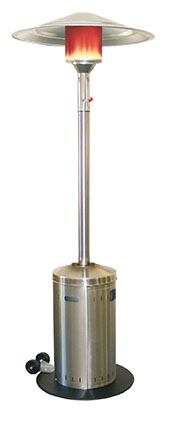
In addition to increased use in the commercial sector, more and more private individuals also use this kind of gas heater. If, for example, the first guests start to get cold at a barbecue or garden party, outdoor heaters and similar devices can give out comfortable heat at the push of a button.
Nominal pressure the same
For both purposes – private and commercial – the regulations stipulate different requirements. The nominal pressure should always be the same. When purchasing the heater, make sure that a nominal pressure of 50 millibar is indicated on the type label. This is the usual pressure in Germany, for which the majority of pressure regulators is also designed.
Commercial use
If you use gas heaters as part of a commercial business in Germany (e.g. restaurant, snack bar, stall at a Christmas market), regulation 110-010 of the German Accident Insurance Act (formerly: DGUV V 79) is applicable.

© Pixabay
The pressure regulator must therefore have an over-pressure safety device. Also mandatory: an excess flow device if the hose assembly is longer than 40 centimetres – which is often the case for heaters and patio heaters.
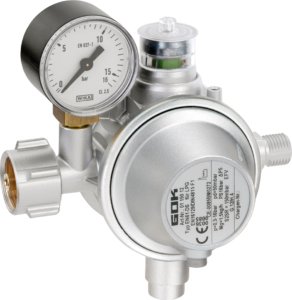
For commercial use, we recommend the pressure regulator type EN61-DS with order number 01 150 12. The pressure regulator has an integrated over-pressure safety device and excess flow device as well as a pressure gauge with which the operator can carry out a simplified leak check.
Private use
In Germany, worksheet G 612 (A) of the German Technical and Scientific Association for Gas and Water (DVGW) applies here with the working title “Operation of portable LPG systems in leisure time for outdoor use”. If you use a heater which is operated with LPG at home, it is sufficient to have a pressure regulator without a safety device. Nevertheless, the excess flow device is prescribed as soon as the hose assembly is longer than 150 centimetres.
Recommendation
Even if the pressure regulator does not have any nominal safety device, we recommend using the same equipment as in the commercial sector. The excess flow device is integrated, the over-pressure safety device provides additional comfort if something should happen. And unfortunately it does happen from time to time, whether for private or commercial use. This means it’s great if the pressure regulator has an over-pressure safety device.
Gas anti-tilt device
Regardless of whether you use patio heaters, outdoor heaters or radiant heaters in private or commercial terms, the gas anti-tilt device is mandatory for portable heating devices if you can tip them over, and are constructed according to DIN EN 14543. For more information, please refer to this article: Is it mandatory to have a gas anti-tilt device for outdoor heaters, patio heaters and radiant heaters?
You might also find this interesting


This blog will never ask members of the public or unqualified persons to make changes to or fiddle around with technical systems themselves.
In accordance with the Industrial Safety Regulation (BetrSichV), a qualified person must take care of a system which requires monitoring.
A qualified person is someone who has the specific specialist knowledge required. This knowledge is gained by way of a professional apprenticeship, corresponding professional experience or current occupational activity.
Please note that the texts are based on information, regulations and standards for Germany. Please always check the rules and regulations in the relevant country of destination and consult specialists if necessary.