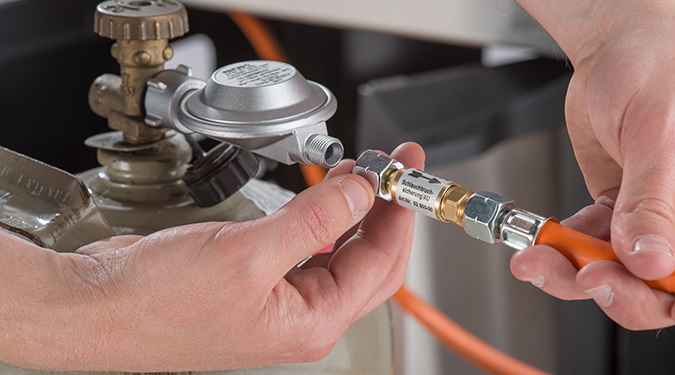
The pressure gauge of the pressure regulator/pressure reducer does not show the filling level of the LPG cylinder. GOK offers a solution for filling level monitoring.
Inhaltsverzeichnis
The pressure gauge of the pressure regulator/pressure reducer does not show the filling level of the LPG cylinder. GOK offers a solution for filling level monitoring.
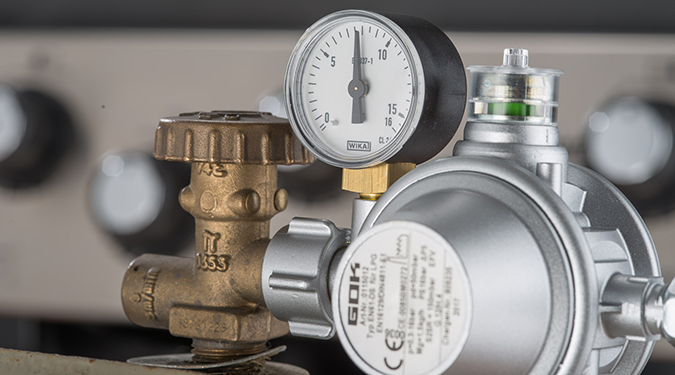
Many users believe that the pressure gauge on the gas regulator shows the filling level of the gas cylinder — similar to a fuel gauge in a car. But this is a misconception: what the gauge actually shows, and what alternative there is for measuring the volume precisely, you will learn in this article.
Does the pressure gauge on the gas regulator really indicate how much gas is left in the cylinder? Experts are asked this question regularly — because many users assume that the needle gives a clue as to how much liquefied gas is still in the bottle. In fact, this misunderstanding frequently leads to unnecessary replacements or even operational disruptions.
In this article you will learn what the pressure gauge really measures, why it is not suitable as a fill‑level indicator, and what practical alternative exists to keep an eye on your gas supply.
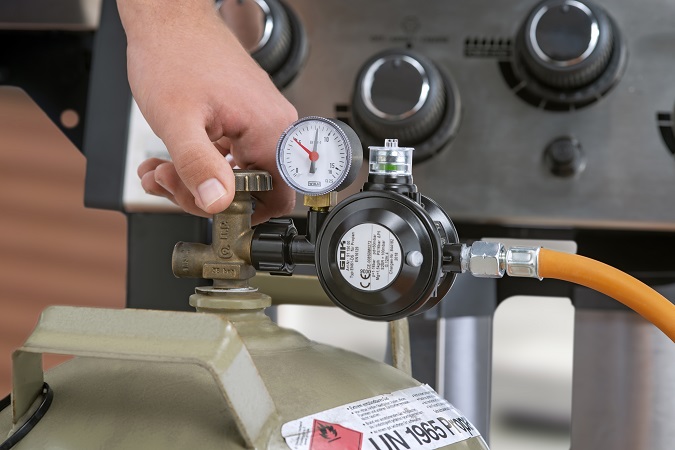
The pressure gauge displays the so‑called incoming pressure at the pressure regulator. This is the gas pressure flowing from the gas cylinder towards the regulator and present at its inlet. Put simply: as long as there is liquefied gas in the cylinder, this pressure remains more or less constant.
It is only when no liquefied gas is left to evaporate that the pressure drops — then very rapidly. In that scenario the gauge’s needle usually falls quickly from about 6 bar towards 0. However, you cannot draw any conclusions about the filling level during that phase.

Liquefied gas — i.e. propane, butane, or mixtures thereof — is usually withdrawn from the cylinder in the gaseous state. If there is still enough liquefied gas in the cylinder, from which a vapour‑space can form, then the pressure remains largely, regardless whether the bottle is half full or almost empty. Only when all liquefied gas has vapourised does the pressure in the gas space fall. Physically, then, a continuous indication of filling level via pressure is not possible.
As long as liquefied gas is evaporating, the pressure remains constant. When there is no liquefied gas left, the pressure in the gas space drops abruptly. The needle then moves quickly to the left — many users interpret that as a sudden “pressure loss”, although it is a normal behaviour.

Even though the gauge does not display the filling level of the cylinder, it still serves an important function — especially for safety and functional checks of the gas system.
The gauge measures the pressure with which the gas stands before the regulator — the so‑called cylinder pressure or inlet pressure. This should lie — depending also on ambient temperature — in a typical range of around 6 bar. If the pressure is conspicuously low, even when the cylinder is full, this may indicate a problem.

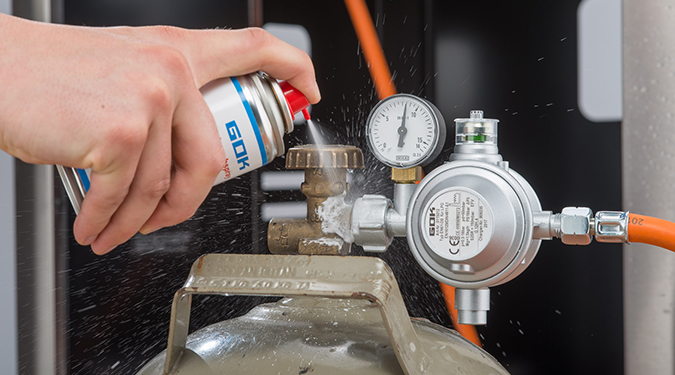
A sudden pressure drop can also indicate leaks or malfunctions — for example if closed valves show pressure loss. In combination with a leak test, the gauge is therefore helpful for detecting leaks.
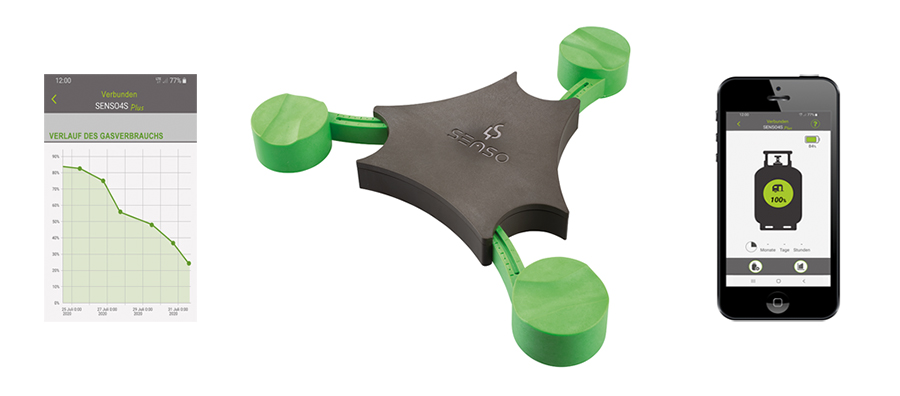
For those interested in monitoring the filling level of the gas cylinder, we recommend Senso4s PLUS. The Senso4s measures the weight of the liquefied gas contained in the cylinder and then sends it via Bluetooth to a smartphone or tablet.
The accompanying app then presents the data graphically and visually. In addition, the user can set a warning when the level falls below a defined limit.
The gauge on the pressure regulator is an important control instrument. It shows current gas pressure (cylinder/inlet pressure) — not the filling level. As long as liquefied gas is evaporating in the cylinder, this pressure remains stable. Only when the cylinder is empty does the pressure fall. Our tip: use the gauge for leak detection, but not as a filling level display. For that, there are more precise methods such as scales, sensors or digital systems.
This blog will never ask members of the public or unqualified persons to make changes to or fiddle around with technical systems themselves.
In accordance with the Industrial Safety Regulation (BetrSichV), a qualified person must take care of a system which requires monitoring.
A qualified person is someone who has the specific specialist knowledge required. This knowledge is gained by way of a professional apprenticeship, corresponding professional experience or current occupational activity.
Please note that the texts are based on information, regulations and standards for Germany. Please always check the rules and regulations in the relevant country of destination and consult specialists if necessary.