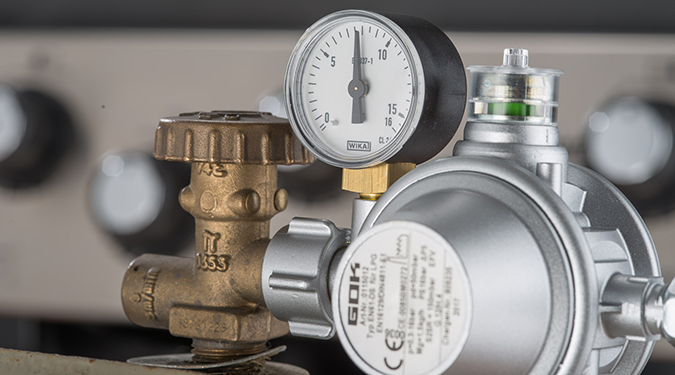
The excess flow device protects against gas leakage, for example in the case of gas barbecues, outdoor heaters or radiant heaters. As soon as a massive leak occurs in the hose assembly, the safety device shuts off the gas supply and prevents worse things.
Post Views:109
A hose rupture or a major leak can quickly become dangerous: within seconds, unburnt liquefied gas may escape uncontrollably. A hose break‑safety device (HBS) reliably protects in such cases by automatically interrupting the gas supply.
Whether camping, barbecuing or heating – liquefied gas systems are practical, but they also carry risks, just like many other energy media. One of the most important safety components for liquefied gas systems is the hose break‑safety device. It detects when gas flow suddenly and unusually increases and immediately shuts off the supply. But how does this technology work in detail? When does it activate, and what standard values apply? In this article, we explain the functionality of an HBS, provide practical examples, and show why it is indispensable in many applications.
GOK automatic excess flow device for enhanced safety in LPG installations
What is a hose break‑safety device?
A hose break‑safety device, or HBS, is a safety component in liquefied gas systems. Its main function: to automatically interrupt the gas flow if a serious leak occurs in a hose line. This prevents large amounts of liquefied gas from escaping uncontrollably—an important protection against fire and explosion hazards.
The HBS is used in many areas: from a gas barbecue on the patio to applications while camping in a motorhome or caravan, to heating appliances or commercial liquefied gas systems. Its principle is similar to that of an “aquastop” in washing machines: should a leak occur, the device immediately reacts and shuts off the flow.
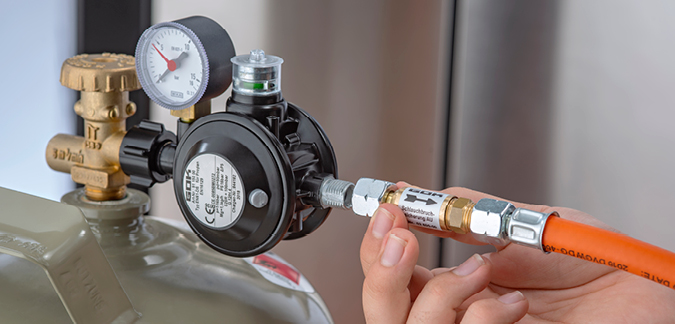
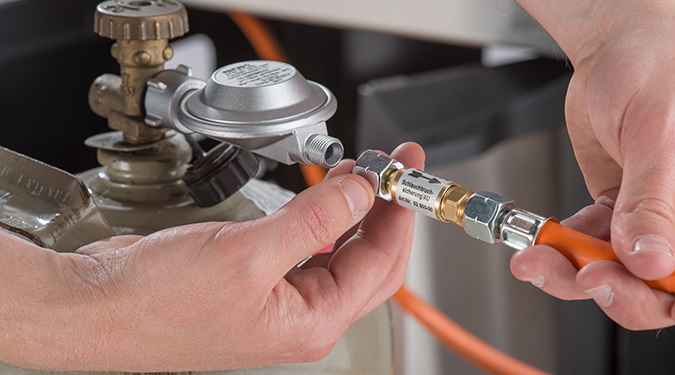
The HBS may either be installed as a separate component directly between the pressure regulator and the hose, or already integrated into the pressure regulator. Which design is used depends on the specific system and requirements.
In the event of a leak in the hose assembly, the excess flow device prevents the uncontrolled release of large quantities of gas.
Inside a hose break‑safety device is a special mechanism that responds to gas flow. Under normal conditions, gas flows through the device at a constant rate intended for the system. If the flow suddenly increases significantly—e.g. due to a rupture or separation of the hose—the HBS detects this abnormal rate and activates.
The heart of the device is a closing cone or valve pin that is propelled by the high gas flow. Within seconds, it completely blocks the passage. Gas flow stops, and no more liquefied gas can escape uncontrollably.
There are two versions of HBS:
Automatic HBS reset themselves once the cause has been addressed.
Manual HBS must be re‑opened by hand at start‑up and after activation—often using a small lever or button.
The manual excess flow device is connected by the operator directly to the outlet of the pressure regulator.
When does the hose break‑safety device activate?
Each HBS is designed to trigger at a specific response point, based on the nominal flow rate of the connected liquefied gas system. If this is exceeded by a defined percentage, the HBS activates and interrupts the gas flow.
A typical example: for small‑cylinder systems—such as those used for gas barbecues, heaters or parasols—the standard HBS is rated at 1.5 kg of liquefied gas per hour at an outlet pressure of 50 mbar. If a leak develops in the hose and actual flow exceeds this nominal rate by around 10%, the valve shuts off. This prevents large quantities of gas from escaping in a short time.
Whether installed as a standalone component or integrated into the regulator, the activation mechanism remains the same: it responds to unusually high flow rates and stops the gas supply within seconds.
Installation and application areas
The hose break‑safety device is usually installed directly at the outlet of the pressure regulator. From there, the hose leads to the appliance—e.g. to a barbecue, heater or cooker. Positioned there, the HBS monitors the entire gas flow in the hose line and can react immediately in the event of a defect.
There are two common designs:
Separate component: the HBS is screwed between the pressure regulator and hose. This solution is particularly suited to mobile applications where individual components can be swapped out flexibly.
Integrated design: the HBS is built directly into the pressure regulator. This saves space and reduces the number of connections. However, not all regulators for different applications come with an integrated HBS—often because they are simply not required.
Typical application areas:
Camping & Caravanning, e.g. operating gas cookers or hob outdoors, or as part of a crash‑sensor system for the liquefied gas installation in motorhomes or caravans while driving.
Barbecue & BBQ, for gas barbecues in private or commercial settings.
Commercial applications, e.g. heating appliances in workshops or market stalls.
Domestic use, for instance with patio heaters or where the hose line is not easily visible or accessible.
In all cases, installation should be carried out by a qualified person according to the supplied installation and operating instructions to ensure tightness and functional safety.
Typical applications of the excess flow device include commercial settings, such as patio heaters in hospitality areas.
Advantages and safety notes
Advantages:
Immediate gas shut‑off in case of hose defect or leak.
Protection against fire and explosion hazards.
Suitable for domestic, commercial and mobile applications.
Simple retrofit on existing systems possible.
Safety notes:
Regularly check the HBS for external damage and functionality.
Ensure correct sizing: the HBS must match the system’s nominal flow and outlet pressure.
Always identify and rectify the cause before re‑enabling gas supply after activation.
Use only approved components and follow the manufacturer’s installation instructions.
Conclusion
The hose break‑safety device is a small but highly effective safety component in any liquefied gas system. It prevents uncontrolled gas leakage in the event of hose failure—protecting people, vehicles, buildings and appliances from accidents. Depending on the application area, different regulations apply:
Private / Outdoor / Camping: mandatory for hose lengths over 1.5 m.
Commercial: required for lengths over 0.4 m.
Motorhome / Caravan: if used while driving, an HBS in conjunction with a crash‑sensor (e.g. Caramatic DriveOne / DriveTwo) is always required. For external appliances supplied via e.g. a service flap, the requirement for hose lengths over 1.5 m also applies.
At home, on the road or in commercial use—the hose break‑safety device provides critical protection everywhere and should never be omitted from any system.
The articles are written by specialist authors in the fields of LPG, fuel oil, liquid media, tank management and safety engineering, who contribute their expertise from product management, development, technical customer support, training and standardisation activities.
The members of the editorial team have many years of practical experience in the planning, application and further development of technical solutions for the safe supply of LPG and liquid fuels. Several authors are actively involved in specialist committees and working groups of the DVGW, DVFG and figawa, as well as in national and European standardisation committees. The team includes, among others, experts certified in accordance with G 607 and G 608, competent persons in accordance with the TRF, and specialists who contribute to the development and evaluation of technical regulations and industry standards.
In addition to providing information about GOK products and solutions, the editorial team focuses on sharing knowledge relating to safety, regulations, maintenance, operation and future technologies in the field of LPG and liquid media.
Share this post
Related articles
From what length of hose assembly do I need an excess flow device?
Camping & Leisure, Grill & BBQ, Home & Commercial
Which GOK components do I need as a private individual for my gas barbecue?
Safety
FAQ – Frequently asked questions about the hose break‑safety device
It automatically interrupts the gas supply if there is a significant leak or rupture in the hose line.
It triggers when gas flow exceeds a set limit—typically around 10 % above the nominal flow.
It is typically installed directly at the outlet of the regulator (immediately before the hose), either as a separate component or integrated.
Yes, in certain cases: e.g. in motorhome/caravan systems when driving (in combination with a crash‑sensor), in many commercial outdoor applications, and for cylinder systems with hoses over 40 cm in length.
For standard gas barbecues, an HBS rated 1.5 kg/h at 50 mbar is usually sufficient. It is important that the values match the system.
Visually inspect for damage, ensure connections are leak‑tight, and—if possible—perform a function test by simulating a leak (see operating instructions).
Yes, once the cause of activation has been eliminated, the HBS can continue to be used in the liquefied gas system.
You might also find this interesting
How can I use several LPG cylinders in the caravan, motor caravan or on the boat at the same time?
Camping & Leisure
How does a PRV pressure relief valve work?
Camping & Leisure, Home & Commercial, Safety
Which pressure regulator do I need for which output?
Camping & Leisure, Grill & BBQ, Home & Commercial
Are there any differences in the gas test of mobile homes or caravans and motor caravans?
Camping & Leisure
How do I know when I need to replace the components of my LPG system?
Camping & Leisure, Grill & BBQ, Home & Commercial
Where can I find operating manuals for GOK products?
Camping & Leisure, Grill & BBQ, Home & Commercial, Tank & Liquid Media
From what length of hose assembly do I need an excess flow device?
Camping & Leisure, Grill & BBQ, Home & Commercial
Which pressure regulator connections exist for LPG cylinders in Europe?
Camping & Leisure, Grill & BBQ, Home & Commercial
How can I release an OPSO (SAV)?
Home & Commercial
What is an OPSO (SAV) and how does it work?
Home & Commercial
Does the pressure regulator gauge show the filling level of the LPG cylinder?
Camping & Leisure, Grill & BBQ, Home & Commercial
Does the gas have to be discharged out of the line before releasing the OPSO (SAV)?
Home & Commercial
This blog will never ask members of the public or unqualified persons to make changes to or fiddle around with technical systems themselves.
In accordance with the Industrial Safety Regulation (BetrSichV), a qualified person must take care of a system which requires monitoring.
A qualified person is someone who has the specific specialist knowledge required. This knowledge is gained by way of a professional apprenticeship, corresponding professional experience or current occupational activity.
Please note that the texts are based on information, regulations and standards for Germany. Please always check the rules and regulations in the relevant country of destination and consult specialists if necessary.