The withdrawal volume or withdrawal output from LPG tanks depends not only on the size of the tank, but also on the time of year, the weather and the installation site – above ground or underground. We’ll show you how much you can withdraw in which conditions.
Views:104
The mere size of the tank is an important factor in the withdrawal output or the withdrawal volume of LPG tanks. The larger the tank, the more kilograms per hour you can withdraw. But the seasons and the installation location of the tank are at least just as crucial.
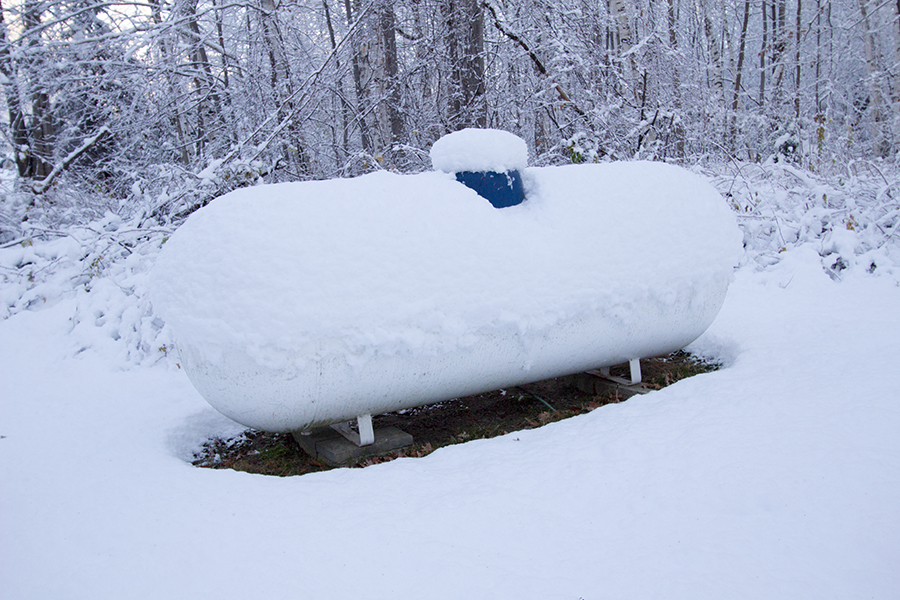
Generally speaking, an above-ground LPG tank is subject to seasonal fluctuations in terms of the withdrawal volume. Of course, whether the sun is shining and it is a warm day with 30 degrees or whether the snow is falling has a massive impact on the withdrawal output.
Of course, at these temperatures, you can withdraw less LPG from an LPG tank than you can in the summer months.
Third factor
In addition to the tank size and weather conditions, the withdrawal period is the third decisive factor. If the connected consumer equipment only needs gas for a short time or only periodically, the withdrawal output is sometimes significantly higher than for continuous withdrawal.
For clarification:
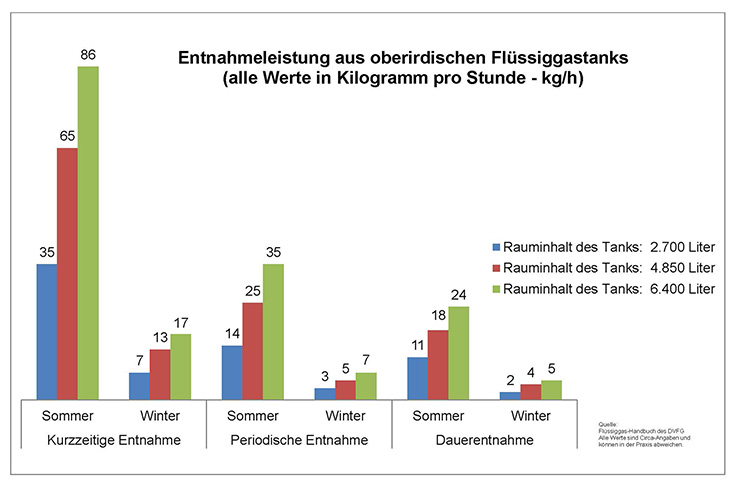
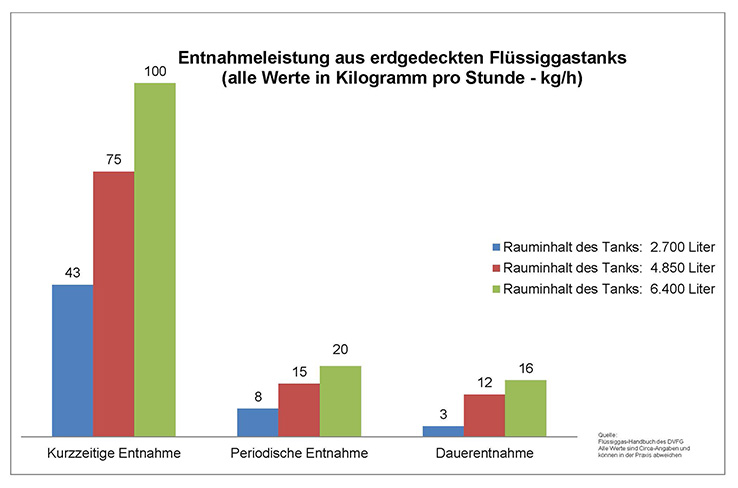
Short-term withdrawal: You can withdraw the maximum amount for about 20 to 30 minutes.
Periodic withdrawal: Boilers require LPG in phases and not continuously. This is referred to as periodic withdrawal.
Continuous withdrawal: As the name suggests, LPG is constantly withdrawn from the LPG tank over a longer period of time. This may be the case with an industrial paint system, for example.
LPG tank graphic
We have prepared this for you visually in the following graphics:
In the illustration, you can see the withdrawal output within the three withdrawal modes, subdivided into the two seasons summer and winter. The rule of thumb says that you can withdraw five times more in summer than you can in winter.
LPG tank restriction values
Please note that the values are maximum and approximate data. In practice, for example, there may be deviations depending on the weather or installation site.
The articles are written by specialist authors in the fields of LPG, fuel oil, liquid media, tank management and safety engineering, who contribute their expertise from product management, development, technical customer support, training and standardisation activities.
The members of the editorial team have many years of practical experience in the planning, application and further development of technical solutions for the safe supply of LPG and liquid fuels. Several authors are actively involved in specialist committees and working groups of the DVGW, DVFG and figawa, as well as in national and European standardisation committees. The team includes, among others, experts certified in accordance with G 607 and G 608, competent persons in accordance with the TRF, and specialists who contribute to the development and evaluation of technical regulations and industry standards.
In addition to providing information about GOK products and solutions, the editorial team focuses on sharing knowledge relating to safety, regulations, maintenance, operation and future technologies in the field of LPG and liquid media.
Share this post
Related articles
No results found.
You might also find this interesting
How does a PRV pressure relief valve work?
Camping & Leisure, Home & Commercial, Safety
Which pressure regulator do I need for which output?
Camping & Leisure, Grill & BBQ, Home & Commercial
How do I know when I need to replace the components of my LPG system?
Camping & Leisure, Grill & BBQ, Home & Commercial
Where can I find operating manuals for GOK products?
Camping & Leisure, Grill & BBQ, Home & Commercial, Tank & Liquid Media
From what length of hose assembly do I need an excess flow device?
Camping & Leisure, Grill & BBQ, Home & Commercial
Which pressure regulator connections exist for LPG cylinders in Europe?
Camping & Leisure, Grill & BBQ, Home & Commercial
How can I release an OPSO (SAV)?
Home & Commercial
What is an OPSO (SAV) and how does it work?
Home & Commercial
Does the pressure regulator gauge show the filling level of the LPG cylinder?
Camping & Leisure, Grill & BBQ, Home & Commercial
Does the gas have to be discharged out of the line before releasing the OPSO (SAV)?
Home & Commercial
How do I carry out a simplified leak check on an LPG cylinder system?
Camping & Leisure, Grill & BBQ, Home & Commercial
What is the heating value of media such as fuel oil, LPG and natural gas?
Home & Commercial, Tank & Liquid Media
This blog will never ask members of the public or unqualified persons to make changes to or fiddle around with technical systems themselves.
In accordance with the Industrial Safety Regulation (BetrSichV), a qualified person must take care of a system which requires monitoring.
A qualified person is someone who has the specific specialist knowledge required. This knowledge is gained by way of a professional apprenticeship, corresponding professional experience or current occupational activity.
Please note that the texts are based on information, regulations and standards for Germany. Please always check the rules and regulations in the relevant country of destination and consult specialists if necessary.