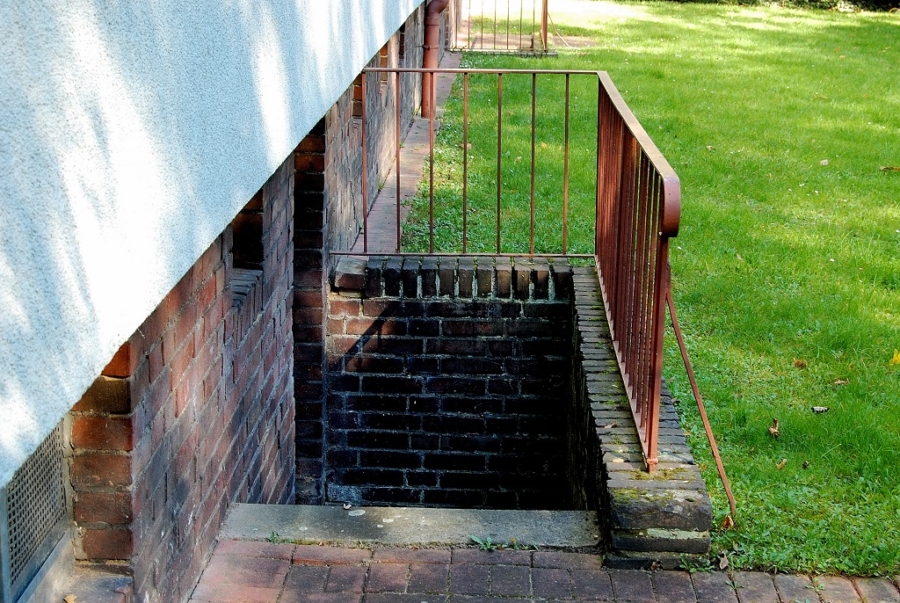
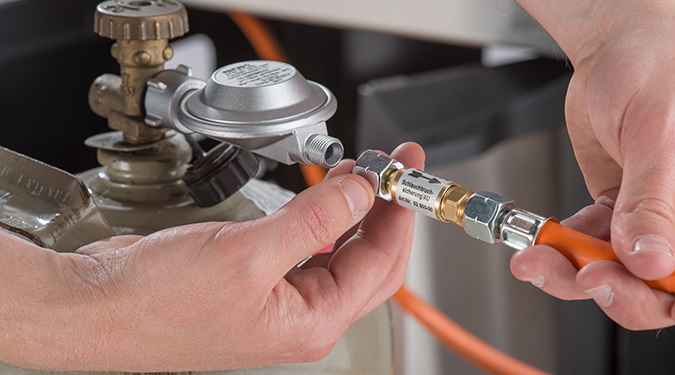
Where can I store the gas cylinder? This is a question many users and tradespeople ask themselves when they want to have a full one on site as a reserve or, for example, take the LPG installation out of operation for a short time. The cellar is usually the least troublesome place to store them. But is it even allowed to store it there, let alone operate it?
Post Views:140
Storing gas cylinders in the basement of residential buildings – is it allowed? We explain what is possible, where clear limits are set, and what you should consider when storing them.
Especially in households where LPG is only occasionally used – for example for barbecues, heaters or emergency use during power outages – the basement may seem like a practical storage location. But this is precisely where a frequently underestimated danger lurks: LPG is heavier than air, can escape in the event of leaks, and accumulate at the lowest point of a room. The result in the event of a leak? A dangerous gas concentration may occur, which could become ignitable under unfavourable conditions. In addition, inhaling LPG can lead to oxygen deficiency and, as a consequence, to unconsciousness. This article explains the applicable regulations, why they make sense, and how to store your gas cylinders safely.
Am I allowed to store a gas cylinder in the basement?
In short: No, this is not permitted – neither in private households nor in commercial settings. This applies regardless of whether the cylinder is full, half-full, or seemingly “empty”. LPG is a highly flammable substance that can quickly accumulate at the lowest point of a room in the event of a leak – and in basements, i.e. rooms below ground level, this is almost always the case.
Many people mistakenly believe that enclosed cellar or utility rooms are safe. In fact, the opposite is true: a leaky valve, damaged seal, or accidental heating can be enough to generate dangerous gas concentrations. Even small quantities are sufficient to create an explosive atmosphere.
That’s why storage in basements, underground garages or similar areas below ground level is strictly prohibited – and for good reason.
What do the regulations specifically say?
The Technical Rules for LPG (TRF 2021) define the provisions for private use. They clearly state: storage in rooms below ground level is not permitted. This includes any rooms whose floor lies more than 1 metre below the surrounding terrain. This applies to typical basements as well as poorly ventilated, low-lying storage areas or shafts. Also prohibited is the placement and storage of LPG cylinders in bedrooms!
For commercial use, the DGUV Rule 110-010 applies additionally. It likewise prohibits storage in enclosed spaces below ground level. Even reserve cylinders must not be placed there. Regardless of the storage quantity, no storage is allowed in passageways (e.g. stairwells, escape and rescue routes, corridors, narrow courtyards). Storage would only be permitted under very specific technical conditions – such as in specially ventilated and explosion-protected areas. These are practically unfeasible in typical settings.
Both regulations agree on one key message: no LPG cylinder storage in the basement.
Why is LPG in the basement so problematic?
LPG – i.e. propane or butane and their mixtures – is heavier than air. Even a small amount leaking from a cylinder – due to a faulty valve or damaged seal – will sink and mix with the air. In enclosed rooms below ground level like basements, it can accumulate on the floor and gradually reach dangerous concentrations.
Another risk factor: LPG vaporises at room temperature. This means it already forms an ignitable gas-air mixture under normal conditions. If this mixture comes into contact with an ignition source – such as a light switch, a heating flame, or even static electricity – an explosion or deflagration may occur.
Although such scenarios are extremely rare given the large number of LPG systems in use, they are nonetheless possible. That is why the regulations prescribe preventive measures – and explicitly exclude high-risk storage areas like basements.
Are there exceptions or special cases?
In very specific exceptional cases, storage of LPG cylinders in indoor areas below ground level may be permitted – but only under strict technical requirements defined in TRGS 510 (Technical Rules for Hazardous Substances). These include:
Permanently effective technical ventilation systems
Explosion-proof electrical installations
Airtight, fire-protected rooms
Special building law approvals
These requirements explicitly do not apply to private households. Even in commercial settings, such exceptions are rarely granted – and must be verified and regularly inspected.
Important: Even a seemingly “empty” cylinder is no exception. It always contains residual gas or LPG residues which pose the same hazards if released. Short-term storage “just until tomorrow” is also not allowed. The regulations do not allow any time-based exceptions.
If in doubt, always consult the local fire brigade or a competent expert – particularly in special structural situations such as semi-basements, lower ground floors or combined boiler rooms.
If at all, there are exceptions and special cases regarding the installation and storage of LPG cylinders in commercial settings – such as in a restaurant kitchen. In private households, exemption regulations do not exist.
Where can I safely store gas cylinders?
If basements and other rooms below ground level are ruled out – where can you store gas cylinders? The answer is: outdoors – and under clearly defined conditions.
The following basic rules apply:
The storage location must be constantly ventilated, easily accessible and at ground level.
Cylinder valves must be tightly closed and fitted with the intended protective devices (e.g. valve caps, possibly sealing nuts).
Cylinders should stand upright and be secured against falling or tipping over (e.g. using brackets or chains).
Avoid direct sunlight and heat sources – ideally use a shady, covered area.
Do not store near doors, windows or basement shafts to prevent gas ingress into lower building levels in the event of a leak.
Prevent unauthorised access, especially by children – e.g. by using a lockable gas cabinet.
Tip: For outdoor use, there are regulation-compliant metal gas cylinder cabinets providing safety and weather protection. GOK also offers suitable accessories for both private and commercial applications.
In commercial applications, additional requirements such as quantity limits, signage or special fire protection provisions may apply – these are detailed in TRGS 510.
Conclusion: Clear rules for greater safety
Storing LPG cylinders in the basement is strictly regulated – and rightly prohibited. Clear requirements apply to both private households and businesses to reliably prevent hazards from leaking gas.
Anyone using LPG should therefore ensure proper outdoor storage. Suitable installation sites and matching accessories ensure safety and functionality at all times – whether for camping and caravanning, trades or at home.
The articles are written by specialist authors in the fields of LPG, fuel oil, liquid media, tank management and safety engineering, who contribute their expertise from product management, development, technical customer support, training and standardisation activities.
The members of the editorial team have many years of practical experience in the planning, application and further development of technical solutions for the safe supply of LPG and liquid fuels. Several authors are actively involved in specialist committees and working groups of the DVGW, DVFG and figawa, as well as in national and European standardisation committees. The team includes, among others, experts certified in accordance with G 607 and G 608, competent persons in accordance with the TRF, and specialists who contribute to the development and evaluation of technical regulations and industry standards.
In addition to providing information about GOK products and solutions, the editorial team focuses on sharing knowledge relating to safety, regulations, maintenance, operation and future technologies in the field of LPG and liquid media.
Share this post
Related articles
No results found.
FAQ – Frequently Asked Questions about Gas Cylinder Storage
No. Even seemingly empty cylinders contain flammable residual gas or LPG residues and must not be stored below ground level.
The place must be well-ventilated, at ground level, and protected from heat, access and tipping – ideally outdoors.
The basic rules, such as a maximum of two gas cylinders in residential buildings, apply here as well. In addition, house rules or fire safety regulations from the property management may specify further details.
Private households: A maximum of two 11-kg cylinders may be kept in the building at the same time, with only one connected.
Small cylinders with a maximum filling weight of 5 kg may also be used in certain cases – this is regulated in Section 5.2.5 of TRF 2021. Consultation with a specialist company is recommended here, as the specifics depend on room size, ventilation and type of use.
Commercial sector: Here, different rules apply depending on usage. According to DGUV Rule 110-010, Section 5.3.2.1, LPG cylinders may only be placed in workrooms if required for the immediate operation of connected equipment – i.e. only during intended use. Storage is explicitly prohibited.
In addition, only one LPG cylinder with a maximum filling weight of 16 kg may be placed in a room.
No, temporary storage in the basement is also not permitted. The rules apply without time limitations.
In private households, a maximum of two LPG cylinders with up to 16 kg filling weight each may be present in the building – only one of which may be connected. Additional cylinders must be stored outdoors (see TRF 2021, Section 6.2.2).
If you smell gas, leave the room immediately and call the fire brigade (112). Do not create ignition sparks – e.g. avoid using electrical devices or smoking!
If there is no gas smell, secure the cylinder immediately and move it outdoors as quickly as possible. Ventilate the room thoroughly.
No. Even small screw-on cartridges contain flammable gas and are subject to the same physical risks as large cylinders.
You might also find this interesting
How many kilowatt hours correspond to a kilogram of LPG (propane)?
Safety
How does a PRV pressure relief valve work?
Camping & Leisure, Home & Commercial, Safety
Which pressure regulator do I need for which output?
Camping & Leisure, Grill & BBQ, Home & Commercial
How do I know when I need to replace the components of my LPG system?
Camping & Leisure, Grill & BBQ, Home & Commercial
Where can I find operating manuals for GOK products?
Camping & Leisure, Grill & BBQ, Home & Commercial, Tank & Liquid Media
From what length of hose assembly do I need an excess flow device?
Camping & Leisure, Grill & BBQ, Home & Commercial
Which pressure regulator connections exist for LPG cylinders in Europe?
Camping & Leisure, Grill & BBQ, Home & Commercial
How can I release an OPSO (SAV)?
Home & Commercial
What is an OPSO (SAV) and how does it work?
Home & Commercial
Does the pressure regulator gauge show the filling level of the LPG cylinder?
Camping & Leisure, Grill & BBQ, Home & Commercial
Does the gas have to be discharged out of the line before releasing the OPSO (SAV)?
Home & Commercial
How do I carry out a simplified leak check on an LPG cylinder system?
Camping & Leisure, Grill & BBQ, Home & Commercial
This blog will never ask members of the public or unqualified persons to make changes to or fiddle around with technical systems themselves.
In accordance with the Industrial Safety Regulation (BetrSichV), a qualified person must take care of a system which requires monitoring.
A qualified person is someone who has the specific specialist knowledge required. This knowledge is gained by way of a professional apprenticeship, corresponding professional experience or current occupational activity.
Please note that the texts are based on information, regulations and standards for Germany. Please always check the rules and regulations in the relevant country of destination and consult specialists if necessary.