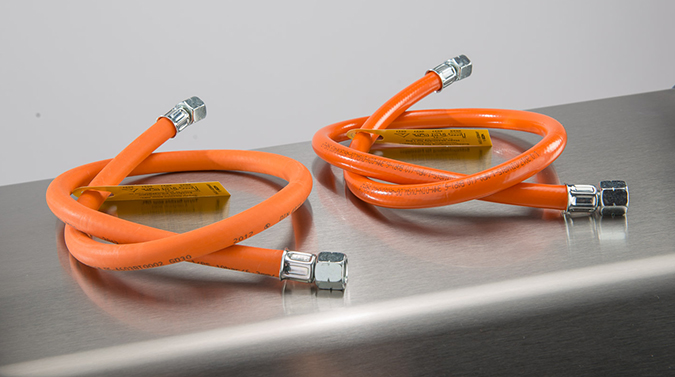
Some data and markings are printed on the orange hoses. With so many letters and numbers on the hose material, it can get confusing. Where can I find the year of manufacture, where the approval number? Up to what pressure can I use the hose and up to what temperature?
Views:220
The orange gas hose from GOK has a few details printed on the material – some of which will certainly be obscure to users. This is why we have decided to show you in this article which data is printed on the hose assemblies and which is not.
The GOK hose assemblies for the gases propane and butane and their mixtures are extremely versatile. For example, they can connect the pressure regulator with the gas barbecue, the gas anti-tilt device with the heating mushroom or the excess flow device with the heater.
Standard for labeling
On the hose material itself, you will find the exact data for the gas hose in blue or black text. DIN EN 16436-1, which replaced DIN 4815-1, stipulates what must go where. Below is a graphic which shows the labelling (click to enlarge the graphic):
what do all the things on the gas hose mean?
Perhaps one or two of the terms aren’t familiar to you. We’ll explain the individual points of the standard-compliant marking once more in detail:
Manufacturer’s mark – This is an abbreviation of the manufacturer, in this example, it’s GOK.
DIN EN 16436-1 – Right after that, the applicable standard for the requirements of the gas hose is printed.
class 2 – The standard stipulates different product classifications. On GOK hose assemblies you will either find the label “class 2” or “class 3”. These two categories only differ in terms of their highest permitted working pressure (class 2 = 10 bar; class 3 = 30 bar).
6.3 mm – This measurement is the inside diameter of the hose assembly
10 bar – The gas hose is suitable for pressure up to this number.
Propane/butane – Not difficult to work out: You may only use the hose assembly in connection with the gases propane and butane (in other words: liquefied gas or LPG).
-30 °C – The hose can be used above this minimum ambient temperature.
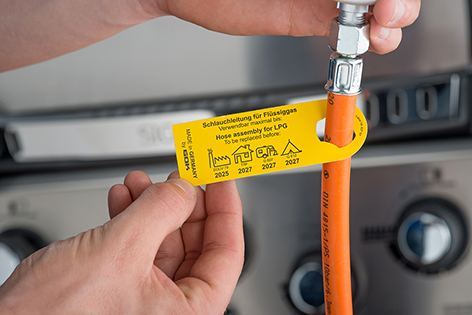
PROD DATE 2017: – This is the year in which the hose assembly was produced. The majority of our hose assemblies also have a yellow tag. This tag tells you the year in which you have to replace your hose assembly, at the latest.
DVGW XX-XXXXXXXXXX – The German Technical and Scientific Association for Gas and Water assigns an approval number for the hose assemblies which is printed on each one.
ABCD – finally, you will find the batch number for the hose assembly, for example, to guarantee traceability of production series.
For whatever purpose you use your hose assembly for, on the yellow tag you will find information about the year in which you need to replace it with a new one.
As you may have noticed, the GOK part number is not part of the labelling on the gas hose. This has relatively practical reasons. We buy the hose material on a reel and we don’t know which part of hose will fit which part number.
We have numerous different varieties of hose assemblies. This makes it impossible to print the part number on the raw material during the labelling process.
The articles are written by specialist authors in the fields of LPG, fuel oil, liquid media, tank management and safety engineering, who contribute their expertise from product management, development, technical customer support, training and standardisation activities.
The members of the editorial team have many years of practical experience in the planning, application and further development of technical solutions for the safe supply of LPG and liquid fuels. Several authors are actively involved in specialist committees and working groups of the DVGW, DVFG and figawa, as well as in national and European standardisation committees. The team includes, among others, experts certified in accordance with G 607 and G 608, competent persons in accordance with the TRF, and specialists who contribute to the development and evaluation of technical regulations and industry standards.
In addition to providing information about GOK products and solutions, the editorial team focuses on sharing knowledge relating to safety, regulations, maintenance, operation and future technologies in the field of LPG and liquid media.
Share this post
Related articles
No results found.
You might also find this interesting
How can I use several LPG cylinders in the caravan, motor caravan or on the boat at the same time?
Camping & Leisure
How does a PRV pressure relief valve work?
Camping & Leisure, Home & Commercial, Safety
Which pressure regulator do I need for which output?
Camping & Leisure, Grill & BBQ, Home & Commercial
Are there any differences in the gas test of mobile homes or caravans and motor caravans?
Camping & Leisure
How do I know when I need to replace the components of my LPG system?
Camping & Leisure, Grill & BBQ, Home & Commercial
Where can I find operating manuals for GOK products?
Camping & Leisure, Grill & BBQ, Home & Commercial, Tank & Liquid Media
From what length of hose assembly do I need an excess flow device?
Camping & Leisure, Grill & BBQ, Home & Commercial
Which pressure regulator connections exist for LPG cylinders in Europe?
Camping & Leisure, Grill & BBQ, Home & Commercial
How can I release an OPSO (SAV)?
Home & Commercial
What is an OPSO (SAV) and how does it work?
Home & Commercial
Does the pressure regulator gauge show the filling level of the LPG cylinder?
Camping & Leisure, Grill & BBQ, Home & Commercial
Does the gas have to be discharged out of the line before releasing the OPSO (SAV)?
Home & Commercial
This blog will never ask members of the public or unqualified persons to make changes to or fiddle around with technical systems themselves.
In accordance with the Industrial Safety Regulation (BetrSichV), a qualified person must take care of a system which requires monitoring.
A qualified person is someone who has the specific specialist knowledge required. This knowledge is gained by way of a professional apprenticeship, corresponding professional experience or current occupational activity.
Please note that the texts are based on information, regulations and standards for Germany. Please always check the rules and regulations in the relevant country of destination and consult specialists if necessary.