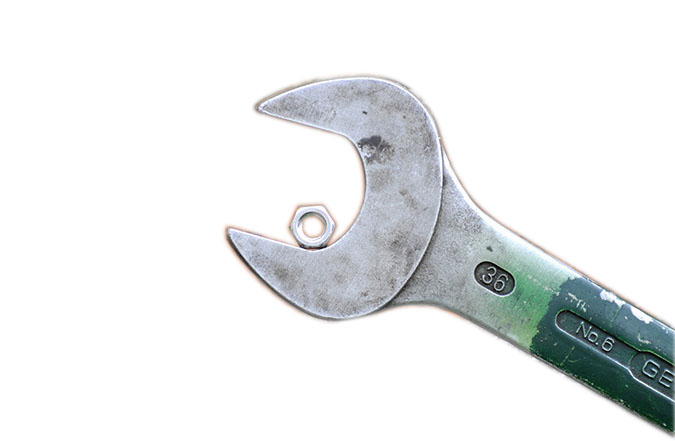
The LPG cylinders commonly used in Germany for propane and butane mixtures have different connections. Often you can only make a tight connection using a spanner. We show you which spanner size you need for which cylinder connection.
Views:185
Immediately after the gas cylinder, you generally need a pressure regulator, also known as a pressure reducer. At the pressure regulator itself, there is a coupling nut which the operator uses to create a tight seal on the gas cylinder.
It’s at this stage of the process that many people start their search for the right spanner. Spanner size 17, 19 or even bigger. In the following overview, you will see which spanner you need for which cylinder connection.
Mini cylinder
We’ll start with the mini cylinder, the gas cylinder with the lowest filling weight, 425 grams of propane/butane mixture fit into the cylinder, which is predominantly used by tradespeople – especially for roofing and plumbing work. You can screw a pressure regulator with inlet connector G 3/8 LH nut onto this cylinder valve. This corresponds to a spanner size of 19.
The cylinder connection for the mini cylinder requires a spanner size of 19 (see B).
Small cylinder
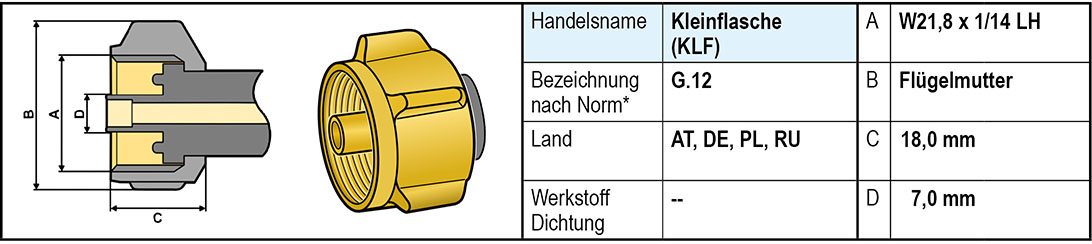
This term covers the popular 5 and 11-kilogram gas cylinders. There are also a few more with different filling weights. On these cylinders in Germany, you always find a wing nut to tighten by hand, so you don’t have to use any spanner.
For a tight connection, we recommend using the practical aid known as a MiniTool.
The operator doesn’t need any spanner for a tight seal between the pressure regulator and the small cylinder (5 or 11 kilograms). It is recommended to use the MiniTool.
Large cylinder
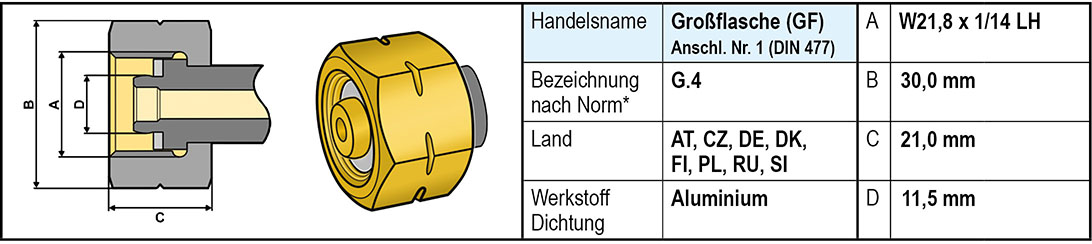
The 33-kilogram gas cylinder is the largest cylinder commonly available in Germany, and it didn’t get its name for nothing. If you want to create a tight connection between the pressure regulator, excess flow device or high pressure hose assembly, you need a spanner with spanner size 30.
For example, 33-kilogram gas cylinders have a large cylinder connection. You need a spanner size of 30 to fasten a pressure regulator, excess flow device or high pressure hose assembly (see B).
Combo connection
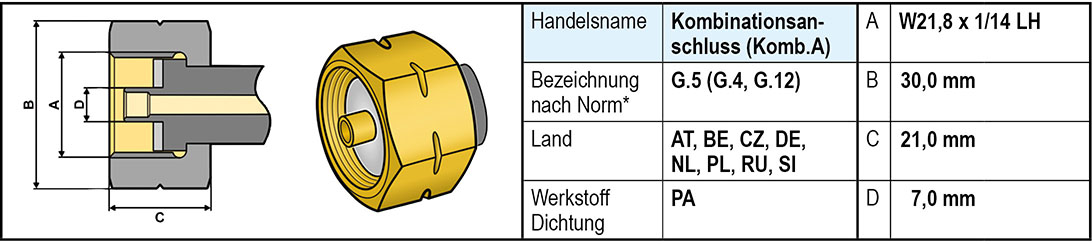
The combo connection is designed so that it fits on 5, 11 and 33-kilogram cylinders, making it a kind of one-size-fits-all solution. To be able to connect the pressure reducer tightly to the cylinder connection, the operator needs a size 30 spanner.
It fits on a 5, 11 or 33-kilogram gas cylinder: the combo connection. The right spanner size is 30, the same as the large cylinder connection.
You can also find more information in the assembly and operating manual of the GOK product. We have summarised all inlet connectors common in Europe in an easy-to-read datasheet.
The articles are written by specialist authors in the fields of LPG, fuel oil, liquid media, tank management and safety engineering, who contribute their expertise from product management, development, technical customer support, training and standardisation activities.
The members of the editorial team have many years of practical experience in the planning, application and further development of technical solutions for the safe supply of LPG and liquid fuels. Several authors are actively involved in specialist committees and working groups of the DVGW, DVFG and figawa, as well as in national and European standardisation committees. The team includes, among others, experts certified in accordance with G 607 and G 608, competent persons in accordance with the TRF, and specialists who contribute to the development and evaluation of technical regulations and industry standards.
In addition to providing information about GOK products and solutions, the editorial team focuses on sharing knowledge relating to safety, regulations, maintenance, operation and future technologies in the field of LPG and liquid media.
Share this post
Related articles
No results found.
You might also find this interesting
How can I use several LPG cylinders in the caravan, motor caravan or on the boat at the same time?
Camping & Leisure
How does a PRV pressure relief valve work?
Camping & Leisure, Home & Commercial, Safety
Which pressure regulator do I need for which output?
Camping & Leisure, Grill & BBQ, Home & Commercial
Are there any differences in the gas test of mobile homes or caravans and motor caravans?
Camping & Leisure
How do I know when I need to replace the components of my LPG system?
Camping & Leisure, Grill & BBQ, Home & Commercial
Where can I find operating manuals for GOK products?
Camping & Leisure, Grill & BBQ, Home & Commercial, Tank & Liquid Media
From what length of hose assembly do I need an excess flow device?
Camping & Leisure, Grill & BBQ, Home & Commercial
Which pressure regulator connections exist for LPG cylinders in Europe?
Camping & Leisure, Grill & BBQ, Home & Commercial
How can I release an OPSO (SAV)?
Home & Commercial
What is an OPSO (SAV) and how does it work?
Home & Commercial
Does the pressure regulator gauge show the filling level of the LPG cylinder?
Camping & Leisure, Grill & BBQ, Home & Commercial
Does the gas have to be discharged out of the line before releasing the OPSO (SAV)?
Home & Commercial
This blog will never ask members of the public or unqualified persons to make changes to or fiddle around with technical systems themselves.
In accordance with the Industrial Safety Regulation (BetrSichV), a qualified person must take care of a system which requires monitoring.
A qualified person is someone who has the specific specialist knowledge required. This knowledge is gained by way of a professional apprenticeship, corresponding professional experience or current occupational activity.
Please note that the texts are based on information, regulations and standards for Germany. Please always check the rules and regulations in the relevant country of destination and consult specialists if necessary.