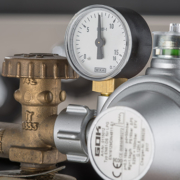
Are there pressure regulators with integrated excess flow device for barbecuing with gas?
Barbecuing with LPG is becoming increasingly popular. Like many other media, the propane-butane mixture carries risks. However, all barbecue enthusiasts place great importance on operating their gas BBQ safely. That’s exactly what safety devices are for, such as the excess flow device. A new pressure regulator from GOK bears the label HPU, making the use of gas appliances even safer.
What is the new low pressure regulator with HPU?
Unlike conventional pressure regulators for gas barbecuing, the new low pressure regulator type EN61 offers a major difference: the HPU. HPU stands for Hose Protection Unit and is a safety device that protects against unintentional gas leaks – for example, in the event of significant hose damage.
The special feature of this regulator is that both pressure regulation and safety monitoring take place within a single fitting. Until now, barbecue users, campers, etc., usually had to purchase a pressure regulator and a separate excess flow device. With the new low pressure regulator type EN61 with HPU, this Hose Protection Unit takes over the function of the excess flow device.

The new low pressure regulator type EN61 with HPU makes barbecuing a safe affair.
What does HPU mean and how does it work?
As mentioned, HPU stands for Hose Protection Unit and is a different type of excess flow device. The HPU continuously monitors the connected hose line, protects against the release of unburned LPG in the event of hose damage, and automatically shuts off the gas flow if the hose is torn off or suffers a major leak.
In the HPU regulator, the “excess flow device” is integrated into the regulator. When correctly installed and under normal operation, the safety device (HPU) remains in a neutral position (1), which means: a ball stays in its designated position inside the regulator. This keeps the gas supply open.

The operating principle of the Hose Protection Unit is quite simple, yet highly effective!
If the hose line becomes damaged, a higher flow rate is generated, triggering the safety device – in other words, the ball moves from its original position. The ball blocks the regulator’s outlet (2). This interrupts the gas flow and prevents any further gas from escaping.
When is an excess flow device mandatory?
In private use, an excess flow device must be used if the hose length exceeds 150 centimetres. This requirement is specified in the DVGW worksheet G 612 (A). For commercial users, the use of an excess flow device is mandatory when the hose length exceeds 40 cm.
Is the HPU something entirely new?
No, the HPU itself is not entirely new in GOK’s range of pressure regulators. There are already regulators with the same safety technology, although these have not previously been labelled with the “HPU” designation.
Essentially, the HPU fulfils the same function as a conventional excess flow device. This is known to most as a retrofit single component, but it has also existed for quite some time as an integral part of established pressure regulators.
For example, the pressure regulator designated type EN-61 DS for outdoor use is available both with and without an integrated excess flow device. It also features an overpressure shut-off device S2SR (OPSO) to protect the gas appliances from excessive pressure. This combination represents the highest level of safety for pressure regulators used in small cylinder systems (such as 5 or 11 kilogram cylinders) outdoors.
Why do I need a pressure regulator for a gas barbecue?

Basic requirements for a functioning gas barbecue: gas cylinder, pressure regulator, and hose line!
A regulator ensures that the pressure from the gas cylinder reaches the barbecue at a consistent and usable level. If the gas appliance does not receive a constant pressure, this can lead to malfunctions and, as a result, poor grilling performance. In addition, some pressure regulators are equipped with special safety devices such as an excess flow device or overpressure shut-off. These protect the connected appliances and nearby individuals in the event of an incident.
How should I store gas cylinders for the barbecue?
Gas cylinders are not permitted to be stored or used just anywhere. Outdoor use is generally always unproblematic, and for gas barbecues, the cylinder may remain permanently in the cabinet beneath the unit.
However, under no circumstances should the cylinder be stored in places like a cellar or a bedroom. More information about proper storage can be found in this video:
You are currently viewing a placeholder content from Youtube. To access the actual content, click the button below. Please note that doing so will share data with third-party providers.
FAQ – Druckregler mit integrierter Schlauchbruchsicherung
What are the advantages of a pressure regulator with integrated excess flow device for gas barbecues?
A pressure regulator with an integrated excess flow device, such as the EN61 model with HPU, combines pressure control and safety in a single unit. This eliminates the need for a separate excess flow device, simplifying installation and increasing safety.
How does the integrated Hose Protection Unit (HPU) in the pressure regulator work?
The HPU continuously monitors the connected hose line and automatically shuts off the gas supply if a leak or hose rupture is detected. A ball inside the regulator moves into position to block the gas outlet and prevent uncontrolled gas release.
When is an excess flow device required when barbecuing with gas?
In private settings, an excess flow device is mandatory for hose lengths over 150 cm. For commercial use, it is required for hose lengths exceeding 40 cm, as per DVGW worksheet G 612 (A).
Is the HPU technology available in other GOK pressure regulators?
Yes, HPU technology is already used in other GOK regulators. The “HPU” label is new, but the principle has been implemented previously without the specific designation.
Why is a pressure regulator necessary for a gas barbecue?
A pressure regulator ensures that the pressure from the gas cylinder reaches the barbecue evenly and at the correct level. Without it, malfunctions or safety risks may occur.
Can the gas cylinder be stored in the barbecue’s lower cabinet?
Yes, when used outdoors, the gas cylinder may be permanently stored in the barbecue’s lower cabinet. However, storage in enclosed spaces such as basements or bedrooms is prohibited.