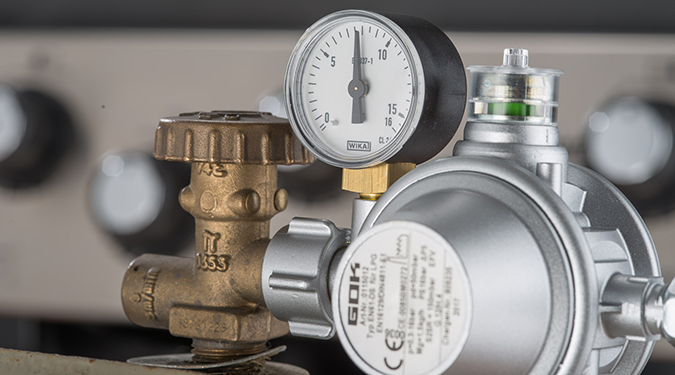
Does the pressure regulator gauge show the filling level of the LPG cylinder?
Many users believe that the pressure gauge on the gas regulator shows the filling level of the gas cylinder — similar to a fuel gauge in a car. But this is a misconception: what the gauge actually shows, and what alternative there is for measuring the volume precisely, you will learn in this article.
Does the pressure gauge on the gas regulator really indicate how much gas is left in the cylinder? Experts are asked this question regularly — because many users assume that the needle gives a clue as to how much liquefied gas is still in the bottle. In fact, this misunderstanding frequently leads to unnecessary replacements or even operational disruptions.
In this article you will learn what the pressure gauge really measures, why it is not suitable as a fill‑level indicator, and what practical alternative exists to keep an eye on your gas supply.
What the pressure gauge on the gas regulator measures — and what it does not
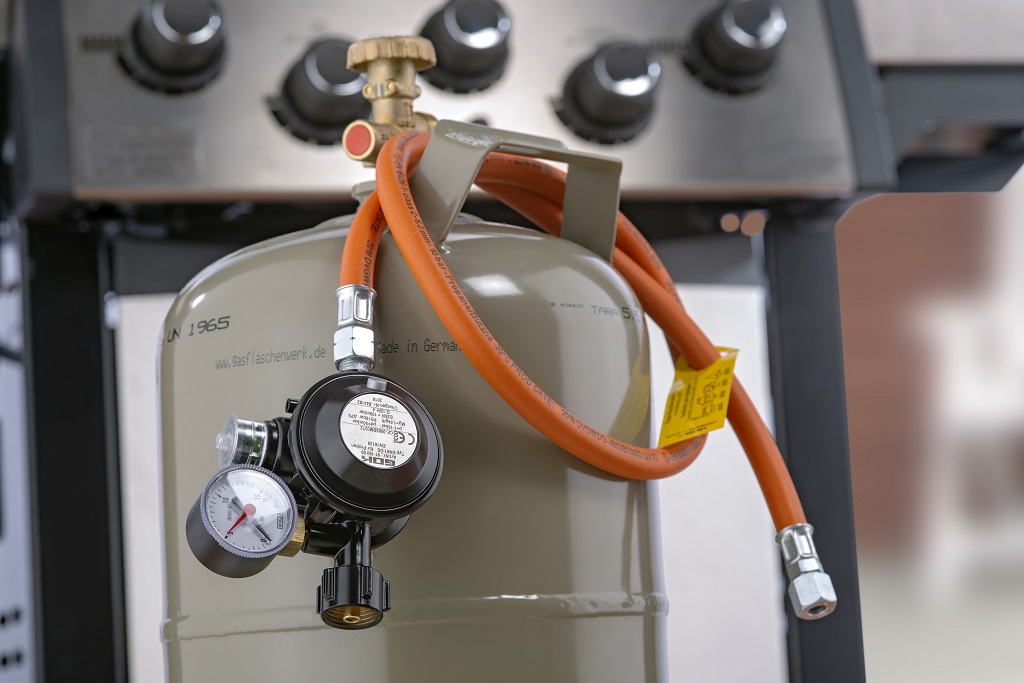
The pressure gauge displays the so‑called incoming pressure at the pressure regulator. This is the gas pressure flowing from the gas cylinder towards the regulator and present at its inlet. Put simply: as long as there is liquefied gas in the cylinder, this pressure remains more or less constant.
It is only when no liquefied gas is left to evaporate that the pressure drops — then very rapidly. In that scenario the gauge’s needle usually falls quickly from about 6 bar towards 0. However, you cannot draw any conclusions about the filling level during that phase.

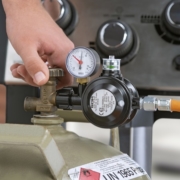
Pressure gauges measure the inlet pressure at the pressure regulator. However, no conclusions about the fill level can be drawn from this at this stage.
Why you cannot read off the filling level from the pressure
Liquefied gas — i.e. propane, butane, or mixtures thereof — is usually withdrawn from the cylinder in the gaseous state. If there is still enough liquefied gas in the cylinder, from which a vapour‑space can form, then the pressure remains largely, regardless whether the bottle is half full or almost empty. Only when all liquefied gas has vapourised does the pressure in the gas space fall. Physically, then, a continuous indication of filling level via pressure is not possible.
Typical misinterpretations in practice
- “The red needle is at zero — is the bottle empty?”
→ Not necessarily. Some gauges have both a black and a red needle. While the black needle shows the actual pressure, the red one can be adjusted manually through the glass of the gauge. This is relevant for leak‑testing (see link below!). - “The pressure suddenly falls — is something leaking?”
→ Often this is no fault, but the normal effect when gas withdrawal nears the end, and the filling level is almost gone.
As long as liquefied gas is evaporating, the pressure remains constant. When there is no liquefied gas left, the pressure in the gas space drops abruptly. The needle then moves quickly to the left — many users interpret that as a sudden “pressure loss”, although it is a normal behaviour.

The pressure in an LPG cylinder remains constant as long as liquid gas is still evaporating. Once there is no more liquid gas, the pressure in the gas space drops abruptly – the pointer moves quickly to the left.
What the pressure gauge is for
Even though the gauge does not display the filling level of the cylinder, it still serves an important function — especially for safety and functional checks of the gas system.
The gauge measures the pressure with which the gas stands before the regulator — the so‑called cylinder pressure or inlet pressure. This should lie — depending also on ambient temperature — in a typical range of around 6 bar. If the pressure is conspicuously low, even when the cylinder is full, this may indicate a problem.
Moreover, the gauge allows for a leak test:

The pressure gauge measures what is known as the cylinder pressure, which typically ranges around 6 bar. If the pressure is conspicuously low even though the cylinder is full, this may indicate a problem.
Safety‑relevant notes
A sudden pressure drop can also indicate leaks or malfunctions — for example if closed valves show pressure loss. In combination with a leak test, the gauge is therefore helpful for detecting leaks.
Digital fill‑level monitoring
For those interested in monitoring the filling level of the gas cylinder, we recommend Senso4s PLUS. The Senso4s measures the weight of the liquefied gas contained in the cylinder and then sends it via Bluetooth to a smartphone or tablet.
The accompanying app then presents the data graphically and visually. In addition, the user can set a warning when the level falls below a defined limit.
You are currently viewing a placeholder content from Youtube. To access the actual content, click the button below. Please note that doing so will share data with third-party providers.

Conclusion: What to keep in mind when looking at the pressure gauge
The gauge on the pressure regulator is an important control instrument. It shows current gas pressure (cylinder/inlet pressure) — not the filling level. As long as liquefied gas is evaporating in the cylinder, this pressure remains stable. Only when the cylinder is empty does the pressure fall. Our tip: use the gauge for leak detection, but not as a filling level display. For that, there are more precise methods such as scales, sensors or digital systems.
FAQ – Frequently Asked Questions about the Pressure Gauge on the Gas Regulator
Does a pressure gauge show how full the cylinder is?
No. The gauge measures the pressure in the gas space of the cylinder, not the fill volume. As long as there is liquefied gas in the cylinder, the pressure stays largely stable — regardless of how full the bottle is.
Why is the red needle at zero, although gas still flows?
The red needle is a tool for leak testing, but does not show the current pressure. The black needle alone indicates the actual pressure.
What does it mean when the gauge reads “0”?
A zero pressure can indicate an empty cylinder, but also technical issues like a frozen or defective fitting, a blocked valve, an interrupted gas supply. Also, a defective gauge may be the cause.
Are there gas regulators with a real filling‑level display?
No. Regulators with built‑in gauges only show the cylinder/inlet pressure. A filling level display requires additional measurement systems such as scales, ultrasonic sensors or electronic indicators.
How do I reliably measure the filling level of a gas cylinder?
The most reliable methods are weighing the cylinder, using ultrasonic fill‑level gauges, or digital sensor solutions like Senso4s PLUS. Even simpler aids like thermal indicators can give useful hints during operation — although with limited accuracy.