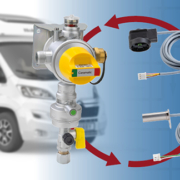
Gas filter for fixed LPG tanks: Essential when campers refuel with autogas for motor caravans and caravans?
Anyone travelling in a motor caravan or caravan with a fixed LPG tank usually refuels with autogas and does not have conventional bottled gas from 5 or 11 kg gas cylinders in the system. This has practical advantages – but can also have technical consequences. Why this is the case, what role oil residues play, and how a special LPG tank filter from GOK addresses this issue precisely, is explained in this blog article.
More and more campers are opting for fixed LPG tanks in their motor caravans, caravans or expedition vehicles. This is convenient, saves bottle exchanges and allows refuelling with autogas across Europe – thanks to special adapters. What many don’t consider: autogas is not always exactly the same as conventional, refined bottled gas. Presumably, it contains far more residues, particles or oil aerosols which, over time, can damage the LPG system. The consequences: contaminated and oil-fouled pressure regulators, impaired gas appliances or even complete failure of system components or consumer devices such as heaters or fridges.
The simple and effective solution for anyone wanting to protect their equipment: an LPG tank filter! And GOK offers just that – specially designed for this application. In this article, we show why it’s worth using, how it works and what users should bear in mind.
What is autogas – and how does it differ from bottled gas?
Autogas – also known as LPG (Liquefied Petroleum Gas) – consists, like bottled gas, of a propane-butane mixture. The key difference, however, lies in the composition, processing and quality assurance. While conventional bottled gas must consist of at least 95 percent propane and propene and is specially purified and standardised for sensitive LPG systems, the composition of autogas can vary, as it is primarily intended as a fuel for internal combustion engines using liquid withdrawal.
Depending on the country of origin and the filling station, autogas may contain additives, lubricants or other residues. These residues pose no problem when refuelling vehicles – but in gas-powered domestic appliances such as fridges, heaters or boilers in motor caravans, they can be critical. There, they may settle out of the gas phase as oil mist, deposits or particles in the LPG system and cause malfunctions or defects.
From a purely formal perspective, however, there is no drastic difference in quality between autogas from filling stations and conventional bottled gas – both must meet strict purity requirements. A clear scientific distinction has not yet been proven, especially since most analyses by suppliers show no significant contaminants. The DVFG quality checks also regularly return inconspicuous results.
Nevertheless, many campers report from experience that autogas tends to leave more residues in the gas phase. These fine impurities – such as paraffins, oil aerosols or minute particles – have in fact been detected in filter systems and faulty regulators, even if they occur only in very low concentrations in the gas. For campers, this means: prevention is better than cure.
Autogas (LPG) is a common energy source for leisure vehicles, used to fill fixed-installed gas tanks or so-called gas cylinder tanks. However, residues in the gas can affect sensitive appliances such as the refrigerator or the heater.
What can happen if unfiltered autogas flows through the system?
Even though autogas is generally clean, even the smallest amounts of paraffins or suspended matter are enough to affect sensitive components of the LPG system in a motor caravan or caravan.
Particularly affected are:
- Pressure regulators, which may become impaired in function or permanently damaged by oil-containing residues,
- Consumer devices such as heaters, boilers or fridges, where deposits can accumulate in nozzles or pipelines,
- Changeover and safety devices, whose function can be disrupted by residues.
In relevant forums, campers repeatedly report problems such as:
- Regulators that had to be replaced sooner than expected,
- undefined malfunctions of gas appliances,
- or maintenance reports showing noticeably oil-contaminated system components.
In addition, such problems usually do not occur immediately, but gradually. A regulator suddenly functions only to a limited extent, the gas pressure drops, gas appliances with high consumption are the first to stop working – and in the worst case, the entire gas supply fails while on the road.
Especially on longer trips abroad in Europe, where autogas quality can vary more significantly, a preventive protection measure is worthwhile. After all, what use is the best device if it is compromised by minimal impurities?
The good news: there is a simple solution – an LPG tank filter between tank and regulator that prevents exactly these problems before they occur.
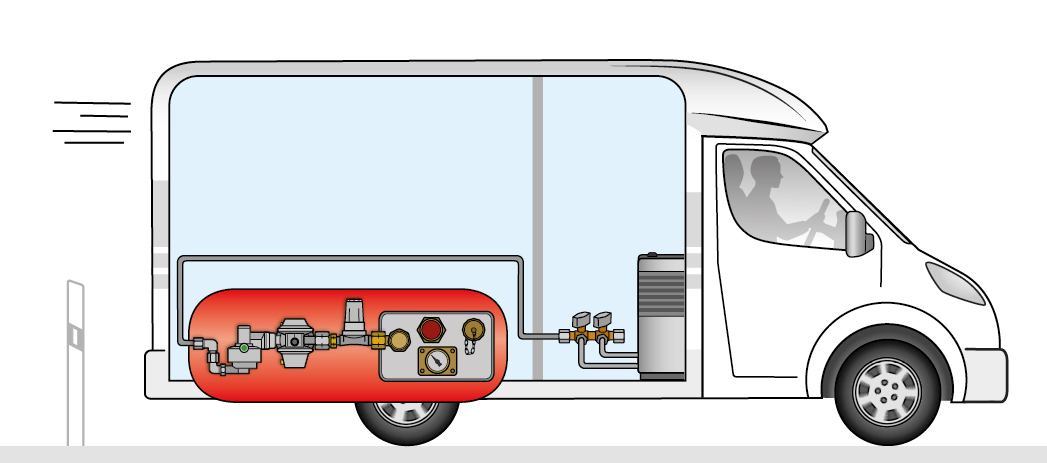
The Caramatic ConnectClean gas tank filter is installed between the tank and the regulator and protects the gas system against contamination.
Ein LPG tank filter is a simple yet highly effective component in the gas installation of a motor caravan or caravan. He is installed between the fixed LPG tank and the pressure regulator and fulfils a central task: he filters oil-containing residues, condensates, aerosols, paraffins and the smallest particles from the gas flow before these reach sensitive equipment.
This is especially relevant when using autogas. Because even though the gas itself is generally of high quality, fine impurities – as previously described – can enter the system. Without a filter, these residues gradually accumulate in regulators, lines and appliances. The result: malfunctions, reduced gas flow or, in the worst case, system failure while on the road.
An LPG tank filter counteracts this specifically by reliably capturing harmful substances from the gas flow. The filter element of the Caramatic ConnectClean LPG tank filter from GOK achieves 99% separation of oil-containing particles and other impurities.
An LPG tank filter is particularly useful:
- when regularly refuelling at LPG filling stations (especially abroad),
- for new vehicles with sensitive technology,
- and whenever the gas system is to remain protected and low-maintenance in the long term.
In short: anyone who keeps their gas system clean will have fewer issues with defects, failures or repairs later on – and can enjoy travelling with their leisure vehicle much more relaxed.
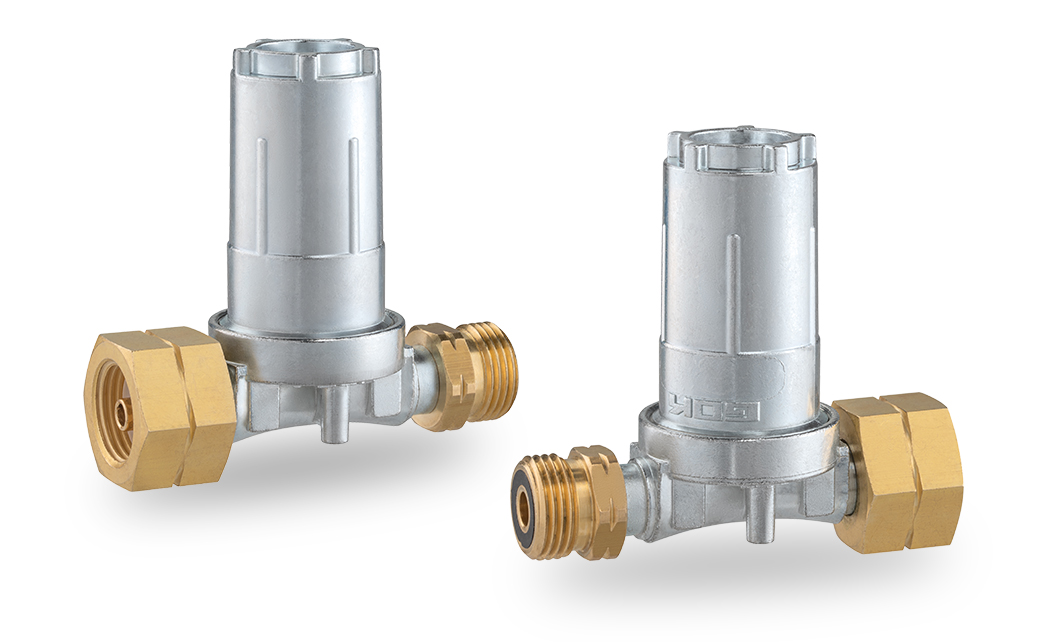
The Caramatic ConnectClean gas tank filter in front and rear view: its compact design allows for easy integration in new vehicle builds as well as quick retrofitting in existing vehicles.
With the Caramatic ConnectClean LPG tank filter, GOK offers a filter solution specifically developed for leisure vehicles, optimally tailored to the requirements of modern gas systems with a fixed tank. The focus is not only on filtration performance, but also on an especially compact design and ease of use.
This is what sets the ConnectClean LPG tank filter apart:

The ConnectClean 2.0 is therefore a well-designed solution for anyone who wants to permanently protect their gas system while travelling – whether in new vehicles or as part of a conversion to autogas. Its filtration performance is not just technical protection, but an active contribution to the longevity and operational safety of the entire system.
Installation & maintenance – what users should pay attention to
Important points regarding installation, maintenance and filter replacement:
- The filter must be installed correctly on the pressure side – ideally by a certified gas technician or specialist company.
- The installation position and flow direction must be observed (note the arrow direction).
- Filter elements should be checked regularly and replaced depending on frequency of use – recommended: after each refuelling, at least once a year.
- The element can be replaced without tools and with ease (a tightening aid should be used to secure it).
- GOK offers suitable replacement filter elements (Filter Element 2.0) as accessories.
Thanks to its simple design and sustainable construction, maintenance is especially convenient for users. Anyone who travels regularly and refuels with autogas should consider filter replacement a fixed part of system maintenance – comparable to an oil change in a car.
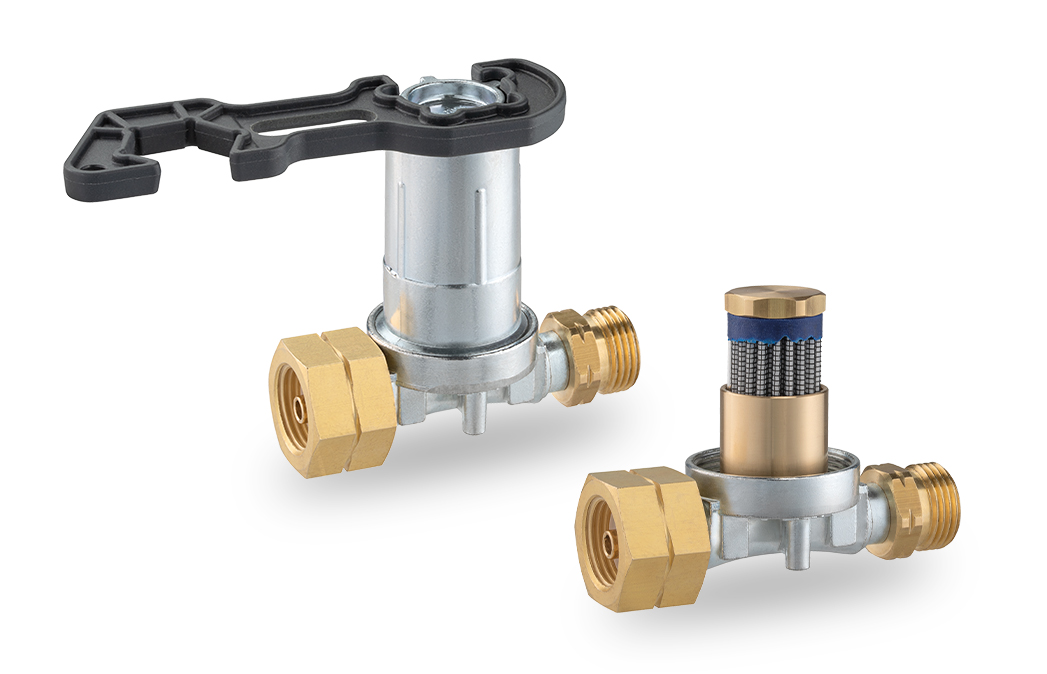
The GOK gas filter with removable filter cup allows for quick replacement of the filter cartridge – ideal for regular maintenance.
Voices from the community – what campers report
The desire for a clean, trouble-free gas supply is a common concern among campers in relevant forums and Facebook groups. Especially among motorhome owners who have already converted to fixed LPG tanks or regularly refuel with autogas abroad, the topic of “gas filters” is coming up more and more frequently.
Some typical experiences from the community (a summarised selection based on forums such as wohnmobilforum.de, campingforen.de and camperforum.de):
- “After two years, my regulator suddenly failed – the gas technician found traces of oil.”
- “We often refuel in Southern Europe and kept having issues with heater outages.”
- “During servicing, the filter element was slightly oily – so it did its job. I now replace it every year, it’s cheaper than a new regulator.” (Disclaimer: used with a conventional cylinder system)
These statements show: many users appreciate not only the protective function but also the easy maintenance and predictable costs. Especially compared to expensive repairs or equipment failures, many see the filter element as a reassuring investment in the operational safety of their gas system.

In addition to reliable protection, the Caramatic ConnectClean LPG tank filter also impresses with easy maintenance and predictable costs – a worthwhile investment in the operational safety of the gas system.
Conclusion
Those who refuel with autogas gain convenience – but potentially also introduce residues into the system. The Caramatic ConnectClean LPG tank filter from GOK is therefore a simple, cost-effective and technically sensible solution to permanently protect the gas system in a motor caravan or caravan. For anyone travelling with a fixed LPG tank, it’s more than just an accessory: it’s an investment in safety, performance and peace of mind while travelling.
FAQ: Use of LPG Tank and LPG Tank Filter
Why is a gas filter useful for a fixed LPG tank in a motor caravan?
A gas filter protects the gas system from oily residues, particles and other impurities that can enter the system when refuelling with autogas. This helps prevent damage to pressure regulators and consumer devices such as heaters or fridges.
How does autogas differ from conventional bottled gas?
Autogas is subject to less stringent cleaning and quality standards than bottled gas. It may contain additives, oil aerosols or other residues that are unproblematic for vehicle engines but can cause issues in gas systems in motor caravans or caravans.
What damage can contaminated autogas cause?
Residues in autogas can oil-foul pressure regulators, clog nozzles or impair safety valves. This can lead to malfunctions, reduced gas flow or even failure of the entire gas supply.
How does the Caramatic ConnectClean LPG tank filter from GOK work?
The Caramatic ConnectClean LPG tank filter is installed between the tank and the pressure regulator and filters up to 99% of oily particles from the gas flow. This effectively protects the entire gas system in a motor caravan or caravan.
When should an LPG tank filter be replaced?
Depending on use, it is recommended to replace the filter element about once a year – possibly earlier with frequent use. The replacement is tool-free, as only the internal element – not the entire unit – needs to be replaced.
Can I install the Caramatic ConnectClean LPG tank filter myself?
Installation should ideally be carried out by a certified specialist. However, campers can also retrofit the LPG tank filter themselves – don’t forget to carry out a leak test before putting it into operation.
Is a gas tank filter necessary when travelling abroad?
Yes, especially abroad, the quality of autogas can vary more significantly. A filter provides reliable protection against unexpected residues and increases operational safety – even though it is not mandatory.