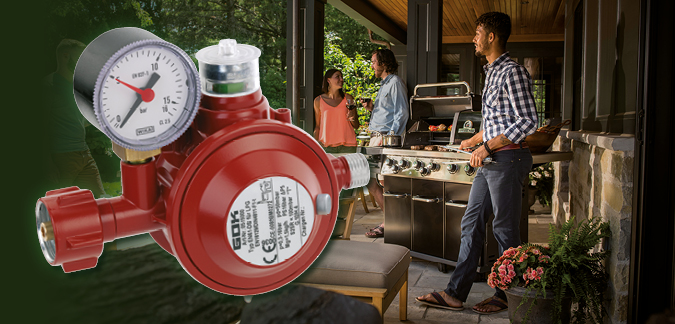
The red pressure regulators from GOK for small gas cylinders (5 and 11-kilogram filling weight) are actually designed for use in buildings. We explain whether you may also use them outdoors, for example for a gas barbecue or outdoor heater.
Post Views:92
The “red pressure regulator” refers to a special type of pressure regulator. These are the pressure regulators with the highest safety standard, type EN61-DS. This fitting is expressly suitable for use in buildings. Can it also be used in the open air without any concern, for example on a gas barbecue or outdoor heater?
Red pressure reducer; order number 05 150 00
The clear answer: Yes! The pressure reducers with the order numbers 05 150 00, 05 150 02 and 05 150 06 can also be used outdoors. This applies to both private and commercial use. Whether this also makes sense is another question. But more about this below. Red pressure regulators of type EN61-DS are always fitted with at least the following:
This equipment is included by the pressure regulator with order number 05 150 00. The fitting with the end number -02 also has an integrated excess flow device. The difference between 05 150 00 and 05 150 06 is only that the first one has a straight outlet and the second one is angled by 90 degrees.
In the GOK product range, there are also silver and black pressure regulators of the same type. Unlike the red, there is a small but fine difference: The silver and black versions always lack the thermal cut-out device. It is a central requirement in order to be able to use the pressure regulator indoors as well.
Suitable for outdoor use and with a few safety devices included: the silver pressure regulator with part number 01 150 12.
Brief summary
To sum up: You can use the red pressure regulators of the type EN61-DS both indoors and outdoors. In a sense, this fitting does everything thanks to the vast range of safety devices and versatile area of use. Silver pressure regulators of the same type may only be used if the gas equipment, such as radiant heater or outdoor heater, is located outdoors.
The black pressure regulators, known as “barbecue regulators” are specially designed for barbecuing with LPG. This means that the user can use the pressure regulator outdoors.
Useful or not?
Finally, we should repeat the question of whether it makes sense to use the red pressure regulator outdoors. In principle, there is nothing wrong with this; however, if you leave the system permanently outdoors in wind and weather conditions, it should be remembered that the coupling nut of the red pressure regulator is made of steel. This means: If you frequently loosen the nut, screw it back on again and expose the regulator to the weather unprotected, you must expect that the nut will start to rust.
In contrast, the silver and black pressure regulators have a brass coupling nut. However, both must not be used within buildings because they lack the thermal cut-out device.
If you use the gas equipment exclusively as a private individual and only outdoors, no safety devices are required at all. However, we are increasingly aware that barbecue users like to spend a few euros more with safety-relevant system components.
Silver pressure regulators without safety devices are permitted according to the standard. Many barbecue users are making increasing use of pressure reducers with safety devices.
Example: gazebo
Why it makes sense to use the red pressure reducer outdoors as well: Let’s take the example of a gazebo or an allotment. There you have a gas stove in the hut as well as an outdoor heater so you can spend cooler evenings outdoors. If you don’t want to get two different pressure reducers, it makes sense to buy just the red pressure regulator of type EN61-DS.
You can use this as a pressure regulator for the gas stove in the hut. If you disconnect the hose assembly there, carry the gas cylinder and the pressure regulator to the outside and connect it to the outdoor heater, you also use a permitted pressure reducer. Depending on how long the hose assembly is, please note the following: From which hose length do I need an excess flow device?
The articles are written by specialist authors in the fields of LPG, fuel oil, liquid media, tank management and safety engineering, who contribute their expertise from product management, development, technical customer support, training and standardisation activities.
The members of the editorial team have many years of practical experience in the planning, application and further development of technical solutions for the safe supply of LPG and liquid fuels. Several authors are actively involved in specialist committees and working groups of the DVGW, DVFG and figawa, as well as in national and European standardisation committees. The team includes, among others, experts certified in accordance with G 607 and G 608, competent persons in accordance with the TRF, and specialists who contribute to the development and evaluation of technical regulations and industry standards.
In addition to providing information about GOK products and solutions, the editorial team focuses on sharing knowledge relating to safety, regulations, maintenance, operation and future technologies in the field of LPG and liquid media.
Share this post
Related articles
Which GOK components do I need as a private individual for my gas barbecue?
Safety
You might also find this interesting
Which pressure regulator do I need for which output?
Camping & Leisure, Grill & BBQ, Home & Commercial
How do I know when I need to replace the components of my LPG system?
Camping & Leisure, Grill & BBQ, Home & Commercial
Where can I find operating manuals for GOK products?
Camping & Leisure, Grill & BBQ, Home & Commercial, Tank & Liquid Media
From what length of hose assembly do I need an excess flow device?
Camping & Leisure, Grill & BBQ, Home & Commercial
Which pressure regulator connections exist for LPG cylinders in Europe?
Camping & Leisure, Grill & BBQ, Home & Commercial
Does the pressure regulator gauge show the filling level of the LPG cylinder?
Camping & Leisure, Grill & BBQ, Home & Commercial
How do I carry out a simplified leak check on an LPG cylinder system?
Camping & Leisure, Grill & BBQ, Home & Commercial
How do commercial operation and private operation of a gas barbecue differ?
Grill & BBQ
How do I identify the year of manufacture of a pressure regulator from GOK?
Camping & Leisure, Grill & BBQ, Home & Commercial
How do I find out whether the nominal pressure on the pressure regulator and gas equipment match?
Camping & Leisure, Grill & BBQ, Home & Commercial
What spanner size do coupling nuts on pressure regulators have for connecting to LPG cylinders in Germany?
Camping & Leisure, Grill & BBQ, Home & Commercial
How can I operate gas cartridge devices via an LPG cylinder?
Camping & Leisure, Grill & BBQ
This blog will never ask members of the public or unqualified persons to make changes to or fiddle around with technical systems themselves.
In accordance with the Industrial Safety Regulation (BetrSichV), a qualified person must take care of a system which requires monitoring.
A qualified person is someone who has the specific specialist knowledge required. This knowledge is gained by way of a professional apprenticeship, corresponding professional experience or current occupational activity.
Please note that the texts are based on information, regulations and standards for Germany. Please always check the rules and regulations in the relevant country of destination and consult specialists if necessary.