The same thing again and again: The gas cylinder is empty, exactly when you absolutely want to get a room to the right temperature using the radiant heater or fire up the gas barbecue for your party guests. Basically, it helps to have a replacement cylinder nearby. However, if you want to be certain about the filling level of your cylinder in use, we will show you two ways of doing it in this article: the conventionally analogue way and digitally with the aid of an app and consumption forecast, which is especially convenient.
Views:225
All of a sudden: the gas cylinder is empty! Lucky you if you have a spare cylinder to hand. But experience has shown that an empty cylinder will always catch you off guard, and at the worst possible time. So, what can you do? In the short term: Somehow get your hands on another cylinder. In the medium term: Measure the gas cylinder’s filling level more often. We show two options: analogue and digital.
The first option is rather simple, but it can be carried out quickly and with the easiest means. In order to determine the filling level of the gas cylinder, only a conventional luggage scale is actually required.
Measuring and calculating the filling level in the analogue way
The carrying handle or collar of the gas cylinder is best suited to attach the luggage scale. The scale now specifies the total weight. If you subtract the tare weight of the gas cylinder from this weight, you will discover the actual filling weight.
An example calculation can be found here in this infographic. We assume that the luggage scale shows a total weight of 10.1 kilograms for a gas cylinder with a filling weight of 5 kilograms:
Disadvantage of the analogue method
However, this measurement method has one disadvantage, because you only receive a value in kilograms; on gas equipment such as gas barbecues, gas hobs or outdoor heaters, however, the power is given in kilowatts in most cases. Of course, you can convert kilograms into kilowatts and estimate how long the gas will last.
The weight of the gas cylinder can be measured and calculated with ease using a luggage scale. However, this measuring principle also offers a major disadvantage.
Digital: Senso4s
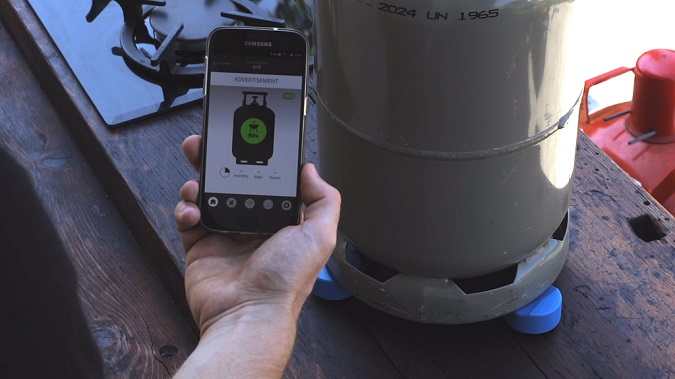
It can be much more precise and convenient with the Senso4s system (image). This is a combination of a level gauge and an app. The Senso4s measures the total weight of the cylinder. Before start-up, the user must state the filling and tare weight of the gas cylinder in the app.
On this basis, the Senso4s then transmits the filling level of the gas cylinder in percent by volume to a mobile device, such as your smartphone or tablet PC. The highlight here is: From the second measurement, an algorithm calculates how long the gas in the cylinder will last and makes a forecast.
The more often the Senso4s takes subsequent measurements, the more precise the forecast will be when the gas is running out, as the system can access more data. And the Senso4s carries out a new measurement every 15 minutes and sends the data to the app of the connected user.
If no user is connected to the Senso4s via Bluetooth, the device still measures the filling level every 15 minutes and sends the data to the user the next time the Bluetooth connection is made.
Permissible total weight and maximum diameter
However, the permissible total weight, i.e. filling weight plus tare weight, must not exceed 45 kilograms. For this reason, the Senso4s cannot measure the filling level of a 33-kilogram gas cylinder.
The Senso4s is attached to the base of the gas cylinder. Although the filling level gauge can be extended flexibly, it still has a minimum and maximum diameter. This means that the diameter of the gas cylinder must not be below 18 centimetres or above 32 centimetres. Everything within this diameter range fits on the Senso4s.
Flexible, digital, easy to use and with additional benefits: The Senso4s helps with monitoring the gas cylinder.
The articles are written by specialist authors in the fields of LPG, fuel oil, liquid media, tank management and safety engineering, who contribute their expertise from product management, development, technical customer support, training and standardisation activities.
The members of the editorial team have many years of practical experience in the planning, application and further development of technical solutions for the safe supply of LPG and liquid fuels. Several authors are actively involved in specialist committees and working groups of the DVGW, DVFG and figawa, as well as in national and European standardisation committees. The team includes, among others, experts certified in accordance with G 607 and G 608, competent persons in accordance with the TRF, and specialists who contribute to the development and evaluation of technical regulations and industry standards.
In addition to providing information about GOK products and solutions, the editorial team focuses on sharing knowledge relating to safety, regulations, maintenance, operation and future technologies in the field of LPG and liquid media.
Share this post
Related articles
How many kilowatt hours correspond to a kilogram of LPG (propane)?
Safety
What withdrawal volume do I get out of one gas cylinder?
Camping & Leisure, Grill & BBQ, Home & Commercial
You might also find this interesting
How can I use several LPG cylinders in the caravan, motor caravan or on the boat at the same time?
Camping & Leisure
How does a PRV pressure relief valve work?
Camping & Leisure, Home & Commercial, Safety
Which pressure regulator do I need for which output?
Camping & Leisure, Grill & BBQ, Home & Commercial
Are there any differences in the gas test of mobile homes or caravans and motor caravans?
Camping & Leisure
How do I know when I need to replace the components of my LPG system?
Camping & Leisure, Grill & BBQ, Home & Commercial
Where can I find operating manuals for GOK products?
Camping & Leisure, Grill & BBQ, Home & Commercial, Tank & Liquid Media
From what length of hose assembly do I need an excess flow device?
Camping & Leisure, Grill & BBQ, Home & Commercial
Which pressure regulator connections exist for LPG cylinders in Europe?
Camping & Leisure, Grill & BBQ, Home & Commercial
How can I release an OPSO (SAV)?
Home & Commercial
What is an OPSO (SAV) and how does it work?
Home & Commercial
Does the pressure regulator gauge show the filling level of the LPG cylinder?
Camping & Leisure, Grill & BBQ, Home & Commercial
Does the gas have to be discharged out of the line before releasing the OPSO (SAV)?
Home & Commercial
This blog will never ask members of the public or unqualified persons to make changes to or fiddle around with technical systems themselves.
In accordance with the Industrial Safety Regulation (BetrSichV), a qualified person must take care of a system which requires monitoring.
A qualified person is someone who has the specific specialist knowledge required. This knowledge is gained by way of a professional apprenticeship, corresponding professional experience or current occupational activity.
Please note that the texts are based on information, regulations and standards for Germany. Please always check the rules and regulations in the relevant country of destination and consult specialists if necessary.