
The Caramatic two-cylinder system ensures long-term gas supply in caravans and motor caravans as well as on boats and ships. The easy-to-operate fittings set is available in two versions: 30 mbar and 50 mbar.
Inhaltsverzeichnis
The Caramatic two-cylinder system ensures long-term gas supply in caravans and motor caravans as well as on boats and ships. The easy-to-operate fittings set is available in two versions: 30 mbar and 50 mbar.
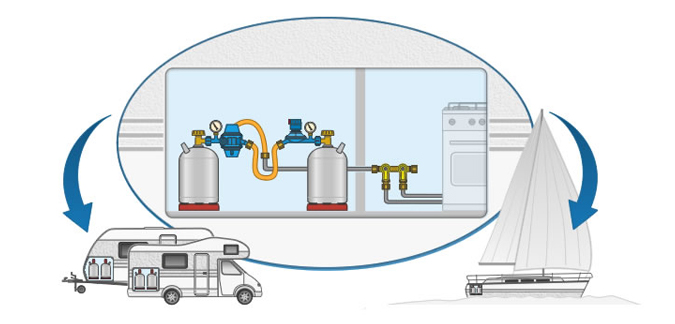
For caravan fans and sailors, it is especially annoying when the LPG runs out while you’re on a trip. This is because: It’s usually anything but simple to get your hands on more when travelling abroad or at high seas. The solution for many holidaymakers is called Caramatic BasicTwo.
The two-cylinder system offers the comfort of a long-term secure gas supply in caravans and motor caravans, as well as on boats and sailing boats, and is relatively simple to install. The set consists of two pressure regulators, one central regulator and one changeover regulator, two hose assemblies and adapters to 8 or 10 millimetre piping.

The two pressure regulators are directly attached to the cylinders. During installation, it is irrelevant which pressure regulator you are installing on which gas cylinder. It even doesn’t matter whether you use a gas cylinder with a filling weight of 5, 11 or 33 kilograms as long as it has a standard connection in Germany. Both pressure regulators have a so-called combination soft connection, which enables installation on all listed gas cylinders.
The hose assembly with a 3/8 inch connection on both sides connects the central and changeover regulators. The second hose assembly of the set connects the central regulator to the piping of the LPG system. Both hose assemblies are 40 centimetres long and cold-resistant up to -30 degrees Celsius.
The changeover regulator has its name because the operator can switch between“Operation” and “Reserve” settings. As shown in Figure 1, the rotary knob of the changeover regulator, now only referred to as B, will be set to reserve. For the Caramatic BasicTwo, this means that only LPG is withdrawn from the cylinder, on which the central regulator, referred to as A, has been installed. Important: Please always turn the rotary knob to B as far as it will go.

In figure 1 and 2, changeover regulator B is at reserve and gas is drawn from the gas cylinder with central regulator A as a priority. Figure 3 and 4 shows changeover regulator B in operation. Only when the pressure of this cylinder decreases, gas is successively drawn from the full cylinder.
As soon as the cylinder with A becomes empty, its pressure drops and gas withdrawal changes automatically to the reserve cylinder (diagram 2). At the next opportunity, the user changes the rotary knob from “reserve” to “operation”. Now, the operator can replace the empty cylinder or have it refilled. Big advantage: They can change the cylinder without having to interrupt the operation of the connected gas equipment. The replacement is simple:
If the operator sets B to “Operation” instead of “Reserve“,
the Caramatic BasicTwo draws gas only from the cylinder at which B is installed (see figure 3). Here as well, the same process: When the operating cylinder is empty, the pressure drops and the gas withdrawal changes automatically to the reserve cylinder (figure 4).
This blog will never ask members of the public or unqualified persons to make changes to or fiddle around with technical systems themselves.
In accordance with the Industrial Safety Regulation (BetrSichV), a qualified person must take care of a system which requires monitoring.
A qualified person is someone who has the specific specialist knowledge required. This knowledge is gained by way of a professional apprenticeship, corresponding professional experience or current occupational activity.
Please note that the texts are based on information, regulations and standards for Germany. Please always check the rules and regulations in the relevant country of destination and consult specialists if necessary.


