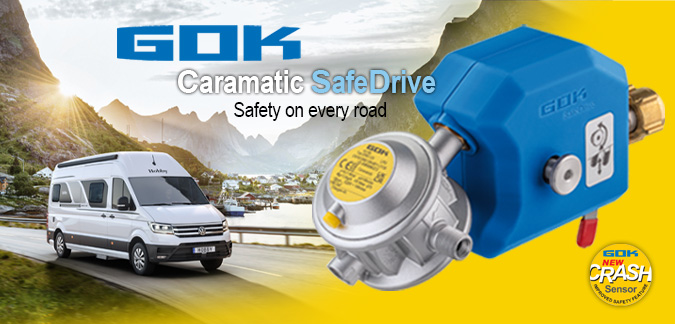
The Caramatic SafeDrive is a pressure regulation system for the safe operation of the LPG system in motor caravans, caravans, or motor homes and camper vans. Its special feature: The crash sensor from GOK allows the gas cylinder to remain open while driving. The layout of the system is brand new and has a number of advantages.
Post Views:105
The Caramatic SafeDrive is a pressure regulation system for the safe operation of the LPG system in motor caravans, caravans, or motor homes and camper vans. Its special feature: The crash sensor from GOK allows the gas cylinder to remain open while driving. The layout of the system is brand new and has a number of advantages.
But hasn’t it been possible to leave the gas cylinder open all the time and to operate a gas heater or gas-powered refrigerator, also while driving, for some time? Yes it has – thanks to GOK. GOK has been offering the DriveOne and DriveTwo from its Caramatic line for single- and two-cylinder systems in camping vehicles for several years.
Caramatic SafeDrive?
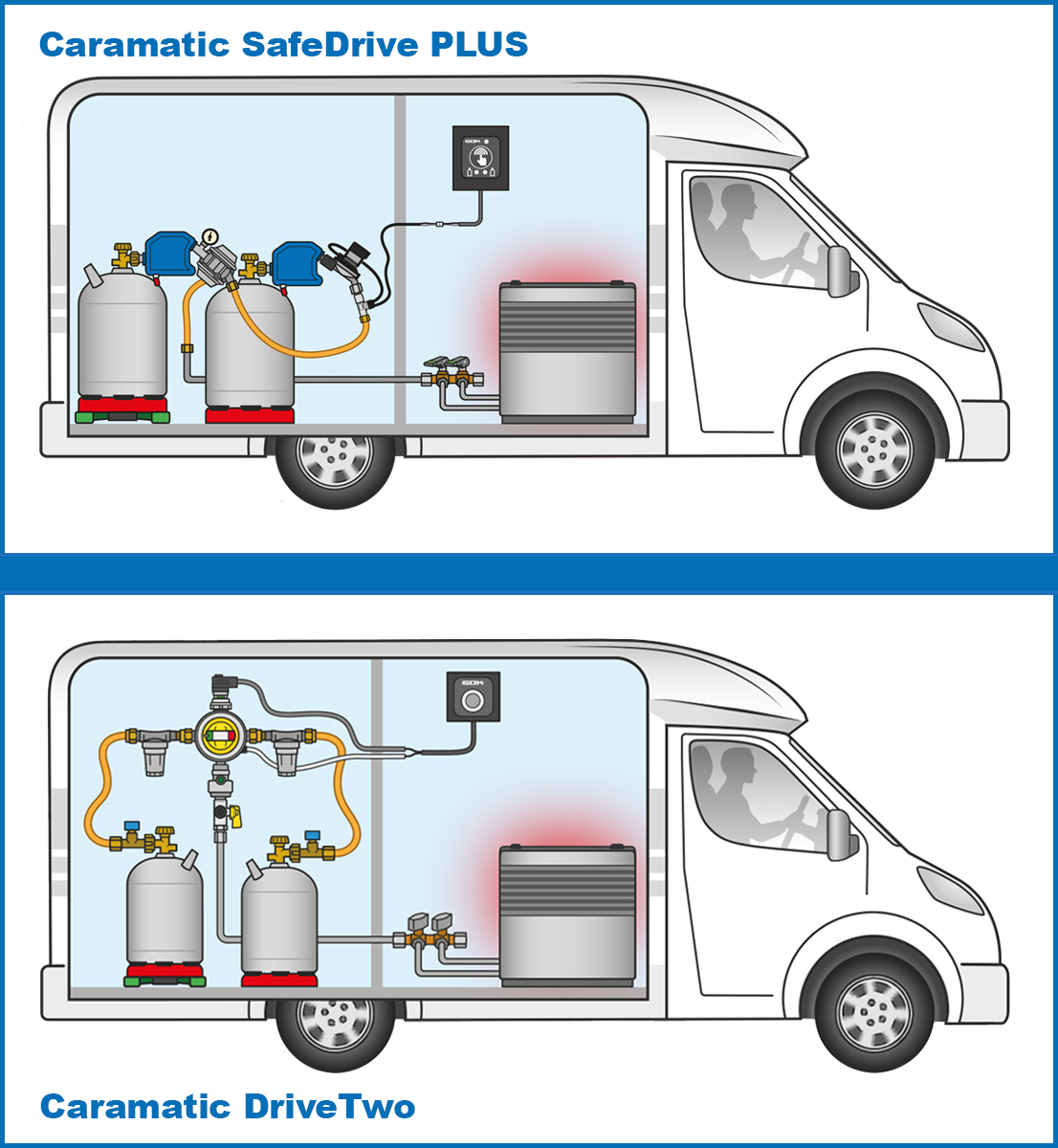
So what’s new about the Caramatic SafeDrive, and how does it differ from the DriveOne and DriveTwo? The biggest difference is its modified system configuration. While the DriveOne or DriveTwo require one (or two) high pressure hose assemblies to connect the gas cylinder to the pressure regulation system, the Caramatic SafeDrive is screwed directly onto the gas cylinder.
The Caramatic SafeDrive is a single unit consisting of a crash sensor and a low pressure regulator. The pressure regulator, also known as a pressure reducer, is responsible for ensuring that the gas equipment installed downstream is continuously pressurised to the same level so that it can function properly.
Advantage 1: Pipe system monitoring
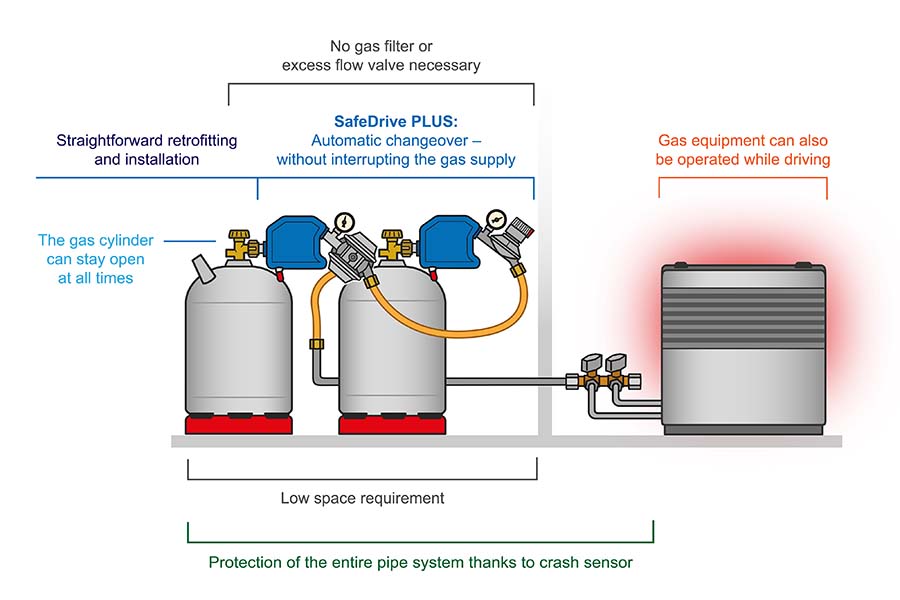
The crash sensor monitors the entire pipe system, including the gas hoses and piping, and shuts off the gas flow if an accident involving the motor caravan, caravan or motor home occurs. If it didn’t do this and the gas cylinder was open, in the worst case scenario, unburned gas could escape and cause damage.
Monitoring the entire pipe system with a safety device is one of the major advantages of the Caramatic SafeDrive, which only this form of system configuration offers.
Advantage 2: Straightforward retrofitting, conversion and installation
Screw the pressure reducer including the crash sensor directly onto the gas cylinder and connect it to the piping with a gas hose – the straightforward installation process is also a considerable advantage. The two-cylinder system can also be installed very easily by any camper.
A unit consisting of a crash sensor (in the blue housing) and pressure reducer is attached to each of the two gas cylinders. The central regulator is connected to the changeover regulator via a hose assembly. Another hose leads from the central regulator to the piping.
This straightforward, well-known system concept makes retrofitting and installation very easy. Changing manufacturers to GOK isn’t a problem either. Regardless of which manufacturer’s system was previously in use, the Caramatic SafeDrive is suitable for a wide range of retrofitting projects.
Advantage 3: Gas filter and excess flow device not necessary
Other systems that fulfil the same purpose (including the DriveOne and DriveTwo) require an additional excess flow device to monitor the gas hose between the gas cylinder and the pressure regulation system.
As already noted, however, the Caramatic SafeDrive unit (crash sensor and pressure reducer) is located directly on the gas cylinder. This means that the crash sensor monitors the entire pipe system, making the additional excess flow device unnecessary.
If the pressure regulation system isn’t located directly on the gas cylinder, a gas filter is required to keep oily residues and soiling at bay. Thanks to its tried-and-tested system design (pressure reducer directly on the gas cylinder), the Caramatic SafeDrive doesn’t require a gas filter.
Omitting an excess flow device and gas filter saves the camper both money and space.
The advantages of the Caramatic SafeDrive, as exemplified by the Caramatic SafeDrive PLUS two-cylinder system.
Advantage 4: Space thanks to SafeDrive
Space is another advantage. In many gas cylinder cases space is very limited and every centimetre counts. Compared with existing system designs (including excess flow device and gas filter), the Caramatic SafeDrive system configuration offers the camper more space in their gas cylinder case.
This can be a considerable advantage for self-furnished motor homes / camper vans, but also for two-cylinder systems for motor caravans, for example.
Advantage 5: Any time, any place
An advantage that the Caramatic SafeDrive shares with the existing systems: the gas cylinder can remain open at all times. This means that campers can also operate gas equipment such as the heater or refrigerator while driving.
Conclusion
Caramatic SafeDrive is a pressure regulation system consisting of a pressure reducer and the crash sensor safety device. Compared to similar systems, the gas pressure regulation system including the crash sensor is located directly on the gas cylinder, which has several advantages.
The articles are written by specialist authors in the fields of LPG, fuel oil, liquid media, tank management and safety engineering, who contribute their expertise from product management, development, technical customer support, training and standardisation activities.
The members of the editorial team have many years of practical experience in the planning, application and further development of technical solutions for the safe supply of LPG and liquid fuels. Several authors are actively involved in specialist committees and working groups of the DVGW, DVFG and figawa, as well as in national and European standardisation committees. The team includes, among others, experts certified in accordance with G 607 and G 608, competent persons in accordance with the TRF, and specialists who contribute to the development and evaluation of technical regulations and industry standards.
In addition to providing information about GOK products and solutions, the editorial team focuses on sharing knowledge relating to safety, regulations, maintenance, operation and future technologies in the field of LPG and liquid media.
Share this post
Related articles
No results found.
You might also find this interesting
How can I use several LPG cylinders in the caravan, motor caravan or on the boat at the same time?
Camping & Leisure
How does a PRV pressure relief valve work?
Camping & Leisure, Home & Commercial, Safety
Which pressure regulator do I need for which output?
Camping & Leisure, Grill & BBQ, Home & Commercial
Are there any differences in the gas test of mobile homes or caravans and motor caravans?
Camping & Leisure
How do I know when I need to replace the components of my LPG system?
Camping & Leisure, Grill & BBQ, Home & Commercial
Where can I find operating manuals for GOK products?
Camping & Leisure, Grill & BBQ, Home & Commercial, Tank & Liquid Media
From what length of hose assembly do I need an excess flow device?
Camping & Leisure, Grill & BBQ, Home & Commercial
Which pressure regulator connections exist for LPG cylinders in Europe?
Camping & Leisure, Grill & BBQ, Home & Commercial
Does the pressure regulator gauge show the filling level of the LPG cylinder?
Camping & Leisure, Grill & BBQ, Home & Commercial
How do I carry out a simplified leak check on an LPG cylinder system?
Camping & Leisure, Grill & BBQ, Home & Commercial
How do I identify the year of manufacture of a pressure regulator from GOK?
Camping & Leisure, Grill & BBQ, Home & Commercial
How do I find out whether the nominal pressure on the pressure regulator and gas equipment match?
Camping & Leisure, Grill & BBQ, Home & Commercial
This blog will never ask members of the public or unqualified persons to make changes to or fiddle around with technical systems themselves.
In accordance with the Industrial Safety Regulation (BetrSichV), a qualified person must take care of a system which requires monitoring.
A qualified person is someone who has the specific specialist knowledge required. This knowledge is gained by way of a professional apprenticeship, corresponding professional experience or current occupational activity.
Please note that the texts are based on information, regulations and standards for Germany. Please always check the rules and regulations in the relevant country of destination and consult specialists if necessary.