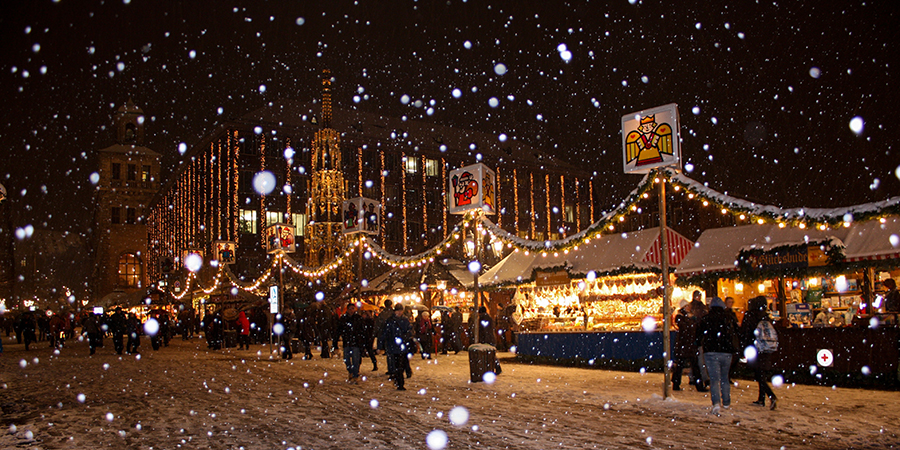
DGUV V 79 defines the regulations for handling LPG in stalls at Christmas markets. Among other things, the policy makes reference to pressure regulators/pressure reducers as well as hose assemblies, excess flow devices and replacement periods.
Views:100
Throughout Germany, from the end of November, Christmas markets open their gates and people start looking forward to warming drinks and festive dishes. To provide visitors with plenty of delicious treats, many stallholders make use of LPG, i.e. propane and butane, to supply their gas barbecue, gas stove and radiant heater.
Due to a lack of technical knowledge, many hospitality businesses use insufficient components in the LPG system or do not use safety-relevant fittings because they simply do not know the regulations, or have not been made aware of them. However: What regulations now apply to operators of stalls and snack bars at Christmas markets?
Many stalls at Christmas markets use LPG (propane) to operate the gas equipment. It is important for operators to know where to install the respective cylinders and what they have to pay attention to when it comes to components such as pressure regulators.
If you use an LPG system for commercial purposes, regulation 110-010 of the German Accident Insurance Act (DGUV 110-010) applies. At the end of the article, you will find helpful links to the rules and regulations mentioned. DGUV 110-010 requires the use of pressure regulators either with the safety devices OPSO (SAV) and PRV respectively UPSO or with over-pressure safety device S2SR.
Pressure regulator type FL90-4 with OPSO and PRV (left) and type EN61-DS with S2SR (right).
5, 11 and 33-kilogram gas cylinder (from left to right).
You are allowed to operate up to two 5 or 11-kilogram cylinders in a stall, hut or kiosk. Nominally, it is not forbidden to also operate a 33-kilogram cylinder indoors – but by no means in combination with a smaller cylinder. However, it is difficult to operate a 33-kilogram cylinder indoors for two reasons:
A safety range of two metres must be observed around the gas cylinder according to DGUV 110-010. There must be no sources of ignition, cellar openings, channel inlets without liquid closures, open windows and fires within this protected area. This is probably impossible in most stalls.
Pressure regulators for 33-kilogram cylinders have a pressure relief valve (PRV). Of course, the discharged gas must not accumulate in the room. For this reason, a discharge line must lead outside, which is difficult at Christmas markets.
In addition, there is a recommendation to secure gas equipment indoors with a thermal shut-off device “T” (TAE). The corresponding pressure regulators do not have such a safety device.
For the above reasons, we recommend that you install the 33-kilogram cylinder outdoors. If you plan a system consisting of several 33-kilogram cylinders, it will have to go outside anyway.
Excess flow device
As in many other areas, excess flow devices are also required at Christmas markets as soon as the hose assembly is longer than 40 centimetres. Further details can be found in paragraph 10 of DGUV 110-010.
Heating with LPG
For example, if you use outdoor heaters or radiant heaters for yourself and/or your guests, you must ensure that a gas anti-tilt device (image) is installed. This blocks the gas supply when the device tips over and automatically releases it again once it has been righted.
A device according to DIN EN 14543 must be fitted ex works with anti-tilt protection. If you have not yet installed an anti-tilt device, however, retrofitting is relatively simple. Simply loosen the hose assembly from the pressure regulator and screw in the anti-tilt device between them.
Replacement periods
It is necessary to have system components such as a pressure regulator, hose assembly, excess flow device and shut-off device replaced eight years after the date of manufacture at the latest. The components may also remain in a system for longer if a qualified person (expert) confirms the proper condition of the system.
This article is only an extract of the regulations which must be complied with by the operator. We recommend always contracting a specialist for repair work, maintenance and conversion, who can give you exact advice on site.
Please observe the requirements of DGUV regulation 110-010 and DGUV principle 310-005 for maintenance and inspection.
The articles are written by specialist authors in the fields of LPG, fuel oil, liquid media, tank management and safety engineering, who contribute their expertise from product management, development, technical customer support, training and standardisation activities.
The members of the editorial team have many years of practical experience in the planning, application and further development of technical solutions for the safe supply of LPG and liquid fuels. Several authors are actively involved in specialist committees and working groups of the DVGW, DVFG and figawa, as well as in national and European standardisation committees. The team includes, among others, experts certified in accordance with G 607 and G 608, competent persons in accordance with the TRF, and specialists who contribute to the development and evaluation of technical regulations and industry standards.
In addition to providing information about GOK products and solutions, the editorial team focuses on sharing knowledge relating to safety, regulations, maintenance, operation and future technologies in the field of LPG and liquid media.
Share this post
Related articles
What is an OPSO (SAV) and how does it work?
Home & Commercial
You might also find this interesting
How does a PRV pressure relief valve work?
Camping & Leisure, Home & Commercial, Safety
Which pressure regulator do I need for which output?
Camping & Leisure, Grill & BBQ, Home & Commercial
How do I know when I need to replace the components of my LPG system?
Camping & Leisure, Grill & BBQ, Home & Commercial
Where can I find operating manuals for GOK products?
Camping & Leisure, Grill & BBQ, Home & Commercial, Tank & Liquid Media
From what length of hose assembly do I need an excess flow device?
Camping & Leisure, Grill & BBQ, Home & Commercial
Which pressure regulator connections exist for LPG cylinders in Europe?
Camping & Leisure, Grill & BBQ, Home & Commercial
How can I release an OPSO (SAV)?
Home & Commercial
What is an OPSO (SAV) and how does it work?
Home & Commercial
Does the pressure regulator gauge show the filling level of the LPG cylinder?
Camping & Leisure, Grill & BBQ, Home & Commercial
Does the gas have to be discharged out of the line before releasing the OPSO (SAV)?
Home & Commercial
How do I carry out a simplified leak check on an LPG cylinder system?
Camping & Leisure, Grill & BBQ, Home & Commercial
What is the heating value of media such as fuel oil, LPG and natural gas?
Home & Commercial, Tank & Liquid Media
This blog will never ask members of the public or unqualified persons to make changes to or fiddle around with technical systems themselves.
In accordance with the Industrial Safety Regulation (BetrSichV), a qualified person must take care of a system which requires monitoring.
A qualified person is someone who has the specific specialist knowledge required. This knowledge is gained by way of a professional apprenticeship, corresponding professional experience or current occupational activity.
Please note that the texts are based on information, regulations and standards for Germany. Please always check the rules and regulations in the relevant country of destination and consult specialists if necessary.