You want to operate a gas cooker or a gas hob with a gas cylinder in a detached house or a rented flat? In this article we clarify important questions, such as: What regulations and technical rules exist? Which gas cylinders are allowed in the flat or house and how do you have to store them? Which pressure reducer should be used and what should be taken into account during installation?
Post Views:143
A propane gas cooker is practical, powerful – and can also be used in a house or rented flat. However, special regulations apply to installation and operation. Pressure regulators, connection sets and the correct storage of gas cylinders play a central role here. Find out what you need to pay attention to in order to operate your propane cooker safely and in compliance with regulations.
Anyone who opts for a gas cooker in the kitchen is consciously choosing flexibility and full cooking performance. If a natural gas connection is available, homeowners usually use it for the gas cooker in the kitchen as well. However, professional caterers and hobby cooks very often also rely on propane – whether for structural reasons or because cylinders are already available. Operating a propane cooker in the home is permitted, but only under certain conditions.
To avoid both safety risks and problems with authorities or insurance companies, regulations must be observed: from selecting the appropriate pressure regulator and the suitable cooker connection set through to the safe storage of the gas cylinders. In this article, you will learn about the differences between small cylinders and large cylinders, which regulators and safety devices are required, and how to use your propane cooker professionally and safely.
Whether for structural reasons or because cylinders are already available – many people rely on propane in the kitchen. What is important here: operation inside the home is only permitted with suitable accessories and safe storage.
Propane Gas Cooker in the Home – Is It Permitted?
In principle, operating a propane gas cooker inside a building is permitted, although only under clearly defined conditions. The decisive factors are the applicable regulations such as the Technical Rules for Liquefied Petroleum Gas (TRF) and relevant DIN standards. These specify how gas appliances and liquefied petroleum gas systems may be installed and operated in order to ensure the safe handling of liquefied petroleum gas.
Unlike natural gas, which is transported to the house via pipelines, propane is supplied in cylinders or tanks. This results in special requirements: cylinders and tanks must be connected in compliance with standards, the pressure must be reduced using a suitable regulator, and installation must be carried out in accordance with clear specifications.
It is also important to note: the connection work may only be carried out by a specialist company. DIY installations are not only dangerous, but may also result in the loss of insurance cover. However, anyone who complies with the regulations can use a propane gas cooker safely and conveniently in the home.
Connecting a Propane Gas Cooker – How It Works
To operate a propane gas cooker safely in the home, certain components are required. GOK pre-assembles complete sets to enable smooth and safe installation. The central component of such sets is always a special pressure regulator, the heart of the liquefied petroleum gas system. It ensures a constant operating pressure of 50 mbar in Germany or alternatively 30 or 37 mbar in European countries.
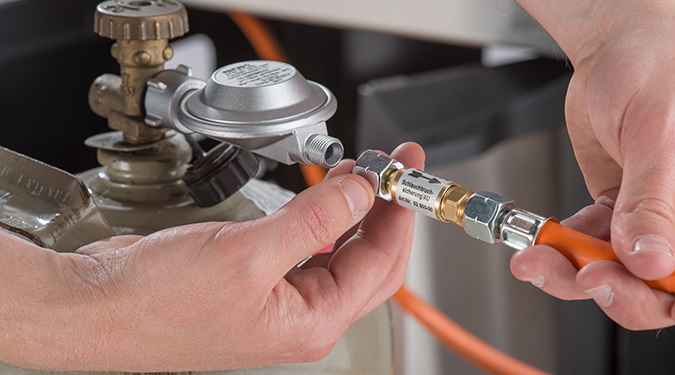
The pressure regulator is fitted directly to the gas cylinder, and a flexible gas hose or a gas hose and pipeline establish the connection to the gas cooker. In principle, there are two different installation options, which we will examine in more detail later in the text.
Installation may only be carried out by an authorised specialist company. This ensures that the system is checked for leaks and that all safety requirements are met. Once installation has been successfully completed, nothing stands in the way of safe and convenient cooking with propane.
The Right Pressure Regulator for Gas Cookers
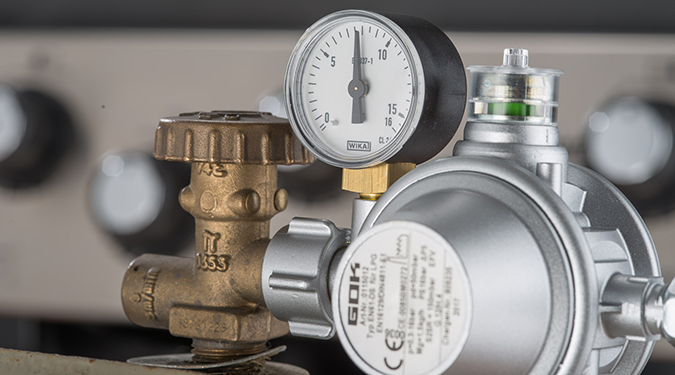
The pressure regulator is the central safety element of every liquefied petroleum gas system. It reduces the high cylinder pressure to the operating pressure permitted for gas appliances. In Germany, this is generally 50 mbar, while in other European countries the standard pressure in mbar may vary. The exact value that must be complied with depends both on the appliance specifications and on the respective national regulations.
Pressure Regulators for Small Cylinders (5, 8 or 11 kg Filling Weight)
For small cylinders, which are often used directly in the kitchen, compact pressure regulators are generally used. These are fitted directly to the cylinder valve. It is important that the pressure regulators are equipped with an integrated S2SR overpressure safety device, which protects against excessive pressure. In addition, pressure regulators for indoor use require a thermal shut-off device (TAE), which automatically stops the gas flow in the event of a fire. Regular inspection of the year of manufacture is also mandatory – pressure regulators must be replaced after ten years at the latest.
Pressure Regulators for Large Cylinders (33 kg Filling Weight)
For large cylinders with a filling weight of 33 kg or even multiple-cylinder systems, a special pressure regulator with higher flow rates is required. In addition to an OPSO overpressure shut-off safety device (SAV), these models are also equipped with a PRV safety relief valve.
Although the pressure regulators for large-cylinder systems operate at the same operating pressures, they provide significantly higher performance. While an output of 1.5 kg/h is common for small cylinders, pressure regulators for large cylinders generally deliver 4 kg/h.
Safety Notice
Regardless of the cylinder size, only pressure regulators with the appropriate approval may be used. Specialist companies check not only the correct selection, but also the leak-tightness and functionality.
Central safety technology: the pressure regulator reduces the cylinder pressure to the operating pressure permitted for gas appliances – in Germany usually 50 mbar. Left: regulator for small cylinders, right: for large cylinders.
Replacement Intervals for Pressure Regulators & Hoses
Even though they are designed to be very robust and durable, pressure regulators and gas hoses are subject to wear due to heavy use. Therefore, the strong recommendation is: operators must replace pressure regulators and orange hose assemblies no later than 10 years after the fitting’s date of manufacture.
This applies regardless of cylinder size, the type of pressure regulator used or the hose assembly.
Operation with Small Cylinders
Propane cylinders with a filling weight of up to 11 kg are often used directly in the kitchen. In principle, their use is permitted as long as the applicable regulations are observed. Above all, it is important that the cylinder is positioned upright, securely stable and away from heat sources.
The following applies indoors: as a rule, only one cylinder may be in operation per household, and one additional cylinder may be stored as a reserve. However, the two gas cylinders – whether full or empty – must not be kept in the same room and under no circumstances in bedrooms. This means: if one gas cylinder is connected for operation, you may store one additional cylinder elsewhere inside the house or flat.
Both cylinders must be secured against tipping over. In addition, rooms with sufficient ventilation are required, as propane is heavier than air and may collect on the floor in the event of leaks.
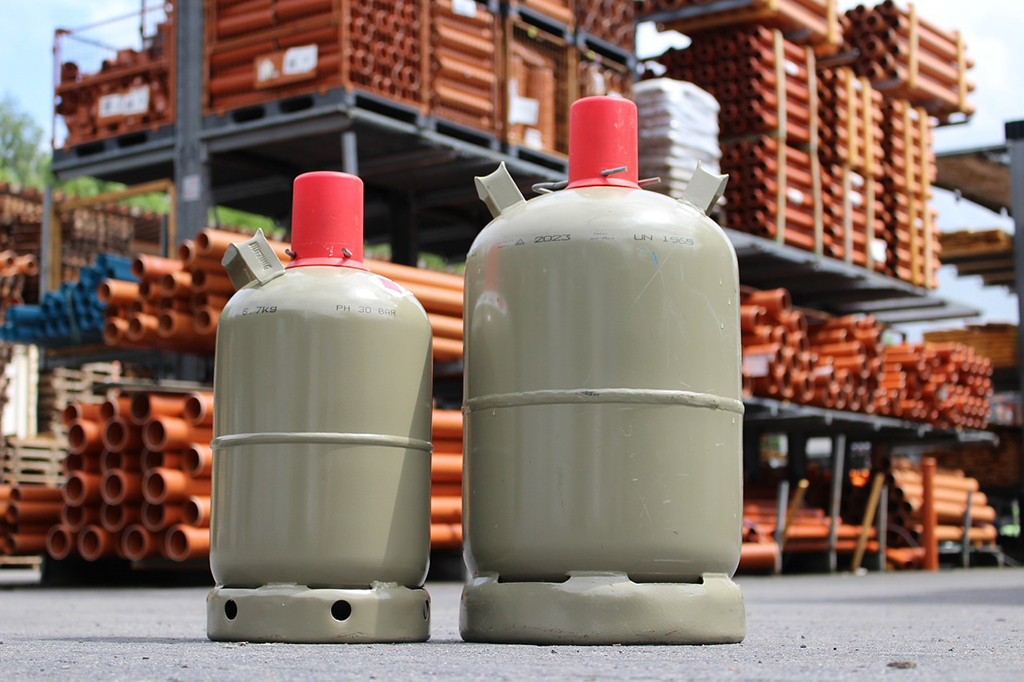
5 kg and 11 kg gas cylinders may be kept inside the building if the gas cooker is operated there – provided the applicable regulations for use and storage are observed.
Operation with Large Cylinders
For large cylinders with a filling weight of 33 kg, as well as for multiple-cylinder systems, stricter requirements apply than for small cylinders. Such cylinders must generally not be operated directly in the installation room of the gas cooker. Instead, they must be installed in a suitable location – for example outdoors, in a separate cylinder installation room or in a special gas cylinder cabinet. Even though, in theory and under certain conditions, large cylinders can be installed inside a building, this is rather impractical in practice. As a rule, 33 kg gas cylinders are positioned outside the building.
The following applies to storage: large cylinders must always be positioned upright and securely stable. They must be secured against tipping over and may not be placed in stairwells, passageways or escape routes. Installation is also prohibited in living rooms, bedrooms or basements. The ideal location is outside the building in a ventilated and protected area.
A specialist company carries out both the connection work and the regular inspection of the system. This ensures that pipelines, regulators and safety devices function reliably and that the legal requirements are fulfilled.
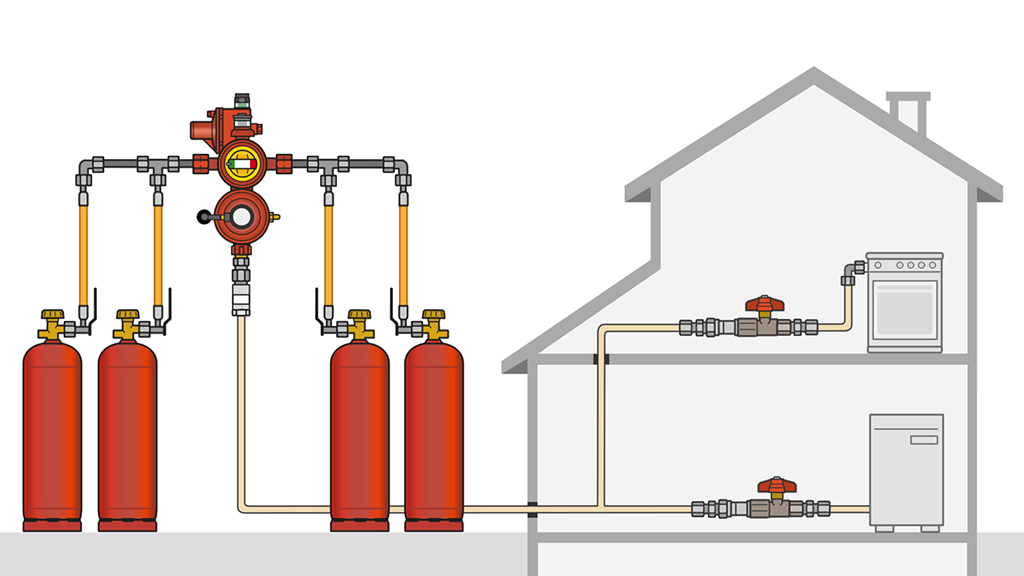
Example drawing of a multiple cylinder system with 33 kg gas cylinders.
Cooker Connection Sets for Propane Gas – An Overview of the Variants
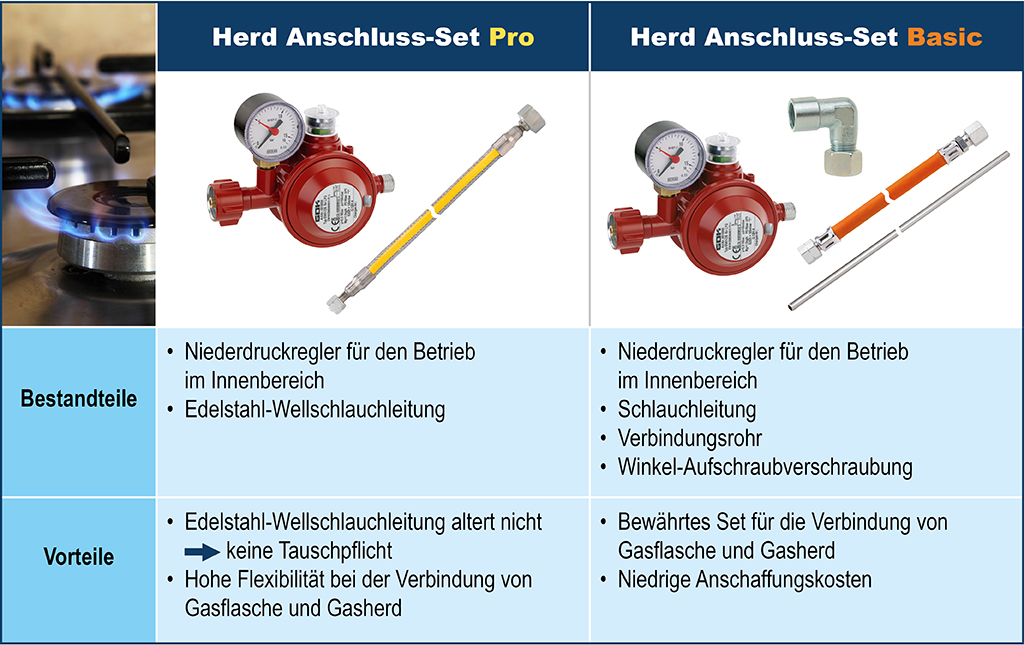
To operate a propane gas cooker safely and conveniently in practice, GOK provides special cooker connection sets. These sets consist of a pressure regulator and a stainless steel corrugated hose assembly (PRO) or a pipe section, a gas hose and an angle connector (BASIC). The sets are configured to meet the requirements of the applicable standards and to simplify installation.
BASIC Cooker Connection Set
The BASIC cooker connection set from GOK consists of a pressure regulator, a pipe section, a gas hose and an angle connector. It is suitable for users looking for a solid and straightforward solution for connecting their propane gas cooker. The pre-assembled components simplify installation, while the flexible hose provides sufficient mobility when changing cylinders. More information: BASIC cooker connection set.
PRO Cooker Connection Set
The PRO cooker connection set is intended for users who place particular value on durability and robustness. In addition to the appropriate pressure regulator, it includes a stainless steel corrugated hose assembly, which is significantly more resistant to mechanical stress and ageing than a conventional gas hose. A major advantage: unlike conventional hoses, operators do not need to replace the stainless steel corrugated hose assembly, as it is practically not subject to ageing.
Both sets are designed to comply with current standards and ensure the safe operation of the gas cooker in the home. Important here as well: the connection work should always be carried out by a specialist company that checks the leak-tightness and functionality.
Please click on the image for a larger view.
Safety & Storage of Propane Gas in the Home
In addition to professional installation, the correct storage of gas cylinders is crucial for safety. The following applies indoors: a maximum of one small cylinder (5, 8 or 11 kg) may be in operation, with one additional cylinder permitted as a reserve. Both cylinders must be positioned upright, securely stable and secured against tipping over. Reserve cylinders must not be stored in the same room as the connected cylinder and must never be stored in bedrooms or basements.
As a general rule, gas cylinders must be kept as far away as possible from naked flames and heat sources. Rooms in which cylinders are installed must be well ventilated, as propane is heavier than air and will collect at floor level in the event of a leak.
The following applies to large cylinders and cylinder banks: they must generally be installed outside the building. There, they must be secured against unauthorised access.
Regular leak-tightness and functional inspections carried out by a specialist company ensure that the system and cylinders always comply with the applicable regulations and that safe operation is maintained.
Conclusion – Safe and Compliant Cooking with Propane
A propane gas cooker can also be operated safely in the home – provided that the legal regulations and technical rules are observed. Key factors include selecting the correct pressure regulator with the prescribed safety devices, using suitable cooker connection sets and ensuring the professional storage of gas cylinders.
Small cylinders may be used indoors under certain conditions, whereas large cylinders generally belong outside. In all cases, the connection work should be carried out by a specialist company that checks the leak-tightness and commissions the system. This ensures that your propane gas cooker operates not only powerfully, but above all reliably and safely.
The articles are written by specialist authors in the fields of LPG, fuel oil, liquid media, tank management and safety engineering, who contribute their expertise from product management, development, technical customer support, training and standardisation activities.
The members of the editorial team have many years of practical experience in the planning, application and further development of technical solutions for the safe supply of LPG and liquid fuels. Several authors are actively involved in specialist committees and working groups of the DVGW, DVFG and figawa, as well as in national and European standardisation committees. The team includes, among others, experts certified in accordance with G 607 and G 608, competent persons in accordance with the TRF, and specialists who contribute to the development and evaluation of technical regulations and industry standards.
In addition to providing information about GOK products and solutions, the editorial team focuses on sharing knowledge relating to safety, regulations, maintenance, operation and future technologies in the field of LPG and liquid media.
Share this post
Related articles
Which LPG cylinders can I use inside buildings?
Home & Commercial
How does an over-pressure safety device S2SR work?
Safety
FAQ – Frequently Asked Questions About Propane Gas Cookers
Yes, operation is generally permitted if the Technical Rules for Liquefied Petroleum Gas (TRF) and other standards are observed. Important: the connection work must be carried out by a specialist company.
In Germany, the operating pressure is generally 50 mbar. The pressure regulator must be equipped with an S2SR overpressure safety device and, for indoor use, additionally with a thermal shut-off device (TAE).
No. A maximum of one cylinder in operation and one additional cylinder as a reserve is permitted – not in the same room and under no circumstances in bedrooms or basements.
Natural gas is supplied permanently to the house via the pipeline network. Propane, on the other hand, is supplied in cylinders or tanks. As a result, additional components such as pressure regulators and connection sets are required.
Yes. DIY installations are not permitted and are dangerous. Only a specialist company may carry out installation, leak-tightness testing and commissioning.
Yes, many gas cookers can be converted from natural gas to propane. This requires special conversion jets matched to the respective operating pressure.
No. Basements, underground car parks and similar rooms are strictly prohibited for the storage of propane cylinders, as the gas collects at floor level in the event of a leak and presents a significant explosion risk.
In principle, operation is possible provided the technical regulations are observed and the landlord agrees. It is important that the connection work is carried out by a specialist company and that the storage regulations for cylinders are complied with. Consultation with the landlord or property management should always take place in advance.
You might also find this interesting
How many kilowatt hours correspond to a kilogram of LPG (propane)?
Safety
How does a PRV pressure relief valve work?
Camping & Leisure, Home & Commercial, Safety
Which pressure regulator do I need for which output?
Camping & Leisure, Grill & BBQ, Home & Commercial
How do I know when I need to replace the components of my LPG system?
Camping & Leisure, Grill & BBQ, Home & Commercial
Where can I find operating manuals for GOK products?
Camping & Leisure, Grill & BBQ, Home & Commercial, Tank & Liquid Media
From what length of hose assembly do I need an excess flow device?
Camping & Leisure, Grill & BBQ, Home & Commercial
Which pressure regulator connections exist for LPG cylinders in Europe?
Camping & Leisure, Grill & BBQ, Home & Commercial
How can I release an OPSO (SAV)?
Home & Commercial
What is an OPSO (SAV) and how does it work?
Home & Commercial
Does the pressure regulator gauge show the filling level of the LPG cylinder?
Camping & Leisure, Grill & BBQ, Home & Commercial
Does the gas have to be discharged out of the line before releasing the OPSO (SAV)?
Home & Commercial
How do I carry out a simplified leak check on an LPG cylinder system?
Camping & Leisure, Grill & BBQ, Home & Commercial
This blog will never ask members of the public or unqualified persons to make changes to or fiddle around with technical systems themselves.
In accordance with the Industrial Safety Regulation (BetrSichV), a qualified person must take care of a system which requires monitoring.
A qualified person is someone who has the specific specialist knowledge required. This knowledge is gained by way of a professional apprenticeship, corresponding professional experience or current occupational activity.
Please note that the texts are based on information, regulations and standards for Germany. Please always check the rules and regulations in the relevant country of destination and consult specialists if necessary.