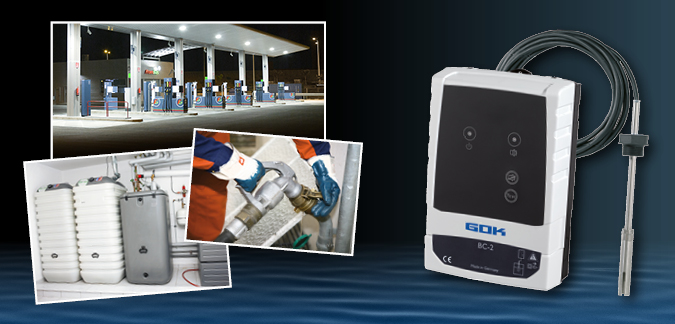
The BC-2 overfill prevention device is a safety device for monitoring tanks in which liquid operating media are stored. The device is the direct successor to the BC-1 overfill prevention device, and comes with some innovations and corresponding advantages.
Post Views:103
The BC-2 overfill prevention device is a safety device for monitoring tanks in which liquid operating media are stored. The device is the direct successor to the BC-1 overfill prevention device, and comes with some innovations and corresponding advantages.
The BC-2 overfill prevention device is basically an alarm device to prevent the overfilling of storage tanks, during the refuelling process, for example. This would generally have expensive consequences. The BC-2 is also used for waste oil tanks into which successively used oil is tipped.
Design and function
The device consists of a probe and a display unit. Both are connected with each other via a cable. If an AdBlue® tank is filled at a service station, for example, the driver of the tank truck does not know when he or she is required to stop the filling process. This is where the use of the BC-2 overfill prevention device makes sense.
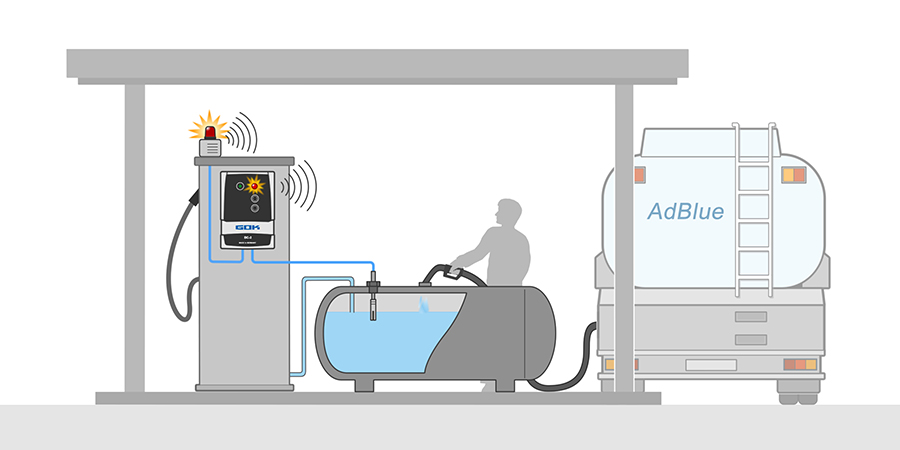
The associated probe is installed via a free opening on the tank. As soon as the integrated sensor comes into contact with the medium, the display unit emits an acoustic and visual alarm. The driver of the tank truck now knows that he or she is required to stop the filling process. We provide a description for an even more convenient solution with the BC-2 overfill prevention device for the driver of the tank truck here.
Filling by hand: the driver of the tank truck fills the AdBlue tank and stops as soon as the BC-2 overfill prevention device emits the acoustic and visual alarm.
Now to the question, though: what’s new on the BC-2 overfill prevention device in comparison with its predecessor model, the BC-1?
New: quicker alarm analysis
The device isn’t only able to display just one type of alarm, i.e. the contact of the sensor with the medium. There are two further scenarios in which the BC-2 emits an alarm:
If there is a short circuit in the cable between the display unit and the sensor.
If the cable between the display unit and the sensor is broken and/or not connected properly.
By looking at the LED, the operator can tell straight away which event has occurred and take action without having to spend a long time looking for the fault.
New: an (affordable) variant for everything
Different variants of the overfill prevention device were previously available for different purposes. The new BC-2 overfill prevention device combines all the variants into one version and one housing. The new housing has a better feel and is optimised for users.
Due to the fusion into one variant, operators no longer have to think about which version they require, and now pay considerably less if they want to install the device outdoors!
It is naturally the case that the BC-2 overfill prevention device is also suitable for installation indoors. However, operators can also install it in weather-protected areas outdoors, as the device also has certification according to protection type IP54. It is therefore protected against damaging quantities of dust and splash water on all sides.
Unlike the previous version, the BC-2 overfill prevention device is not based on one specific language. All the details on the housing are illustrated with symbols, such as the check and/or alarm acknowledgement function. Therefore, there are no hurdles for use in non-German-speaking countries.
Suitable for which media
The BC-2 overfill prevention device is suitable for certain liquids, such as:
Waste oil
Diesel fuel
FAME
Liquid fertiliser
Urea solution (AdBlue®)
Fuel oil
Fuel oil bio
Industrial oil
JGS
Oil-water mixture
Vegetable oil
If you are monitoring another medium in a tank and need a device that provides protection against overfilling, please contact us.
Special feature with tank trucks
Let’s assume – as above – that the driver of the tank truck fills the tank “manually” and has to wait until the alarm of the overfill prevention device sounds and the filling limit is reached. He or she is only able to stop the filling process then – and has to do so manually.
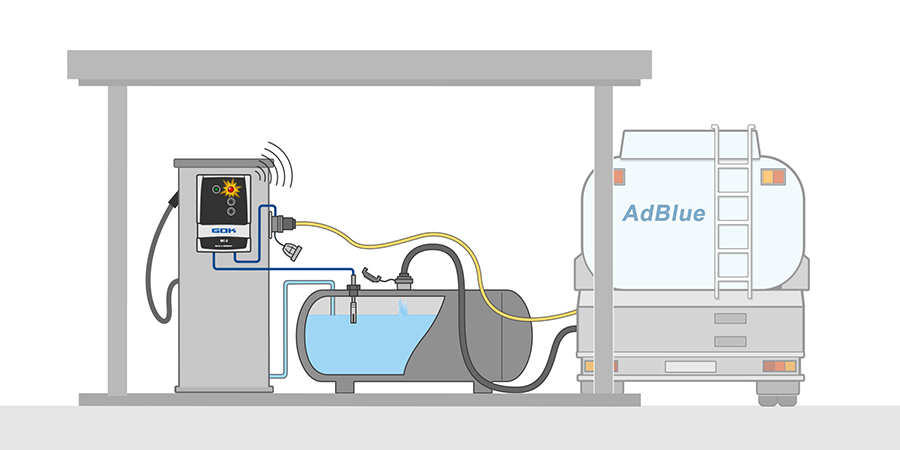
The solution of allowing the BC-2 overfill prevention device to communicate directly with the pump on the tank truck is somewhat more “charming”. GOK has developed an adapter that enables exactly this. The operator installs a plug in the vicinity of the tank. On the one hand, this is connected with the BC-2 overfill prevention device; on the other hand, the driver of the tank truck can establish a cable connection with the tank truck.
If the medium touches the sensor during the filling process, the pump on the tank truck switches off automatically and the driver is somewhat relieved of this requirement.
Filling with automated stop: the pump of the tank truck is connected to the BC-2 overfill prevention device via an adapter.
The articles are written by specialist authors in the fields of LPG, fuel oil, liquid media, tank management and safety engineering, who contribute their expertise from product management, development, technical customer support, training and standardisation activities.
The members of the editorial team have many years of practical experience in the planning, application and further development of technical solutions for the safe supply of LPG and liquid fuels. Several authors are actively involved in specialist committees and working groups of the DVGW, DVFG and figawa, as well as in national and European standardisation committees. The team includes, among others, experts certified in accordance with G 607 and G 608, competent persons in accordance with the TRF, and specialists who contribute to the development and evaluation of technical regulations and industry standards.
In addition to providing information about GOK products and solutions, the editorial team focuses on sharing knowledge relating to safety, regulations, maintenance, operation and future technologies in the field of LPG and liquid media.
Share this post
Related articles
How do I get checkable dry-run protection for AdBlue® systems?
Tank & Liquid Media
You might also find this interesting
How many kilowatt hours correspond to a kilogram of LPG (propane)?
Safety
How does a PRV pressure relief valve work?
Camping & Leisure, Home & Commercial, Safety
When do I need a diaphragm-controlled anti-siphon device?
Tank & Liquid Media
Where can I find operating manuals for GOK products?
Camping & Leisure, Grill & BBQ, Home & Commercial, Tank & Liquid Media
What is the heating value of media such as fuel oil, LPG and natural gas?
Home & Commercial, Tank & Liquid Media
Which GOK components do I need as a private individual for my gas barbecue?
Safety
Can the hose assembly for the stove connection set be longer than 40 centimetres when used privately indoors?
Safety
What components do I need to operate gas equipment in the caravan and motor caravan while driving?
Camping & Leisure, Camping & Leisure, Safety
Can I have a German LPG cylinder filled abroad?
Safety
Can I keep the LPG cylinder lying down when using it?
Safety
Can I use a gas-powered heater on my boat?
Safety
Can I also use the red GOK pressure regulators for indoors in the awning or outdoors?
Safety
This blog will never ask members of the public or unqualified persons to make changes to or fiddle around with technical systems themselves.
In accordance with the Industrial Safety Regulation (BetrSichV), a qualified person must take care of a system which requires monitoring.
A qualified person is someone who has the specific specialist knowledge required. This knowledge is gained by way of a professional apprenticeship, corresponding professional experience or current occupational activity.
Please note that the texts are based on information, regulations and standards for Germany. Please always check the rules and regulations in the relevant country of destination and consult specialists if necessary.