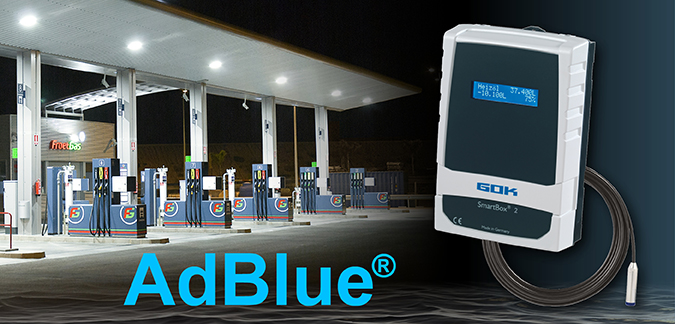
It is every filling station or tank system operator’s nightmare. The tank with AdBlue® is empty, the pump is drawing air and could be damaged and/or lead to false bills. Dry-run protection, also known as product shortage protection, prevents this kind of scenario. Such product shortage protection can be provided with the electronic level gauge SmartBox 2 from GOK, and checked using simple means. Since the beginning of 2022, this has been a prerequisite for calibrating such a tank system!
Views:117
It is every filling station or tank system operator’s nightmare. The tank with AdBlue® is empty, the pump is drawing air and could be damaged and/or lead to false bills. Dry-run protection, also known as product shortage protection, prevents this kind of scenario. Such product shortage protection can be provided with the electronic level gauge SmartBox 2 from GOK, and checked using simple means. Since the beginning of 2022, this has been a prerequisite for calibrating such a tank system!
Actually – and the emphasis in this sentence is on “Actually” – it is rarely the case that a tank with a liquid medium runs empty and the booster pump sucks air. Most operators have an eye on the filling level; either by incorporating electronic or mechanical level gauges (which, in the best case, they can still monitor remotely) or by imposing regular visual inspection intervals on themselves.
Nevertheless, something unexpected can happen at any time and the usual mechanisms do not work. For this reason, dry-run protection is required, in particular for commercially used filling stations and tank systems.
Dry-run protection with SmartBox 2
This kind of safety mechanism is also provided relatively easily, for example with the electronic level gauge SmartBox 2. This allows liquid media such as AdBlue®, fuel oil, diesel or water to be monitored in non-pressurised tanks.
The SmartBox 2 has two potential-free relay contacts where you can select the switch points. We describe the advantages that this offers in terms of dry-run protection/product shortage protection using an example.
Let’s assume that an operator of an AdBlue® system wants to protect their tank system’s booster pump from drawing air because the tank is empty. If the pump is now controlled using these potential-free relay contacts, it ensures that it no longer pumps when, for example, the tank content falls below 10 percent of the total volume. If the operator sets the second switch point to 15 percent, the pump will only resume operation as soon as the tank content exceeds that value – after or during refuelling.
Operators of AdBlue® tank systems or AdBlue® filling stations can use SmartBox 2 to provide checkable dry-run protection. The electronic level gauge stops the booster pump when the level falls below a defined filling level. The check is very simple. Image from Waid1995 on Pixabay
Special case calibration of AdBlue® system
It has been around since 2014, but it has only really come into focus since the beginning of 2022: the Measurement and Calibration Ordinance (MessEV). Since 2022, the calibration offices in Germany are only carrying out calibration of AdBlue® systems, if they have product shortage protection, i.e. dry-run protection, which can be checked using simple means during calibration. The reason for the change in 2022 is that the calibration offices now interpret the MessEV differently.
In concrete terms, this means that anyone who relies on calibration for an AdBlue® system, for example, will inevitably need the SmartBox 2, with which this easily checkable product shortage protection can be provided.
Are all AdBlue® systems affected?
No, not all systems are affected. Only systems subject to commercial use, such as filling stations, must have checkable dry-run protection as these are the systems that also require calibration.
AdBlue® tank systems used exclusively within the company, for example in forwarding companies, to supply the company’s own fleet with AdBlue®, are not affected by this obligation. Operators of non-commercial systems must decide for themselves whether product shortage protection (dry-run protection) is nevertheless sensible for their own system.
Filling stations with an AdBlue® tank system definitely need calibration and therefore also checkable dry-run protection, also called product shortage protection.
Checking dry-run protection
So far we have talked about “checkable dry-run protection” or “checkable product shortage protection”. But what actually is the check and who does the check? We have information from several German calibration offices, stating that a very simple function check is enough. In relation to a system with SmartBox 2, this means: simply pull the probe out of the liquid. This simulates that the tank is empty and the booster pump must subsequently stop operation.
On the one hand, this function is of course checked by the representative from the calibration office, who is ultimately also responsible for the calibration. On the other hand, we would recommend that the operators themselves have the product shortage protection checked by a specialist from time to time.
Approval required?
Although it is frequently necessary for technical devices to have a special approval, that is not the situation in this case. In the context of checkable product shortage protection (dry-run protection), there is no need for any specific approval, for example from the DIBt (German Institute of Building Technology).
The articles are written by specialist authors in the fields of LPG, fuel oil, liquid media, tank management and safety engineering, who contribute their expertise from product management, development, technical customer support, training and standardisation activities.
The members of the editorial team have many years of practical experience in the planning, application and further development of technical solutions for the safe supply of LPG and liquid fuels. Several authors are actively involved in specialist committees and working groups of the DVGW, DVFG and figawa, as well as in national and European standardisation committees. The team includes, among others, experts certified in accordance with G 607 and G 608, competent persons in accordance with the TRF, and specialists who contribute to the development and evaluation of technical regulations and industry standards.
In addition to providing information about GOK products and solutions, the editorial team focuses on sharing knowledge relating to safety, regulations, maintenance, operation and future technologies in the field of LPG and liquid media.
Share this post
Related articles
No results found.
You might also find this interesting
When do I need a diaphragm-controlled anti-siphon device?
Tank & Liquid Media
Where can I find operating manuals for GOK products?
Camping & Leisure, Grill & BBQ, Home & Commercial, Tank & Liquid Media
What is the heating value of media such as fuel oil, LPG and natural gas?
Home & Commercial, Tank & Liquid Media
How can I check the functionality of the limit indicator?
Tank & Liquid Media
How does a limit indicator work?
Tank & Liquid Media
What are the differences between protection types IP54 and IP65?
Tank & Liquid Media
What’s new with the BC-2 overfill prevention device from GOK?
Safety, Tank & Liquid Media
Is a filling level gauge available for water tanks, oil tanks and cisterns?
Tank & Liquid Media
How can the filling level of heating oil or rainwater be monitored digitally via an app?
Tank & Liquid Media
SmartBox AIR Wi-Fi: How to Install and Commission
Safety, Tank & Liquid Media
Heating system modernisation in 2026: The role of LPG and heating oil under the Building Modernisation Act
Tank & Liquid Media
This blog will never ask members of the public or unqualified persons to make changes to or fiddle around with technical systems themselves.
In accordance with the Industrial Safety Regulation (BetrSichV), a qualified person must take care of a system which requires monitoring.
A qualified person is someone who has the specific specialist knowledge required. This knowledge is gained by way of a professional apprenticeship, corresponding professional experience or current occupational activity.
Please note that the texts are based on information, regulations and standards for Germany. Please always check the rules and regulations in the relevant country of destination and consult specialists if necessary.