
You must never take gas from conventional liquid gas cylinders lying down. No matter whether it is a 5, 11 or 33 kilogram cylinder, it must always stand upright and be protected from tipping over.
Inhaltsverzeichnis
You must never take gas from conventional liquid gas cylinders lying down. No matter whether it is a 5, 11 or 33 kilogram cylinder, it must always stand upright and be protected from tipping over.
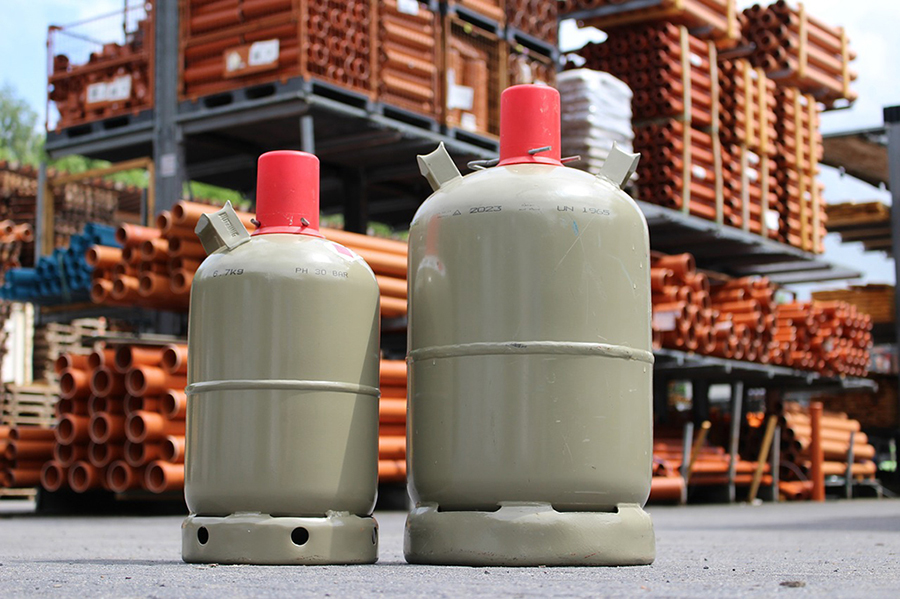
Thankfully you rarely or never see it, because it’s among the most severe mistakes that you can make when handling a propane-butane mixture: tipping the LPG cylinder over, placing it lying down or turning it upside down, and trying to operate an appliance in this position.
It doesn’t matter whether you have a 5, 11 or 33 kg cylinder – tanks filled with a propane-butane mixture have two phases: liquid and gaseous. Due to gravity, the liquid phase of the medium settles at the base of the cylinder, provided the tank is upright. The gas phase is found above the surface of the liquid phase, and this makes its way into the system via the withdrawal valve and pressure regulator.
The pressure regulator, hose assembly and other fittings are only approved for operation with the gas phase. Liquid phase in the pipe system can lead to uncontrollable situations (see 1).
If the gas cylinder were to be in a horizontal position during withdrawal, the evaporated liquid phase would not reach the pipe system. If this happens, two major problems may arise:

This is why the Technical Rules for LPG (TRF 2012) under point 6.2.1 “Setting up LPG cylinders – General information” require the following: “LPG cylinders must be set up vertically for withdrawal.[…]LPG cylinders must be set up on horizontal, even ground which is sufficiently stable.”
This blog will never ask members of the public or unqualified persons to make changes to or fiddle around with technical systems themselves.
In accordance with the Industrial Safety Regulation (BetrSichV), a qualified person must take care of a system which requires monitoring.
A qualified person is someone who has the specific specialist knowledge required. This knowledge is gained by way of a professional apprenticeship, corresponding professional experience or current occupational activity.
Please note that the texts are based on information, regulations and standards for Germany. Please always check the rules and regulations in the relevant country of destination and consult specialists if necessary.


