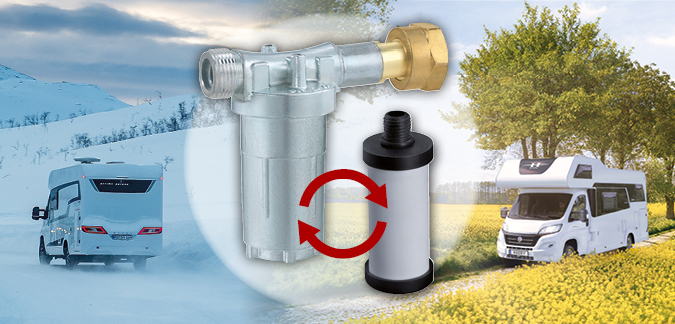
Gas filters are now almost standard in the LPG systems of motor caravans and caravans. For relatively little money, they offer a lot of protection against contamination in LPG for the sometimes very expensive end devices, such as gas heating, refrigerators or gas-powered barbecues. However: When is the gas filter or filter cartridge “full” and when should it be changed by the operator?
Views:174
Gas filters are now almost standard in the LPG systems of motor caravans and caravans. For relatively little money, they offer a lot of protection against contamination in LPG for the sometimes very expensive end devices, such as gas heating, refrigerators or gas-powered barbecues. However: When is the gas filter or filter cartridge “full” and when should it be changed by the operator?
First of all: There is no one ultimate instruction on when campers need to replace the gas filter, i.e. the filter cartridge. This is also completely logical, because there are simply too many parameters that have an effect on the filtering process.
How often is the LPG system used in the motor caravan or caravan? How many pieces of consumer equipment are connected? Which country does the LPG come from? All this (and much more) has a direct influence on the degree of contamination in the gas filter. For this reason, it cannot be said in general: Please replace the filter cartridge after exactly x months or x years! As is so often the case, the question about the ideal time to change it can only be answered with: It depends!
Own responsibility for gas filter
You yourself are well aware of your consumption pattern with regard to LPG. When was the gas filter installed and when was the last time I replaced the cartridge, or when was it so clogged with residue that it was necessary to replace it?
We recommend that you set your own regular inspection intervals. What sounds daunting and overambitious is actually pretty uncomplicated and done in no time at all. From time to time, unscrew the filter cup from the Caramatic ConnectClean gas filter and take a look at how much dirt there is in the filter cartridge.
Gas filter inspection intervals? Tip!
A tip at this point, which is bound to sound logical to you: The more LPG you consume, the shorter the inspection intervals should be. As an example: You are not winter campers, so the motor caravan or caravan remains untouched in the winter season. Of course you don’t then have to check the gas filter every two weeks – to put it bluntly.
Opposite example: You are keen winter campers and regularly run the gas heating, a gas hob and refrigerator. In this case, it makes sense to check the gas filter at shorter intervals.
Now to the all-important question: What are sensible intervals? This too cannot be answered with a one-size-fits-all sweeping statement. As the manufacturer, we definitely do not want to shirk our responsibility by not having to give you any useful recommendations. But with the above examples, you can see for yourself that the use of the LPG system is so different that we could not issue a sensible interval for everything.
The Caramatic ConnectClean gas filters are part of the LPG system in motor caravans or caravans and are installed directly on pressure regulation systems such as Caramatic DriveOne or DriveTwo.
Annual maintenance and replacement, but…
Nevertheless, we want to make a recommendation. If you are using a brand new gas filter and do not have any experience with it yet, make the inspection intervals a bit shorter. When you are parking your recreational vehicle after a three-week round trip with high gas consumption, take a quick look at the gas filter. This allows you to get a better feel for the system and gain experience. After some time and a few excursions, you will always be able to estimate when the filter is due to be replaced.
In any case, GOK always recommends servicing the gas filter at least once a year – this is also specified in the assembly and operating manual. This maintenance primarily includes a visual inspection of the filter cartridge and filter cup. In the Caramatic ConnectClean gas filter assembly and operating manual, we recommend replacing the filter cartridge during annual maintenance.
But here too, we don’t want to and cannot generalise. For example, if you were unable to see any dirt in the gas filter or filter cup during the last visual inspection and if you have not or have hardly used the vehicle, then of course you also don’t need to replace the filter cartridge (as a preventive measure).
When should the filter cartridge definitely be changed?
It is important to change the cartridge when it is clogged and can no longer absorb the oily residue and dirt. The oil and dirt particles then collect in the filter cup. If this is the case, replace the cartridge immediately.
Replacing the filter cartridge – cleaning the filter cup
Apart from the question of when you should replace the gas filter or cartridge, it is of course interesting to know how to open the gas filter correctly, replace the cartridge, clean the filter cup and close it again. A tip before we start: Use gloves!
Proceed as follows:
Disconnect the gas supply and empty the line by letting the consumer equipment run
Loosen the filter cup with a screw aid and unscrew it by hand
Wipe out any residue in the filter cup using an absorbent cloth
Unscrew the filter cartridge by hand
Clean the O-ring
Dispose of the filter cartridge, cloth and possibly gloves Caution:Special waste!
Screw the new filter cartridge in by hand
Screw the filter cup on by hand and tighten it using a screw aid
If necessary, tighten the inlet and outlet connector
Open the gas cylinder valve and check the system for leak-tightness
This is only an extract from the assembly and operating manual. Please have this manual to hand when you install the filter unit or before you open it and read it through carefully.
Cleaning the filter cartridge?
The question of whether you can also clean the gas filter cartridge is of course legitimate and obvious. Generally, cleaning is possible. We have sometimes seen posts to this effect in relevant forums on the Internet. Whether it is advisable, however, is the much more important question.
GOK advises that you do not clean the filter cartridge in the gas filter. In some cases very aggressive cleaning agents would be necessary to remove oil and dirt from the cartridge. However, these kinds of agents not only remove residue, but can also have a negative effect on the filter properties or even completely disintegrate parts of the cartridge.
Summary
Let’s start with the facts: If dirt and/or oily residues have accumulated in the filter cup, this is a sure sign that the filter cartridge needs to be replaced. GOK generally recommends replacing the filter cartridge after one year at the latest, although of course on the one hand the cartridge may get clogged more frequently, and on the other hand, the filter cartridge may still be clean due to the LPG system not being used much.
Therefore, it cannot be generalised when the cartridge really needs to be replaced. From the manufacturer’s point of view, cleaning the filter cartridge is not an option, as the negative aspects outweigh the benefits.
Important information on gas filters
This text, including all recommendations and tips, explicitly refers only to the Caramatic ConnectClean gas filter from GOK and not to gas filters from other manufacturers or gas filters in general.
The articles are written by specialist authors in the fields of LPG, fuel oil, liquid media, tank management and safety engineering, who contribute their expertise from product management, development, technical customer support, training and standardisation activities.
The members of the editorial team have many years of practical experience in the planning, application and further development of technical solutions for the safe supply of LPG and liquid fuels. Several authors are actively involved in specialist committees and working groups of the DVGW, DVFG and figawa, as well as in national and European standardisation committees. The team includes, among others, experts certified in accordance with G 607 and G 608, competent persons in accordance with the TRF, and specialists who contribute to the development and evaluation of technical regulations and industry standards.
In addition to providing information about GOK products and solutions, the editorial team focuses on sharing knowledge relating to safety, regulations, maintenance, operation and future technologies in the field of LPG and liquid media.
Share this post
Related articles
No results found.
You might also find this interesting
How can I use several LPG cylinders in the caravan, motor caravan or on the boat at the same time?
Camping & Leisure
How does a PRV pressure relief valve work?
Camping & Leisure, Home & Commercial, Safety
Which pressure regulator do I need for which output?
Camping & Leisure, Grill & BBQ, Home & Commercial
Are there any differences in the gas test of mobile homes or caravans and motor caravans?
Camping & Leisure
How do I know when I need to replace the components of my LPG system?
Camping & Leisure, Grill & BBQ, Home & Commercial
Where can I find operating manuals for GOK products?
Camping & Leisure, Grill & BBQ, Home & Commercial, Tank & Liquid Media
From what length of hose assembly do I need an excess flow device?
Camping & Leisure, Grill & BBQ, Home & Commercial
Which pressure regulator connections exist for LPG cylinders in Europe?
Camping & Leisure, Grill & BBQ, Home & Commercial
Does the pressure regulator gauge show the filling level of the LPG cylinder?
Camping & Leisure, Grill & BBQ, Home & Commercial
How do I carry out a simplified leak check on an LPG cylinder system?
Camping & Leisure, Grill & BBQ, Home & Commercial
How do I identify the year of manufacture of a pressure regulator from GOK?
Camping & Leisure, Grill & BBQ, Home & Commercial
How do I find out whether the nominal pressure on the pressure regulator and gas equipment match?
Camping & Leisure, Grill & BBQ, Home & Commercial
This blog will never ask members of the public or unqualified persons to make changes to or fiddle around with technical systems themselves.
In accordance with the Industrial Safety Regulation (BetrSichV), a qualified person must take care of a system which requires monitoring.
A qualified person is someone who has the specific specialist knowledge required. This knowledge is gained by way of a professional apprenticeship, corresponding professional experience or current occupational activity.
Please note that the texts are based on information, regulations and standards for Germany. Please always check the rules and regulations in the relevant country of destination and consult specialists if necessary.