Simultaneous operation of gas grill, gas hob and refrigerator? Does it need three LPG cylinders and three pressure regulators? GOK offers two solutions for privately and outdoor (typically camping) operated LPG installations. For this purpose, there is a pressure regulator with several connections and a special branch valve.
Views:121
A balmy summer evening on holiday. You’ve invited your campsite neighbours over for dinner. You need a gas barbecue and gas hob to pacify the growling stomachs; the gas-powered fridge is perfect for keeping the cold drinks accessible for everyone. All things considered, that makes three gas appliances in use. Does this mean that you now also need three gas cylinders and three pressure reducers to go along with them, or are there some with several connections?
You can do it this way, of course, but it’s incredibly complicated and not very practical. It’s also quite a steep cost for the pressure regulators, hose assemblies and, if you’re using them, excess flow devices. We can present you with two solutions which are only permitted for private LPG systems which are used outdoors.
First of all: In this article, when we discuss connections or outlets without more precise specifications, we are always referring to the outlet connectors of the pressure reducer. It should be clear that the fitting only has one inlet connector.
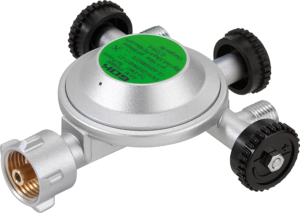
Popular among campers: the pressure regulator with up to three connections. The user can operate each of the black handwheels to control the gas flow for individual pieces of gas equipment. For example, they can continue to operate the fridge even if the gas barbecue and gas hob have already been switched off.
Let’s assume that you have a pressure regulator with three outlets, but you currently only require two of them. In this case, it isn’t enough for you to close the shut-off device of the connection you’re not using. The regulations state that you must seal the connection tightly using a suitable blind nut.
This pressure regulator with several outlets is available in versions for 29 and 50 millibars (mbar). However, only the pressure regulators with an outlet pressure of 50 mbar are permitted for use in Germany. When buying your gas equipment, you should therefore be very careful in ensuring that it has the nominal pressure prescribed for Germany.
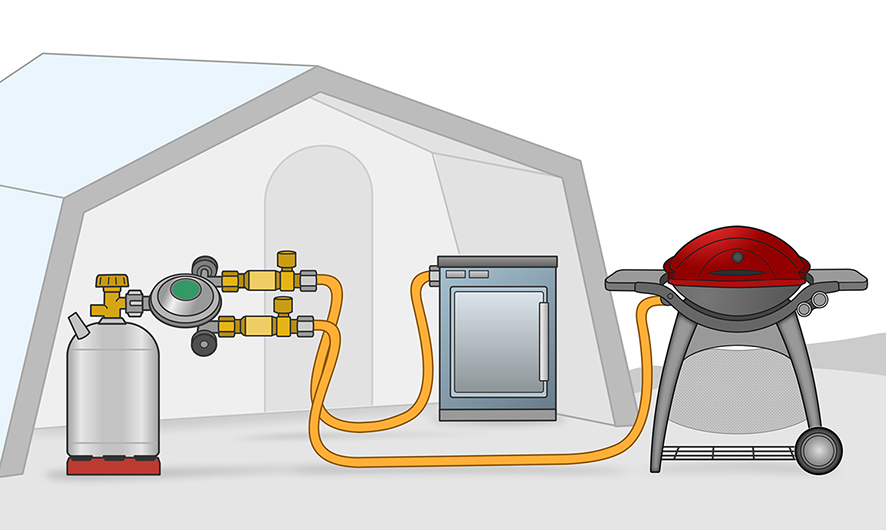
Exemplary system layout with a pressure regulator with two connectors for use when camping.
Branch stop valve after the pressure regulator
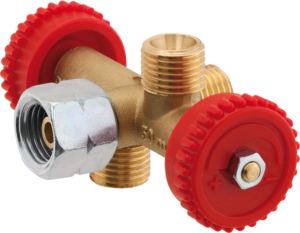
A branch stop valve provides a further option for operating several pieces of gas equipment at the same time via one gas cylinder and one pressure regulator. You can choose versions with two or three connectors, and these are attached directly after the pressure regulator. Just like the pressure regulator with several outlets, the branch stop valve has shut-off devices which you can use to block or allow the gas supply to individual devices.
Close-up of a branch stop valve which is attached directly behind the pressure regulator/pressure reducer in the LPG system. The user can choose between two or three outlets; here, we can see a branch stop valve with three connectors for the hose assemblies, for instance.
Safety as an advantage
Another common feature: Connections which are not used must be sealed tightly with a blind nut.
While safety devices such as the S2SR are not prescribed in the technical regulations for the purpose described above, a so-called excess flow device is prescribed, under certain conditions. If the operator uses a gas hose which is over 150 centimetres in length, the excess flow device is mandatory.
This then also applies to the two solutions described – a pressure regulator with several connections and a branch stop valve after the pressure regulator – and for every individual hose assembly connected. But it can make sense to use an excess flow device even if the gas hoses are not longer than 150 centimetres, because: Who can claim that they can always keep an eye on the hose? Especially when there are three hose assemblies working in parallel?
Output of 1 kg/h according to type plate = 12.9 kW
Output of 1.5 kg/h according to type plate = 19.3 kW
For the operator, this means: Collect the kW values of the connected gas equipment (these can be found on the respective type plates) and add them together. If these exceed the maximum output of the pressure regulator, you will end up losing some output when you want to operate all gas equipment at full power at the same time. In these cases, the camper should think about the optimal way to manage the energy. However, you should always remember to ask yourself “How much can I withdraw from one gas cylinder?”
The articles are written by specialist authors in the fields of LPG, fuel oil, liquid media, tank management and safety engineering, who contribute their expertise from product management, development, technical customer support, training and standardisation activities.
The members of the editorial team have many years of practical experience in the planning, application and further development of technical solutions for the safe supply of LPG and liquid fuels. Several authors are actively involved in specialist committees and working groups of the DVGW, DVFG and figawa, as well as in national and European standardisation committees. The team includes, among others, experts certified in accordance with G 607 and G 608, competent persons in accordance with the TRF, and specialists who contribute to the development and evaluation of technical regulations and industry standards.
In addition to providing information about GOK products and solutions, the editorial team focuses on sharing knowledge relating to safety, regulations, maintenance, operation and future technologies in the field of LPG and liquid media.
Share this post
Related articles
No results found.
You might also find this interesting
How can I use several LPG cylinders in the caravan, motor caravan or on the boat at the same time?
Camping & Leisure
How does a PRV pressure relief valve work?
Camping & Leisure, Home & Commercial, Safety
Which pressure regulator do I need for which output?
Camping & Leisure, Grill & BBQ, Home & Commercial
Are there any differences in the gas test of mobile homes or caravans and motor caravans?
Camping & Leisure
How do I know when I need to replace the components of my LPG system?
Camping & Leisure, Grill & BBQ, Home & Commercial
Where can I find operating manuals for GOK products?
Camping & Leisure, Grill & BBQ, Home & Commercial, Tank & Liquid Media
From what length of hose assembly do I need an excess flow device?
Camping & Leisure, Grill & BBQ, Home & Commercial
Which pressure regulator connections exist for LPG cylinders in Europe?
Camping & Leisure, Grill & BBQ, Home & Commercial
Does the pressure regulator gauge show the filling level of the LPG cylinder?
Camping & Leisure, Grill & BBQ, Home & Commercial
How do I carry out a simplified leak check on an LPG cylinder system?
Camping & Leisure, Grill & BBQ, Home & Commercial
How do commercial operation and private operation of a gas barbecue differ?
Grill & BBQ
How do I identify the year of manufacture of a pressure regulator from GOK?
Camping & Leisure, Grill & BBQ, Home & Commercial
This blog will never ask members of the public or unqualified persons to make changes to or fiddle around with technical systems themselves.
In accordance with the Industrial Safety Regulation (BetrSichV), a qualified person must take care of a system which requires monitoring.
A qualified person is someone who has the specific specialist knowledge required. This knowledge is gained by way of a professional apprenticeship, corresponding professional experience or current occupational activity.
Please note that the texts are based on information, regulations and standards for Germany. Please always check the rules and regulations in the relevant country of destination and consult specialists if necessary.