You are barbecuing and the LPG cylinder is standing in the blazing sun. Some people feel a little queasy in the stomach. Is it possible that the gas cylinder will explode and blow up in your face?
Inhaltsverzeichnis
You are barbecuing and the LPG cylinder is standing in the blazing sun. Some people feel a little queasy in the stomach. Is it possible that the gas cylinder will explode and blow up in your face?
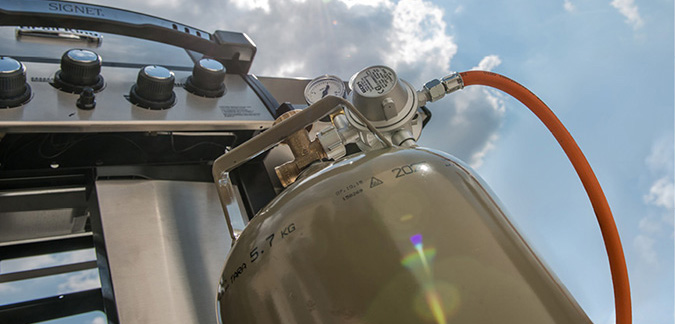
Can a gas cylinder be left in the sun? A simple question – but one with significant implications, especially in summer. As temperatures rise and the sun beats down on balconies, patios or campsites, many users of LPG start to wonder: Is this dangerous? Can the gas cylinder explode?
What happens in extreme heat? And how can I store or transport my gas cylinder safely – for example, in a car? In this article, we explain how heat affects gas cylinders, when there is a real risk – and why the safety valve plays a crucial role. We also provide practical tips on summer storage, correct handling in everyday life and clarify common misconceptions. This way, you stay safe even on hot days.
When outdoor temperatures exceed 30 degrees and the sun shines relentlessly on balconies, gardens or campsites, many users of LPG ask the same pressing question: Can I leave my gas cylinder in direct sunlight? Or is that dangerous – maybe even explosive?
Whether used with a gas barbecue, a camping stove or a pizza oven – gas cylinders are a common sight in summer. At the same time, numerous half-truths circulate about their correct handling in the heat. Some say a cylinder must always be kept in the shade. Others claim that small cylinders could explode in the sun.
So, what is actually true? And how much heat can a cylinder safely withstand? In the following sections, we explain what happens physically, how gas cylinders are constructed, and why the integrated safety valve is such an important protective feature – to keep you safe even in the heat.
When LPG inside a gas cylinder heats up, the pressure inside increases. This is due to the physical properties of liquefied gas: as the temperature rises, more of the liquid turns into gas – thus increasing the internal pressure.
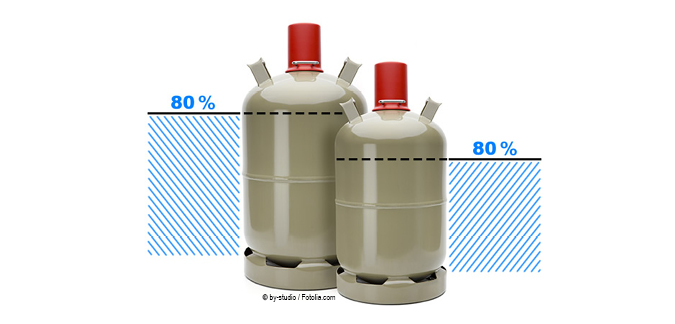
Even if this is the case here, there is absolutely no danger to life and limb. LPG cylinders are never filled to 100%. Almost 20 percent of the cylinder is not filled with the liquid phase of the medium. There has to be room above the liquid phase for a gaseous buffer to form. This ensures that the cylinder won’t immediately reach its capacity limits when the temperature increases.
Gas supply companies recommend storing gas cylinders and cartridges in cool, dry places. However, according to our research, there is no specific guideline regarding the ideal ambient temperature for storing gas cylinders. As a general rule: avoid extreme temperatures. In everyday household use, such extremes are rarely encountered – especially if storage recommendations are followed.
But: even if a cylinder is exposed to direct sunlight for a few hours in summer, this is usually not dangerous. The construction of the cylinder and its safety valve are designed for precisely such situations.
Important to know: The cylinder itself is not the issue – improper handling is. Anyone who follows the basic rules has nothing to fear, even on the hottest days.

The most important safety mechanism for LPG cylinders is the gas cylinder itself! Standardised and designed, manufactured and tested to the highest quality standards, LPG cylinders are extremely safe – particularly when exposed to heat.
The so-called safety valve is installed only for the highly unlikely worst-case scenario. This is part of the gas cylinder valve and opens automatically if the internal pressure exceeds a specific threshold – for example, due to intense heating.
In the event of a very significant pressure increase, the valve purposefully releases a small, non-critical amount of gas to reduce the pressure. This process is referred to as blow-off. The gas escapes to the outside – usually audibly. The key point is: this is not a malfunction but an intentional safety mechanism.
Once the pressure has been reduced through blow-off, the valve closes again automatically. The cylinder can then continue to be used as normal.
Conclusion at this point: The gas cylinder itself is very safely constructed, and the safety valve is an additional and reliable safety mechanism.
In principle, gas cylinders can be stored both indoors and outdoors – even with occasional direct sunlight. Their construction, materials and safety valve are all designed for such conditions.
Nonetheless, some important rules and recommendations apply:
More guidance can be found here:
Also ensure the gas cylinder is not exposed to direct heat from other sources (e.g. patio heaters or open flames).
For mobile uses – such as camping – ensure the cylinder is not left in the sun for extended periods, especially when unattended. A portable sunshade can help, but is not strictly required.
Transporting gas cylinders in summer – especially by car – carries specific risks. Even though the cylinder is technically built to withstand high temperatures, the inside of a car can heat up to over 60 °C in direct sun. This significantly raises the pressure inside the cylinder.
Basic rules for safe transport in the heat:
In addition: If travelling with gas cylinders in a camper, they must be secured with proper tie-down straps in the cylinder compartment. Campers may carry up to two gas cylinders – one for use, one as a reserve.

Many myths circulate regarding gas cylinders and heat. Here we set the record straight on the most common ones:
“Gas cylinders must never be left in the sun!”
Not true. A gas cylinder may be placed in the sun outdoors – as long as it is upright, well-ventilated and used correctly. Shade is advisable, but not mandatory.
“Gas cylinders explode in the heat!”
Gas cylinders are extremely robust and feature safety valves. Under normal conditions, explosions are virtually impossible. It would take major external damage or a technical fault.
“If the safety valve releases gas, the cylinder is defective.”
Incorrect. Venting is a normal safety procedure and does not mean the cylinder is unusable. If unsure, a professional inspection is a good idea.
“It is always illegal to transport cylinders in a car.”
Not true. Transport is allowed – but only if all safety regulations are followed.
“A nearly empty cylinder can be left in the sun, but not a full one.”
Wrong. The fill level is not the issue – correct handling and following safety rules are what matter.
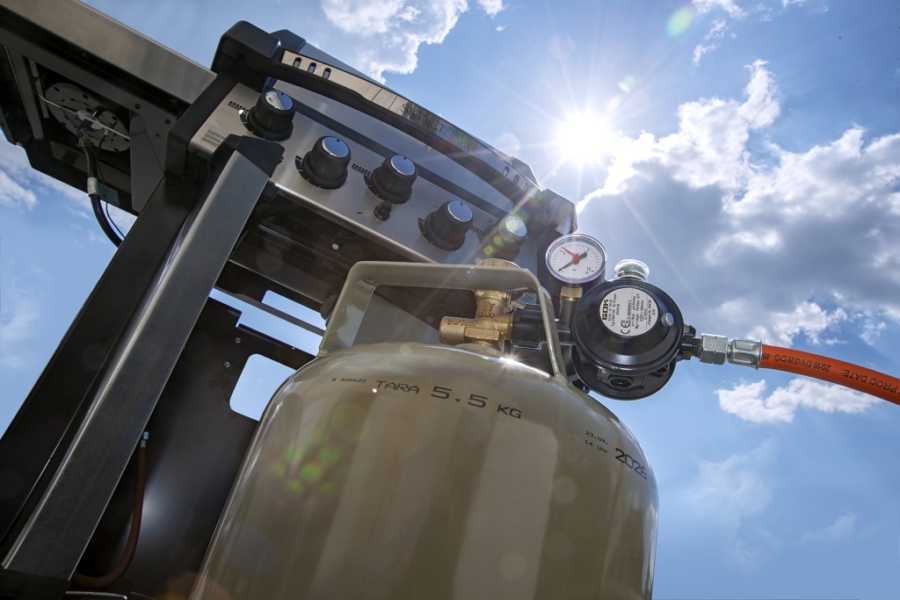
Gas cylinders may be used and stored outdoors even in summer – including in direct sunlight. Proper handling is key: store upright, ensure good ventilation, avoid enclosed spaces and understand the role of the safety valve. The technology is designed to handle heat – uncertainty usually stems from misinformation or myths.
By following these basic principles, liquefied gas can be used safely even at high temperatures – whether barbecuing, camping or in everyday life.
This blog will never ask members of the public or unqualified persons to make changes to or fiddle around with technical systems themselves.
In accordance with the Industrial Safety Regulation (BetrSichV), a qualified person must take care of a system which requires monitoring.
A qualified person is someone who has the specific specialist knowledge required. This knowledge is gained by way of a professional apprenticeship, corresponding professional experience or current occupational activity.
Please note that the texts are based on information, regulations and standards for Germany. Please always check the rules and regulations in the relevant country of destination and consult specialists if necessary.