How am I able to take the gas cylinder(s) home safely from the LPG retailer or DIY shop? As the sale of LPG in cylinders – i.e. propane gas, butane gas or their mixtures – has been booming for some time, increasing numbers of people are asking this question. In this article, we provide the answers, together with tips, tricks and a product recommendation.
Post Views:401
How am I able to take the gas cylinder(s) home safely from the LPG retailer or DIY shop? As the sale of LPG in cylinders – i.e. propane gas, butane gas or their mixtures – has been booming for some time, increasing numbers of people are asking this question. In this article, we provide the answers, together with tips, tricks and a product recommendation.
Appliances that use LPG are becoming increasingly popular with private individuals. Whether it is gas-fired barbecues, patio heaters, gas cookers or LPG systems in a motor caravan or caravan – the consumer equipment invariably requires one or more than one gas cylinder. This takes us to the first and most important question:
Am I allowed to transport gas cylinders by car?
Generally speaking, transporting LPG cylinders in private vehicles isn’t prohibited. However, there are a few things to consider if the private transport by car is to take place in a safe and proper way. The keywords are: marking, securing of the load, transported quantity!
You are required to make sure that the gas cylinder has this white sticker before you are allowed to transport it.
How am I able to transport the gas cylinder safely?
Before you actually load the gas cylinder(s) in your car, make sure that the tanks have the compulsory white sticker for their marking. They are required by law!
There are a few options, such as securing the gas cylinder with lashing straps or straps, or fixing it in place between the row of back seats and the front seats. This works and is practical, but it also has some disadvantages. If the gas cylinder isn’t completely clean, for example, the dirt will transfer to the car seats.
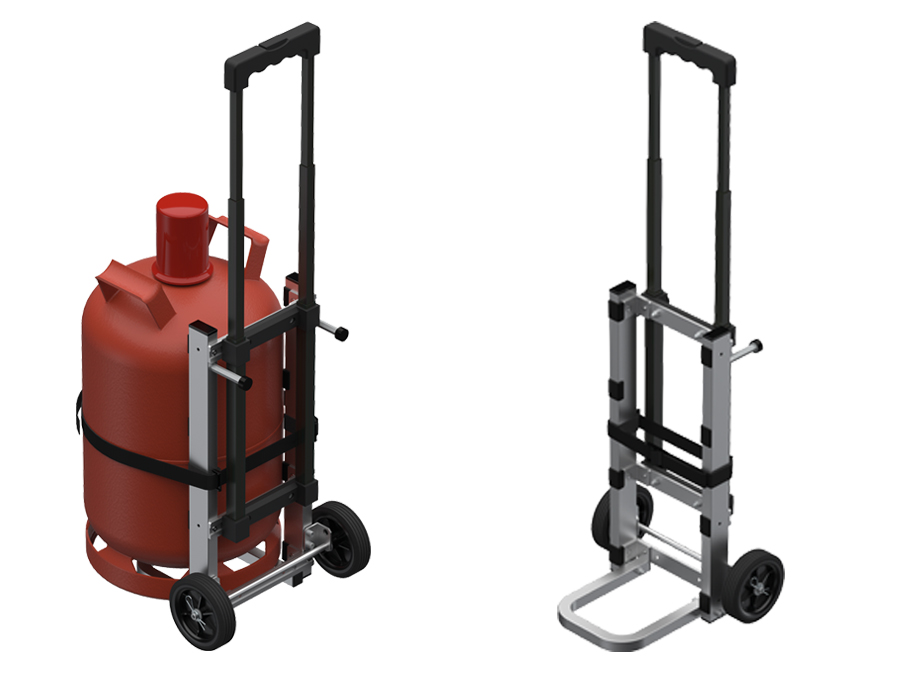
The TROLLEY version is particularly convenient. It allows the user to transport the gas cylinder conveniently after their car journey in a similar way to a suitcase, for example. In contrast to the standard BASE version, the TROLLEY version has an infinitely-adjustable pull-out handle as well as castors, and also functions as a transport trolley.
The TROLLEY transport lock for gas cylinders has two great advantages: safe transport in the car thanks to its stable frame and convenient handling thanks to its two transport castors. The laborious carrying of the heavy and unwieldy gas cylinders is no longer necessary.
Incidentally, special transport crates for gas cylinders are also available, although these are used less often for transporting LPG and are mainly used for transporting medical gases.
This article includes further important information on what private individuals have to pay attention to before and during the loading as well as during the transport and after the journey.
Should gas cylinders be transported in the lying or standing position?
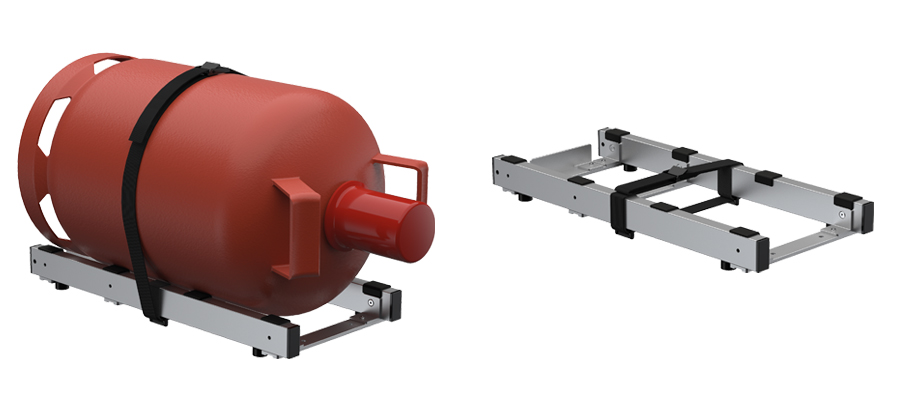
The gas cylinders can be transported by car in either the lying or standing position. If you use the TROLLEY or BASE transport lock, the gas cylinders will usually be transported in the lying position. Whether it is in the standing or lying position, it is important for the gas cylinder to be adequately secured so that, in the worst-case scenario, isn’t able to roll around in the car or the boot.
If you transport the gas cylinder in the lying position, it should ideally be positioned at a right angle to the direction of travel.
With the BASE transport lock, gas cylinders can be transported especially conveniently and safely in the lying position, such as in the boot.
How many gas cylinders am I allowed to transport?
Transporting the “standard household” quantities of one or two gas cylinders doesn’t pose any problems. Private individuals, however, are not allowed to carry a net mass of more than 333 kilograms, although in most cases, it is unlikely that they would ever transport such a weight.
How long can I leave the gas cylinder in the car?
Whether empty or full, the gas cylinder should not be left in the car for longer than absolutely necessary. That means: load the cylinder in your car after you buy it and take it home immediately. Plan things out so that you don’t have to do lots of shopping, pick up your laundry from the dry cleaners or go to an appointment after buying your gas cylinder.
Always make sure that your car’s ventilation system is switched on and that one or preferably more than one of the windows are open. And now that our summer weather is hotter, taking note of protecting LPG cylinders against excessive temperatures has also become more important. In principle, gas cylinders are able to withstand relatively warm temperatures, but it is still important to prevent the occurrence of easily avoidable situations.
Am I allowed to transport gas cylinders in a trailer?
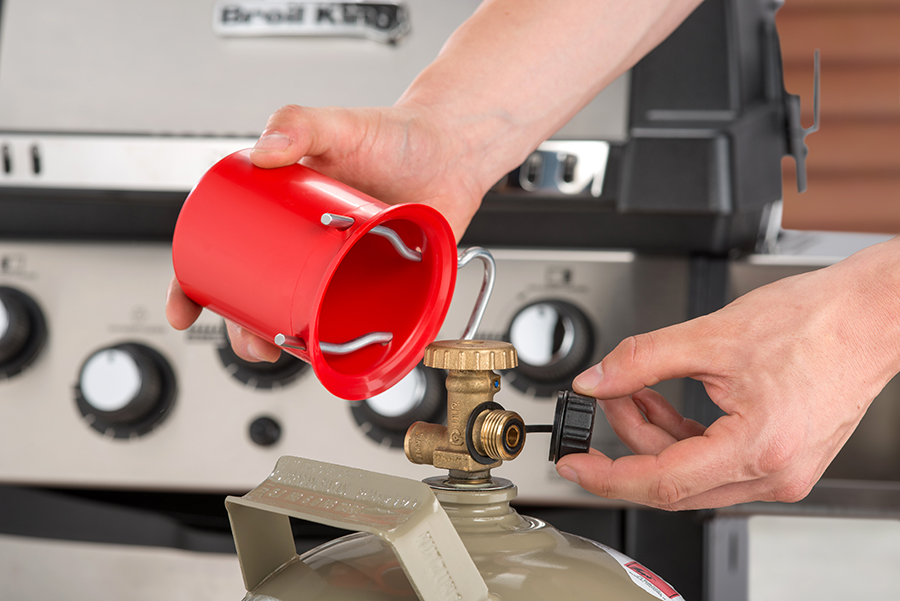
Yes, of course. The rules on this form of transport are similar to those for the transport inside a car. Therefore, check the markings on the gas cylinder, check the valves, and secure the valve protection cap and the load effectively. Because there is inherently a sufficient amount of ventilation in a trailer, you can save yourself the trouble of having to open the windows and turn the ventilation up to maximum…
What is the penalty for transporting gas cylinders incorrectly?
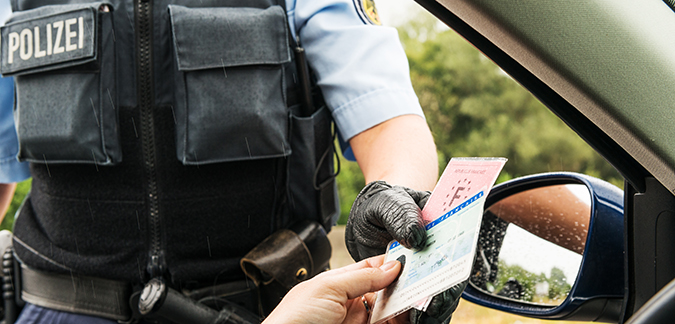
In Germany, the failure to comply with the regulations on the transport of gas cylinders is an administrative offence. It is likely to be similar in other countries. If you fail to transport a gas cylinder properly, regardless of whether it is empty or full, you are liable for a fine of between 25 and 200 euros and will receive a penalty point – depending on the severity of the offence.
The articles are written by specialist authors in the fields of LPG, fuel oil, liquid media, tank management and safety engineering, who contribute their expertise from product management, development, technical customer support, training and standardisation activities.
The members of the editorial team have many years of practical experience in the planning, application and further development of technical solutions for the safe supply of LPG and liquid fuels. Several authors are actively involved in specialist committees and working groups of the DVGW, DVFG and figawa, as well as in national and European standardisation committees. The team includes, among others, experts certified in accordance with G 607 and G 608, competent persons in accordance with the TRF, and specialists who contribute to the development and evaluation of technical regulations and industry standards.
In addition to providing information about GOK products and solutions, the editorial team focuses on sharing knowledge relating to safety, regulations, maintenance, operation and future technologies in the field of LPG and liquid media.
Share this post
Related articles
What should I be aware of when transporting LPG cylinders in my own vehicle?
Camping & Leisure, Grill & BBQ, Home & Commercial, Safety
Gas Cylinders in the Heat: What Is Allowed, What Is Dangerous?
Camping & Leisure, Grill & BBQ, Home & Commercial, Safety
You might also find this interesting
How many kilowatt hours correspond to a kilogram of LPG (propane)?
Safety
How does a PRV pressure relief valve work?
Camping & Leisure, Home & Commercial, Safety
Which GOK components do I need as a private individual for my gas barbecue?
Safety
Can the hose assembly for the stove connection set be longer than 40 centimetres when used privately indoors?
Safety
What components do I need to operate gas equipment in the caravan and motor caravan while driving?
Camping & Leisure, Camping & Leisure, Safety
Can I have a German LPG cylinder filled abroad?
Safety
Can I keep the LPG cylinder lying down when using it?
Safety
Can I use a gas-powered heater on my boat?
Safety
Can I also use the red GOK pressure regulators for indoors in the awning or outdoors?
Safety
What do I need a thermal cut-out device “T” (TAE) for?
Home & Commercial, Safety
How does an over-pressure safety device S2SR work?
Safety
Which connections and adapters can you find in an LPG system?
Safety
This blog will never ask members of the public or unqualified persons to make changes to or fiddle around with technical systems themselves.
In accordance with the Industrial Safety Regulation (BetrSichV), a qualified person must take care of a system which requires monitoring.
A qualified person is someone who has the specific specialist knowledge required. This knowledge is gained by way of a professional apprenticeship, corresponding professional experience or current occupational activity.
Please note that the texts are based on information, regulations and standards for Germany. Please always check the rules and regulations in the relevant country of destination and consult specialists if necessary.