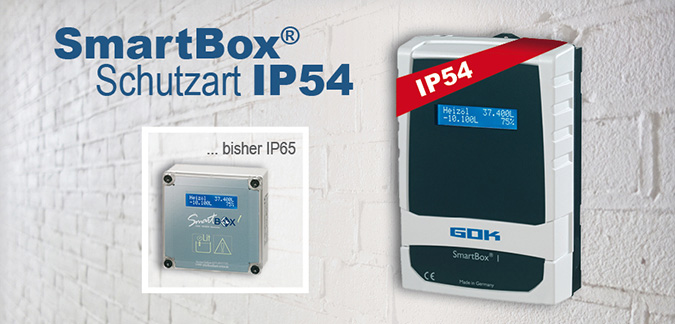
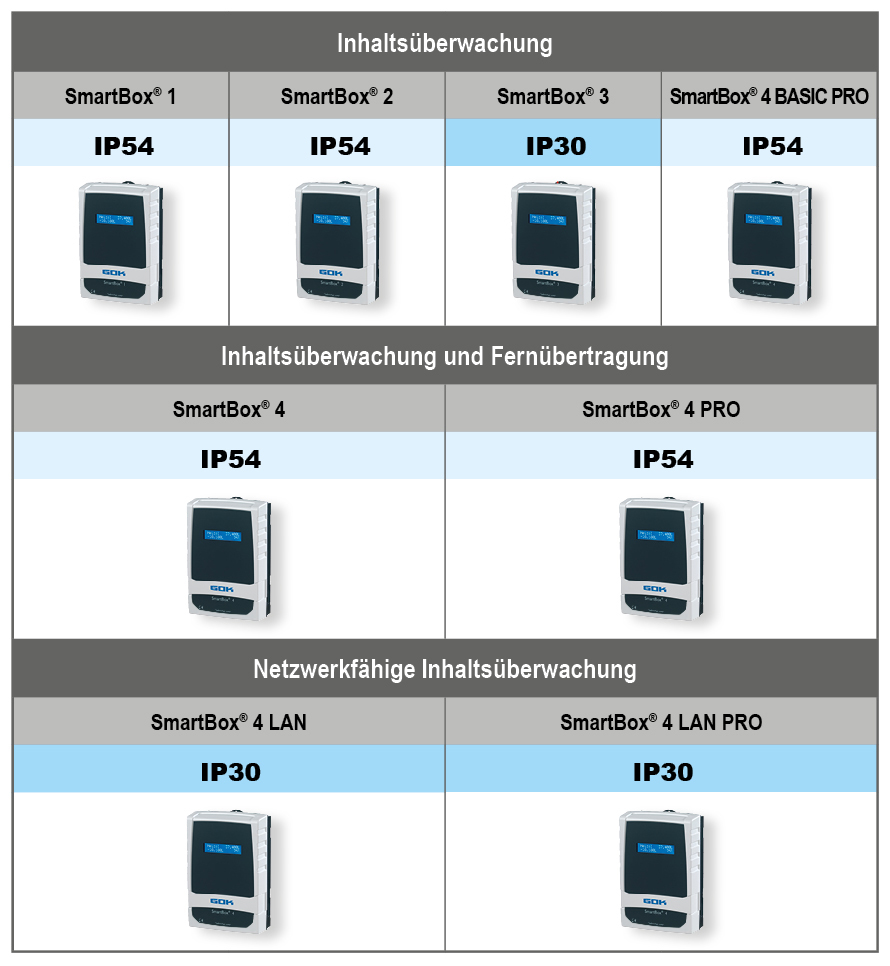
On 1 January 2018, GOK changed the housings for the level gauges of the SmartBox® series. This also resulted in a change in the protection type for the majority of the devices. The devices which were previously protection type IP65 are now covered by IP54. What are the differences? Does the installation or use change in any way? And what does “protection type” even mean? This article provides the answers to all these questions.
Post Views:111
On 1 January 2018, GOK changed the housings for the level gauges of the SmartBox® series. This also resulted in a change in the protection type for the majority of the devices. The devices which were previously protection type IP65 are now covered by IP54. What are the differences? Does the installation or use change in any way? And what does “protection type” even mean? We’ll tell you in this article.
The SmartBox® series consists of various versions for monitoring liquid media in tanks, for example: fuel oil, diesel, water, urea solutions (such as AdBlue®). For over a decade, GOK supplied this level gauge in two housing versions: Either with protection type IP30 or IP65.
In simplified terms, users were able to install the version with protection type IP30 only in buildings; versions with IP65 could also be installed outdoors.
Meaning of protection type
First of all, we have the question: What is a protection type? This indicates the suitability of electrical and electronic devices for different environmental conditions. Among other things, it describes the protection against the potential penetration of solids and liquids into the housing.
Which standard applies and how is the code made up?
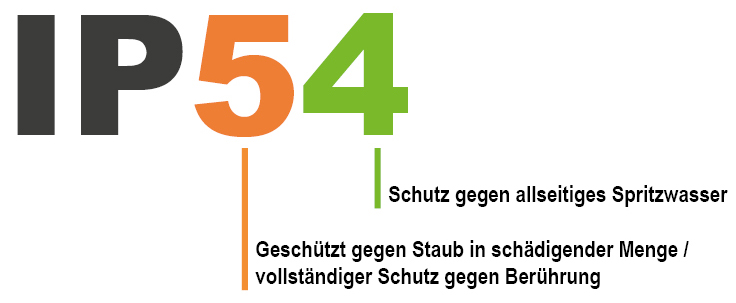
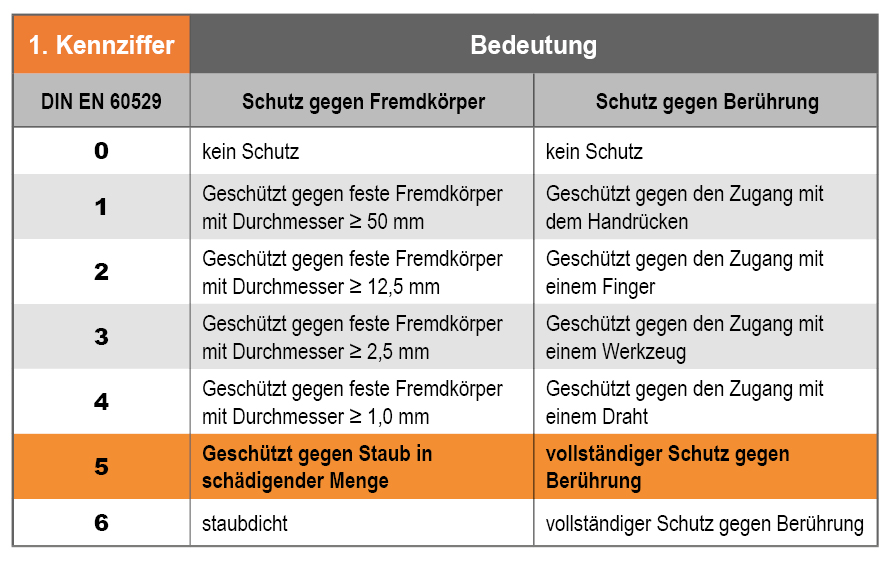
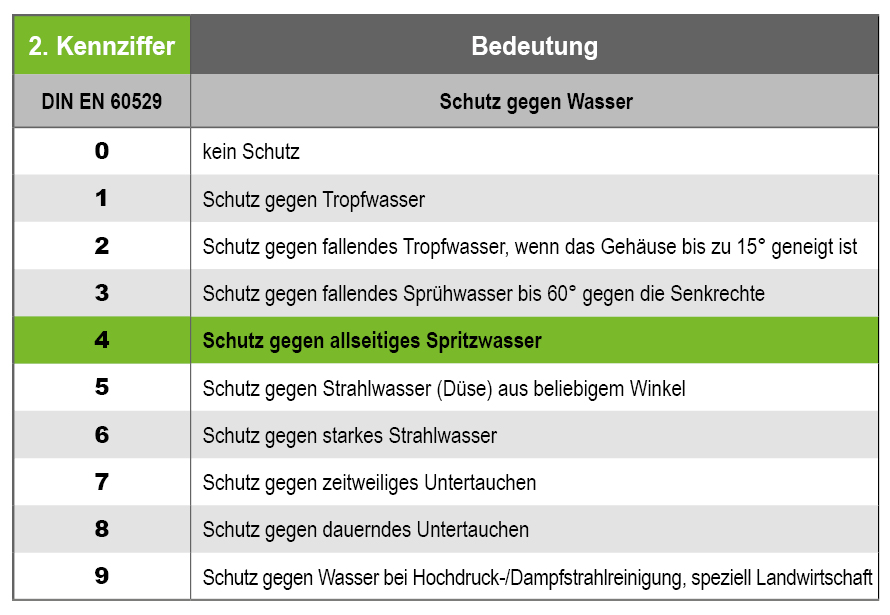
The standard DIN EN 60529 applies to our devices. In principle, the first and second digits are defined there according to the conventional “IP” (short for international protection).
The first digit determines the degree of protection against foreign bodies; the second is against water.
IP30 vs. IP54 vs. IP65
In the GOK product range, there are or were generally three protection types. The SmartBox® 3, SmartBox® 4 LAN and SmartBox® 4 LAN PRO are the last remaining versions with protection type IP30. Due to structural circumstances, according to the current status, only this IP code comes into question.
The IP65 protection type has been completely removed from the range and replaced by IP54. The direct comparison in the following table shows that the differences between these two IP codes are not too great.
Where can I use what?
With IP30, the situation is quite clear: Devices with this protection type may only be installed in dry and protected rooms, for example in industrial halls or in the cellar next to the tank system.
If you install a device indicating IP54, of course, you may do it at least where IP30 devices are also installed. You can also install the SmartBox® 1 or 2 in weather-protected outdoor areas, for example. This means: It is possible to install it under an outdoor canopy.
What changes are there in terms of installation and use?
In principle, nothing changes in the use of the SmartBox®; the functions are the same. The installation is also similar, but no longer exactly the same. You can find all details on installation and start-up in the assembly and operating manual.
The articles are written by specialist authors in the fields of LPG, fuel oil, liquid media, tank management and safety engineering, who contribute their expertise from product management, development, technical customer support, training and standardisation activities.
The members of the editorial team have many years of practical experience in the planning, application and further development of technical solutions for the safe supply of LPG and liquid fuels. Several authors are actively involved in specialist committees and working groups of the DVGW, DVFG and figawa, as well as in national and European standardisation committees. The team includes, among others, experts certified in accordance with G 607 and G 608, competent persons in accordance with the TRF, and specialists who contribute to the development and evaluation of technical regulations and industry standards.
In addition to providing information about GOK products and solutions, the editorial team focuses on sharing knowledge relating to safety, regulations, maintenance, operation and future technologies in the field of LPG and liquid media.
Share this post
Related articles
No results found.
You might also find this interesting
When do I need a diaphragm-controlled anti-siphon device?
Tank & Liquid Media
Where can I find operating manuals for GOK products?
Camping & Leisure, Grill & BBQ, Home & Commercial, Tank & Liquid Media
What is the heating value of media such as fuel oil, LPG and natural gas?
Home & Commercial, Tank & Liquid Media
How can I check the functionality of the limit indicator?
Tank & Liquid Media
How does a limit indicator work?
Tank & Liquid Media
How do I get checkable dry-run protection for AdBlue® systems?
Tank & Liquid Media
What’s new with the BC-2 overfill prevention device from GOK?
Safety, Tank & Liquid Media
Is a filling level gauge available for water tanks, oil tanks and cisterns?
Tank & Liquid Media
How can the filling level of heating oil or rainwater be monitored digitally via an app?
Tank & Liquid Media
SmartBox AIR Wi-Fi: How to Install and Commission
Safety, Tank & Liquid Media
Heating system modernisation in 2026: The role of LPG and heating oil under the Building Modernisation Act
Tank & Liquid Media
This blog will never ask members of the public or unqualified persons to make changes to or fiddle around with technical systems themselves.
In accordance with the Industrial Safety Regulation (BetrSichV), a qualified person must take care of a system which requires monitoring.
A qualified person is someone who has the specific specialist knowledge required. This knowledge is gained by way of a professional apprenticeship, corresponding professional experience or current occupational activity.
Please note that the texts are based on information, regulations and standards for Germany. Please always check the rules and regulations in the relevant country of destination and consult specialists if necessary.