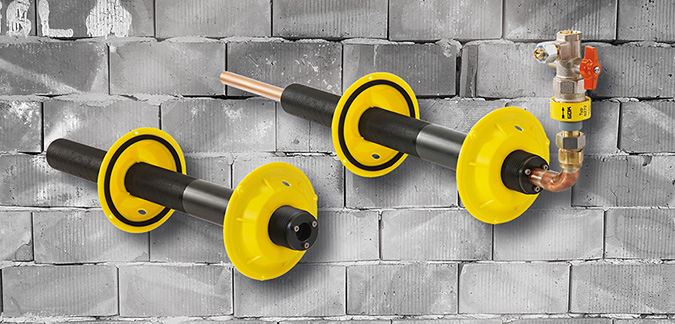
The LPG tank is outdoors, the gas equipment is indoors. The piping must pass through a wall in order to connect the tank to the equipment. If everything is to be installed above ground, there is a rather simple, safe and convenient solution: the wall duct (with integrated main shut-off device). This means that you can expect not to have to undertake any risky work yourself.
Views:114
The initial situation: The LPG tank is outside the building, the gas equipment is inside. The problem: In order to connect both with each other, we have to go through the house wall in one place. The solution: a wall duct for the piping – if necessary even with integrated main shut-off device.
The Technical Rules for LPG (TRF) say, under point 7.2.12 “House lead-ins”:
“For house lead-ins above the soil, piping can be guided through the outside wall of the building with a protective pipe.”
The TRF specifies this in more detail under point 7.3.3 and also shows an example of a “manufactured house lead-in”.
No undesired fiddling around at the wall duct
Theoretically, you could also create a core bore and lead a protective pipe through the wall. The disadvantage here: Depending on the professional skills, the whole thing can quickly turn into fiddling around – and this should be avoided in any case when it comes to handling LPG.
With the wall duct marketed by GOK for LPG piping, you will meet the requirements from the Technical Rules for LPG (TRF).
The same work step inside and outside
Then, slide the pre-assembled plastic protective pipe through this bore and tighten the flange against the inside of the wall. Then, perform the same work step for the outside: Attach the flange to the house wall and fix it in place.
At each of the flanges, you will find a filling opening, which becomes important in the next step. Now you have to seal the space between them, for example with silicone or another suitable filler. This is how you insert the protective pipe firmly into the masonry.
Completion of the work
Now push the pipe seal at the outside onto the copper pipe and tighten it. Once this is done, you can attach the shrinking hose to the copper pipe. The last two steps: connect the gas supply line and “shrink” the shrinking hose.
If LPG leaks out of the system in an uncontrolled manner, which we hope will not happen, the operator or craftsperson must be able to close the line quickly and easily. This is possible with a main shut-off device, which is already combined with the wall duct in a certain design with copper pipe and, incidentally, this is also required by the TRF. This saves the fitter one work step.
The wall duct with integrated main shut-off device can save the fitter an additional work step.
Note
Please observe our note that the work on the system described above may only be carried out by a qualified person.
The articles are written by specialist authors in the fields of LPG, fuel oil, liquid media, tank management and safety engineering, who contribute their expertise from product management, development, technical customer support, training and standardisation activities.
The members of the editorial team have many years of practical experience in the planning, application and further development of technical solutions for the safe supply of LPG and liquid fuels. Several authors are actively involved in specialist committees and working groups of the DVGW, DVFG and figawa, as well as in national and European standardisation committees. The team includes, among others, experts certified in accordance with G 607 and G 608, competent persons in accordance with the TRF, and specialists who contribute to the development and evaluation of technical regulations and industry standards.
In addition to providing information about GOK products and solutions, the editorial team focuses on sharing knowledge relating to safety, regulations, maintenance, operation and future technologies in the field of LPG and liquid media.
Share this post
Related articles
How can I operate a system despite an empty LPG tank?
Home & Commercial
How many kilograms of LPG per hour can I draw from an LPG tank?
Home & Commercial
You might also find this interesting
How does a PRV pressure relief valve work?
Camping & Leisure, Home & Commercial, Safety
Which pressure regulator do I need for which output?
Camping & Leisure, Grill & BBQ, Home & Commercial
How do I know when I need to replace the components of my LPG system?
Camping & Leisure, Grill & BBQ, Home & Commercial
Where can I find operating manuals for GOK products?
Camping & Leisure, Grill & BBQ, Home & Commercial, Tank & Liquid Media
From what length of hose assembly do I need an excess flow device?
Camping & Leisure, Grill & BBQ, Home & Commercial
Which pressure regulator connections exist for LPG cylinders in Europe?
Camping & Leisure, Grill & BBQ, Home & Commercial
How can I release an OPSO (SAV)?
Home & Commercial
What is an OPSO (SAV) and how does it work?
Home & Commercial
Does the pressure regulator gauge show the filling level of the LPG cylinder?
Camping & Leisure, Grill & BBQ, Home & Commercial
Does the gas have to be discharged out of the line before releasing the OPSO (SAV)?
Home & Commercial
How do I carry out a simplified leak check on an LPG cylinder system?
Camping & Leisure, Grill & BBQ, Home & Commercial
What is the heating value of media such as fuel oil, LPG and natural gas?
Home & Commercial, Tank & Liquid Media
This blog will never ask members of the public or unqualified persons to make changes to or fiddle around with technical systems themselves.
In accordance with the Industrial Safety Regulation (BetrSichV), a qualified person must take care of a system which requires monitoring.
A qualified person is someone who has the specific specialist knowledge required. This knowledge is gained by way of a professional apprenticeship, corresponding professional experience or current occupational activity.
Please note that the texts are based on information, regulations and standards for Germany. Please always check the rules and regulations in the relevant country of destination and consult specialists if necessary.