When refueling motorhomes or caravans, the question often arises as to whether gas appliances must be turned off during this process. This question is not only relevant for personal safety but also in terms of legal regulations. In this article, we clarify which rules apply to the operation of gas appliances during the refueling process at the gas station and what needs to be considered.
Views:114
When refueling motorhomes or caravans, the question often arises as to whether gas appliances must be turned off during this process. This question is not only relevant for personal safety but also in terms of legal regulations. In this article, we clarify which rules apply to the operation of gas appliances during the refueling process at the gas station and what needs to be considered.
Legal Regulations and Safety Aspects
The EN 1949 standard specifies the requirements for the installation of LPG systems in habitable leisure vehicles. According to this standard, all gas appliances must be turned off before the refueling process. In other words, campers must shut off the gas appliances at the designated valves. This is for safety reasons, as open flames or sparks in combination with escaping fuel vapors could lead to dangerous situations.
Additionally, the German Road Traffic Licensing Regulations (StVZO) stipulate that all devices that could affect the operational safety of the vehicle must be turned off during the refueling process. This includes gas appliances. According to § 60 StVZO, LPG systems must be designed and installed in such a way that they comply with recognized technical rules and can be operated safely. Furthermore, they must not impair the operational safety of the vehicle.
Although § 60 does not explicitly state that gas appliances must be turned off during refueling, it is advisable to do so for safety reasons to avoid potential hazards from open flames or spark formation.
LPG Cylinders in the Vehicle
When using LPG cylinders in motorhomes and caravans, it is important to ensure that they are installed in designated and ventilated cylinder compartments. The EN 1949 provides precise specifications to ensure safety. During the refueling of the vehicle, all gas appliances supplied by these cylinders should be turned off. Additionally, it must be ensured that no gas cylinders are exchanged or refilled during the refueling process.
Some vehicles are equipped with permanently installed LPG tanks. The safety regulations of DIN EN 1949 also apply here. It is advisable to turn off all gas appliances during the refueling of the vehicle to avoid potential hazards from open flames or spark formation.
Those with a built-in LPG tank or tank gas cylinder in their camper must also observe certain regulations—both when refueling the vehicle and when filling the gas tank or tank gas cylinder.
When refilling the LPG tank itself, special care must be taken, and the specific safety guidelines of the manufacturer as well as the applicable standards must be observed. Important: The EN 1949 specifies that the service valve (withdrawal valve) must be closed during the refueling of the gas tank. This applies equally to LPG tanks and the so-called tank gas cylinder.
Applicability to Systems with Crash Sensors
The aforementioned requirement to close gas appliances during fuel refueling applies without exception to all types of LPG systems in leisure vehicles. It is particularly relevant for campers with a crash sensor installed in the system.
Only thanks to the crash sensor are operators of LPG systems in motorhomes or caravans allowed to use them while driving. However, even systems with a crash sensor must be closed when the camper is refueling the leisure vehicle at the petrol station. All other conventional systems without a crash sensor must be closed during travel.
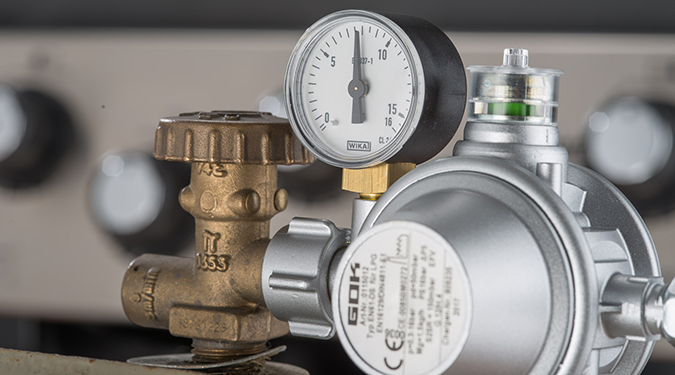
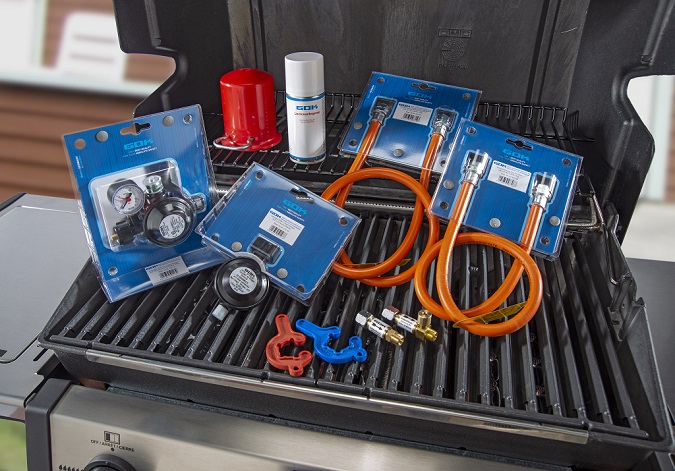
Operators of LPG systems with crash sensors, take note: Only with this type of system—including a crash sensor—are gas appliances allowed to be supplied with LPG while on the move. Therefore, systems with crash sensors (the picture shows a choice of different models) must be closed during fuel refueling! All other systems must be closed anyway.
Scope: Europe
The EN 1949 is a European standard developed by the CEN (European Committee for Standardization). Therefore, this standard is binding for all member countries of the CEN and replaces existing national standards of the member countries. The CEN includes the participating nations of the EU as well as some non-EU countries like Serbia and Turkey.
The DIN EN 1949 thus applies to all countries that are members of the CEN. This includes the member states of the European Union as well as some other European countries that have joined the CEN. This means that the mentioned safety regulations—such as closing gas appliances during fuel refueling—are binding for all member countries of the European Union.
Conclusion
The EN 1949 clearly states that gas appliances such as refrigerators or gas heaters must be closed during the refueling process such as gasoline or diesel—as specified in Section 4.1. For safety reasons and to avoid risks from flammable vapors, it is essential to close the shut-off valves during the refueling process. This significantly contributes to the safety of handling LPG systems in motorhomes and caravans and minimizes potential hazards. The regulations apply to the member countries of the European Union as well as countries of the CEN (European Committee for Standardization).
The articles are written by specialist authors in the fields of LPG, fuel oil, liquid media, tank management and safety engineering, who contribute their expertise from product management, development, technical customer support, training and standardisation activities.
The members of the editorial team have many years of practical experience in the planning, application and further development of technical solutions for the safe supply of LPG and liquid fuels. Several authors are actively involved in specialist committees and working groups of the DVGW, DVFG and figawa, as well as in national and European standardisation committees. The team includes, among others, experts certified in accordance with G 607 and G 608, competent persons in accordance with the TRF, and specialists who contribute to the development and evaluation of technical regulations and industry standards.
In addition to providing information about GOK products and solutions, the editorial team focuses on sharing knowledge relating to safety, regulations, maintenance, operation and future technologies in the field of LPG and liquid media.
Share this post
Related articles
How does the GOK crash sensor with pendulum work and what are the advantages?
Camping & Leisure, Safety
FAQ – Gas appliances in the motorhome while refuelling
Yes, according to DIN EN 1949, all gas appliances in a motorhome must be switched off and shut off at the respective shut-off valves during refuelling with fuel.
Yes, even gas supply systems with a crash sensor must be shut off during refuelling with fuel. They may only remain in operation while driving.
Refuelling releases flammable vapours that could ignite through open flames or sparks. Shutting off gas appliances significantly reduces this risk.
Yes, both permanently installed LPG tanks and so-called refillable gas cylinders must have their outlet valves closed during refuelling.
No, gas cylinders must not be changed or refilled while the vehicle is being refuelled with fuel.
The provisions of DIN EN 1949 apply in all countries that are members of the European Committee for Standardization (CEN) – including all EU member states and some other European countries.
You might also find this interesting
How many kilowatt hours correspond to a kilogram of LPG (propane)?
Safety
How can I use several LPG cylinders in the caravan, motor caravan or on the boat at the same time?
Camping & Leisure
How does a PRV pressure relief valve work?
Camping & Leisure, Home & Commercial, Safety
Which pressure regulator do I need for which output?
Camping & Leisure, Grill & BBQ, Home & Commercial
Are there any differences in the gas test of mobile homes or caravans and motor caravans?
Camping & Leisure
How do I know when I need to replace the components of my LPG system?
Camping & Leisure, Grill & BBQ, Home & Commercial
Where can I find operating manuals for GOK products?
Camping & Leisure, Grill & BBQ, Home & Commercial, Tank & Liquid Media
From what length of hose assembly do I need an excess flow device?
Camping & Leisure, Grill & BBQ, Home & Commercial
Which pressure regulator connections exist for LPG cylinders in Europe?
Camping & Leisure, Grill & BBQ, Home & Commercial
Does the pressure regulator gauge show the filling level of the LPG cylinder?
Camping & Leisure, Grill & BBQ, Home & Commercial
How do I carry out a simplified leak check on an LPG cylinder system?
Camping & Leisure, Grill & BBQ, Home & Commercial
Which GOK components do I need as a private individual for my gas barbecue?
Safety
This blog will never ask members of the public or unqualified persons to make changes to or fiddle around with technical systems themselves.
In accordance with the Industrial Safety Regulation (BetrSichV), a qualified person must take care of a system which requires monitoring.
A qualified person is someone who has the specific specialist knowledge required. This knowledge is gained by way of a professional apprenticeship, corresponding professional experience or current occupational activity.
Please note that the texts are based on information, regulations and standards for Germany. Please always check the rules and regulations in the relevant country of destination and consult specialists if necessary.