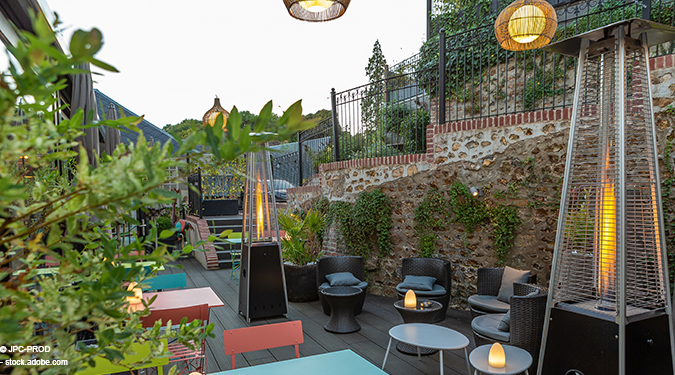
What is to be taken into account when operating gas-powered outdoor heaters, radiant heaters, patio heaters at home and in the commercial industry/hospitality industry?
Coronavirus (COVID-19) has caused enormous losses in sales, especially in hospitality. In late summer 2020, politics and associations discussed whether the hospitality industry should be able to increase their use of gas-powered outdoor heaters, radiant heaters and patio heaters again in order to be able to operate its outdoor areas on cooler days and evenings.
Whatever the outcome of the discussion, there are rules which both business owners and private individuals must adhere to. In this article, we have summarised the most important points.
Post Views:118
When the evenings become cooler, gas-operated heaters are frequently used on balconies and patios, or in outdoor areas in the hospitality industry. The names of the heaters are different – outdoor heaters, radiant heaters, patio heaters – but one thing they all have in common is that operators require a gas cylinder, pressure reducer, excess flow device for the hose and a gas anti-tilt device. In addition, there are requirements for the safe handling of the heaters – for private individuals as well as for use in restaurants, pubs or bars.
The hospitality industry is the area which was hit the hardest by the global coronavirus (COVID-19) pandemic. In order to serve guests outdoors in the cool autumn, and to ensure that the necessary income is obtained, associations and politicians (date: 10 September 2020) have discussed the increased use of gas-powered heaters, such as outdoor heaters.
Although the use of these gas heaters is not permitted in some cities, for this special case, however, there are to be exceptional regulations to support business owners.
Whether these prohibitions are cancelled or not, and whether the devices are used privately or commercially, there are regulations that must be observed when handling outdoor heaters and similar devices.
Industry
If you use an outdoor heater, radiant heater or patio heater commercially, regulation 110-010 of the German Accident Insurance Act (DGUV 110-010) is particularly relevant to you.
The hospitality sector includes, in particular, restaurants, bars, pubs, but also, for example, snack bars at fairs and Christmas markets and club events open to the public. In the following, we look at the most important points if business owners want to use a gas heater.
Operators readily use outdoor heaters operated with LPG to keep guests in their outdoor area for longer. Due to the losses caused by the pandemic, this could now be allowed temporarily on a country-wide basis.
Commercial place of installation
Gas heaters like these can’t just be placed anywhere. DGUV regulation 110-010 defines how the conditions should be at a place of installation for the system. If gas appliances of types A and B, including outdoor heaters, are operated indoors, effective ventilation is mandatory. If natural ventilation is not sufficient, an exhaust air system must be installed.
In principle, however, outdoor heaters or patio heaters should be placed outdoors, as this is also their original purpose. In any case, entrepreneurs should consult experts from the craft sector when it comes to planning and installing a LPG system.
Industry – Allowed or prohibited?
If, as a hospitality business owner, you have an outdoor area that you want to supply with comfortable heat via an outdoor heater, you should find out beforehand online or directly from your responsible city or community whether you are allowed to do so at all.
In some municipalities it’s prohibited, but it’s allowed in others. At this stage, we can’t predict the economic effects of coronavirus if we remove the restrictions.
Industry – Which system components?
In addition to the propane gas cylinder, operators always need the following components for the safe and proper operation of outdoor heaters, radiant heaters or patio heaters:
The DGUV 110-010 stipulates an excess flow device under certain circumstances. If the gas hose used is longer than 40 centimetres , the excess flow device is mandatory.
Gewerbe – Gas-Kippschutzventil
The gas anti-tilt device protects guests, employees and hospitality business owners at the same time when someone accidentally bumps into the outdoor heater, for example. It immediately stops the gas flow if a certain tilt angle is exceeded.
Nominally, the safety component is mandatory in all devices manufactured in accordance with DIN EN 14543. This includes, in particular, outdoor heaters, radiant heaters, etc. If you already have an appropriate device, please check whether the gas anti-tilt device was already fitted at the factory, otherwise please retrofit the device.
It should already be included with all new appliances. However, it doesn’t hurt to have a look at the inner workings before you make your purchase.
Industry – Replacement periods
The operator must replace components such as the pressure reducer, gas hose etc. after ten years at the latest. DGUV V79 requires this. Important: This is not the date of installation; this refers to the year in which the fitting was manufactured.
Private – Allowed or prohibited?
If, for example, you would like to keep your barbecue going until the late evening hours, even if it’s slightly cooler, you probably have a gas-operated heater on your balcony or patio. However: Are these even allowed?
It’s clear: Yes, the use of LPG-operated outdoor heaters, radiant heaters or patio heaters is permitted for private individuals. But here too, certain “rules” apply for safe use, which are set out in worksheet G 612 of the German Technical and Scientific Association for Gas and Water (DVGW).
Private – Place of installation
It is self-evident that outdoor heaters, patio heaters and other heaters are only permitted for outdoor use. This is also explicitly stated in the assembly and operating manual provided by the manufacturers.
If you would like to extend the evening in the garden slightly despite cooler temperatures, you often use an outdoor heater or patio heater operated with LPG. This is permitted in private situations, but operators should observe certain things.
Private – which system components?
It’s clear: Nothing is possible without an LPG cylinder; mostly a gas cylinder with a filling weight of either 5 or 11 kilograms. In addition, the following system components are absolutely required:
The excess flow device offers protection if, for example, the gas hose has a larger leak or is cut through as a result of an accident. The excess flow device detects this and shuts off the gas flow completely. This prevents unburned LPG from escaping and becoming a danger.
If the gas hose is longer than 150 centimetres for private use, the excess flow device is prescribed according to worksheet G 612 of the German Technical and Scientific Association for Gas and Water (DVGW).
GOK recommends its use even for shorter lengths, because: Operators cannot always keep an eye on the gas hose – for example with the outdoor heater – as this is inside the unit.
Private – Gas anti-tilt device
This is where the private and commercial sectors are the same. The gas anti-tilt device is also mandatory for private individuals unless the operator can ensure that the outdoor heater or similar devices cannot overturn under any circumstances.
If you now purchase a new heater, you usually have a corresponding valve installed ex works. If you already have a device in use, you should check the internal workings for safety reasons. If no gas anti-tilt device is installed, operators can easily retrofit it. It is simply attached between the pressure reducer and the gas hose.
Private – Replacement periods
The replacement periods in the private sector are stipulated in worksheet G 612 of the German Technical and Scientific Association for Gas and Water (DVGW). After ten years at the latest, pressure reducers, gas hose, etc. must be replaced.
It is always the year of manufacture of the component that counts as the start of the period, not the installation date. You can find more information here:
The articles are written by specialist authors in the fields of LPG, fuel oil, liquid media, tank management and safety engineering, who contribute their expertise from product management, development, technical customer support, training and standardisation activities.
The members of the editorial team have many years of practical experience in the planning, application and further development of technical solutions for the safe supply of LPG and liquid fuels. Several authors are actively involved in specialist committees and working groups of the DVGW, DVFG and figawa, as well as in national and European standardisation committees. The team includes, among others, experts certified in accordance with G 607 and G 608, competent persons in accordance with the TRF, and specialists who contribute to the development and evaluation of technical regulations and industry standards.
In addition to providing information about GOK products and solutions, the editorial team focuses on sharing knowledge relating to safety, regulations, maintenance, operation and future technologies in the field of LPG and liquid media.
Share this post
Related articles
How do I find the right pressure regulator for outdoor heaters, radiant heaters or patio heaters?
Home & Commercial
You might also find this interesting
How does a PRV pressure relief valve work?
Camping & Leisure, Home & Commercial, Safety
Which pressure regulator do I need for which output?
Camping & Leisure, Grill & BBQ, Home & Commercial
How do I know when I need to replace the components of my LPG system?
Camping & Leisure, Grill & BBQ, Home & Commercial
Where can I find operating manuals for GOK products?
Camping & Leisure, Grill & BBQ, Home & Commercial, Tank & Liquid Media
From what length of hose assembly do I need an excess flow device?
Camping & Leisure, Grill & BBQ, Home & Commercial
Which pressure regulator connections exist for LPG cylinders in Europe?
Camping & Leisure, Grill & BBQ, Home & Commercial
How can I release an OPSO (SAV)?
Home & Commercial
What is an OPSO (SAV) and how does it work?
Home & Commercial
Does the pressure regulator gauge show the filling level of the LPG cylinder?
Camping & Leisure, Grill & BBQ, Home & Commercial
Does the gas have to be discharged out of the line before releasing the OPSO (SAV)?
Home & Commercial
How do I carry out a simplified leak check on an LPG cylinder system?
Camping & Leisure, Grill & BBQ, Home & Commercial
What is the heating value of media such as fuel oil, LPG and natural gas?
Home & Commercial, Tank & Liquid Media
This blog will never ask members of the public or unqualified persons to make changes to or fiddle around with technical systems themselves.
In accordance with the Industrial Safety Regulation (BetrSichV), a qualified person must take care of a system which requires monitoring.
A qualified person is someone who has the specific specialist knowledge required. This knowledge is gained by way of a professional apprenticeship, corresponding professional experience or current occupational activity.
Please note that the texts are based on information, regulations and standards for Germany. Please always check the rules and regulations in the relevant country of destination and consult specialists if necessary.