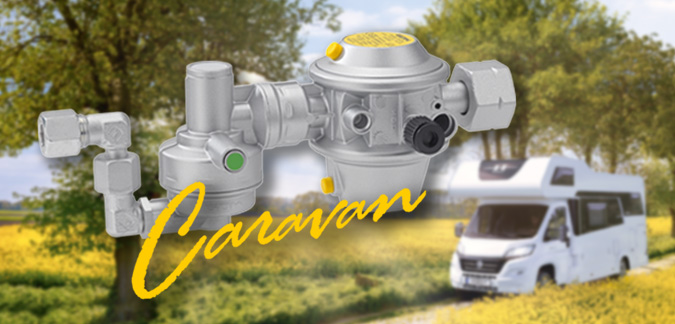
If you have installed an LPG tank in your motor caravan or have it retrofitted, you need certain components in the gas system – in particular, you need a pressure regulation system. In the Caramatic line, GOK offers, among other things, a system for operation while driving and for stationary operation. All the information is in this article.
Views:112
A known problem for campers: The gas cylinders are empty rather quickly and the replacement process is cumbersome and eats into your leisure time. Many people therefore have a permanently installed LPG tank retrofitted for the motor caravan. Unlike conventional single-cylinder or two-cylinder systems, these LPG tanks require other components in the gas system – especially if you wish to heat the vehicle while driving.
LPG tanks are available in a wide range of versions for leisure vehicles. Wynen Gas, for example, talks of up to 23 different sizes between 20 and 195 litres of capacity on their website. While the conventional 11-kilogram gas cylinder holds just under 22 litres, the largest LPG tank nominally holds 195 litres; however, due to the filling stop at 80 percent, only a maximum of 156 litres fits inside. However, this is still more than seven times the largest gas cylinder.
Major consumer or long-term camper?
In other words, if you need a lot of gas on your holidays or, for example, are a long-term camper, you will have already considered buying an LPG tank once or twice. Or you have already managed to install a tank.
For the operation of such LPG tanks, there is not much needed for the downstream gas system. As is often the case, the gas pressure regulator or the gas pressure regulation system is the most important thing. If you can retrofit an LPG tank, you usually have the control device from our Caramatic line installed directly.
If you’re a camper who likes to travel in winter, or even enjoy camping long term, you should have a safe and convenient gas supply. An LPG tank in motor caravans makes it possible – preferably with fittings from the Caramatic line from GOK.
At the latest when the first exchange is due after ten years, the camper should also familiarise themselves with the subject matter. And at the beginning, the question is usually: Do I want to heat the motor caravan while driving or only during stationary operation?
Heating while driving
If you have the right components for heating while driving, you can enjoy a special level of comfort. Namely that of a preheated living room when you arrive at the site.
The basic requirement for heating while driving with the permanently installed LPG tank is a crash sensor as part of the gas regulation system. For this purpose, GOK offers the Caramatic DriveOne in two versions (image): One for the alignment of the LPG tank fitting plate at a 90-degree angle and at an angle of 105 degrees.
The DriveOne is connected directly to the LPG tank on the input side and with the piping on the outlet side. The camper does not need any more components for the gas system itself.
Stationary operation
If you only have to operate the gas system when the vehicle is stationary, you do not need a crash sensor as a safety device. Therefore, you do not need to consider the alignment of the LPG tank fitting plate. A “standard pressure regulator” is sufficient, of course, with the appropriate connections.
GOK offers two different gas pressure regulators for the stationary operation of gas systems in leisure vehicles with LPG tanks:
If no crash sensor is installed in the gas pressure regulation system of the motor caravan, campers may only operate the connected gas equipment via the permanently installed LPG tank in stationary mode.
Conclusion
GOK offers the right options for the operation of LPG tanks in the motor caravan – depending on the exact purpose and working pressure. The camper has the freedom of choice and should observe the installation and operating parameters. If you require more information, you will definitely get some good advice from our specialist retail partners, or just visit our information page for the Caramatic line.
The articles are written by specialist authors in the fields of LPG, fuel oil, liquid media, tank management and safety engineering, who contribute their expertise from product management, development, technical customer support, training and standardisation activities.
The members of the editorial team have many years of practical experience in the planning, application and further development of technical solutions for the safe supply of LPG and liquid fuels. Several authors are actively involved in specialist committees and working groups of the DVGW, DVFG and figawa, as well as in national and European standardisation committees. The team includes, among others, experts certified in accordance with G 607 and G 608, competent persons in accordance with the TRF, and specialists who contribute to the development and evaluation of technical regulations and industry standards.
In addition to providing information about GOK products and solutions, the editorial team focuses on sharing knowledge relating to safety, regulations, maintenance, operation and future technologies in the field of LPG and liquid media.
Share this post
Related articles
What components do I need to operate gas equipment in the caravan and motor caravan while driving?
Camping & Leisure, Camping & Leisure, Safety
How does an over-pressure safety device S2SR work?
Safety
When do I have to replace LPG components in my motorhome or caravan?
Camping & Leisure
You might also find this interesting
How can I use several LPG cylinders in the caravan, motor caravan or on the boat at the same time?
Camping & Leisure
How does a PRV pressure relief valve work?
Camping & Leisure, Home & Commercial, Safety
Which pressure regulator do I need for which output?
Camping & Leisure, Grill & BBQ, Home & Commercial
Are there any differences in the gas test of mobile homes or caravans and motor caravans?
Camping & Leisure
How do I know when I need to replace the components of my LPG system?
Camping & Leisure, Grill & BBQ, Home & Commercial
Where can I find operating manuals for GOK products?
Camping & Leisure, Grill & BBQ, Home & Commercial, Tank & Liquid Media
From what length of hose assembly do I need an excess flow device?
Camping & Leisure, Grill & BBQ, Home & Commercial
Which pressure regulator connections exist for LPG cylinders in Europe?
Camping & Leisure, Grill & BBQ, Home & Commercial
Does the pressure regulator gauge show the filling level of the LPG cylinder?
Camping & Leisure, Grill & BBQ, Home & Commercial
How do I carry out a simplified leak check on an LPG cylinder system?
Camping & Leisure, Grill & BBQ, Home & Commercial
How do I identify the year of manufacture of a pressure regulator from GOK?
Camping & Leisure, Grill & BBQ, Home & Commercial
How do I find out whether the nominal pressure on the pressure regulator and gas equipment match?
Camping & Leisure, Grill & BBQ, Home & Commercial
This blog will never ask members of the public or unqualified persons to make changes to or fiddle around with technical systems themselves.
In accordance with the Industrial Safety Regulation (BetrSichV), a qualified person must take care of a system which requires monitoring.
A qualified person is someone who has the specific specialist knowledge required. This knowledge is gained by way of a professional apprenticeship, corresponding professional experience or current occupational activity.
Please note that the texts are based on information, regulations and standards for Germany. Please always check the rules and regulations in the relevant country of destination and consult specialists if necessary.