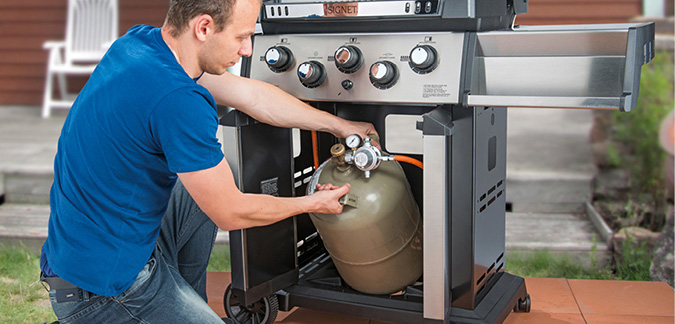
End of July. The sun is burning down from the sky. The gas cylinder is in the cupboard under the gas barbecue, which is covered with a protective bonnet. Temperatures of around 40 degrees Celsius can easily develop near the LPG cylinder. Is there a danger of explosion? GOK tells you in this blog article.
Views:335
The question of the maximum temperature at which you can store the gas cylinder in the cupboard under the gas barbecue is a bit of a hot topic – especially in summer, of course. Once the thermometer hits the 30 degree mark, a good number of barbecue fans will get a little uncomfortable when the barbecue and gas cylinder are sitting in the blazing sun. But this doesn’t have to be the case. Why? GOK will explain in this article.
It’s the end of July. The sun is beating down mercilessly. The gas cylinder is sitting in the cupboard underneath the gas barbecue, which, in turn, has a black cover over it. The temperatures around the LPG cylinder can easily reach 40 degrees Celsius.
Even if that causes unease for some, when you think about the interaction between hot temperatures and LPG, you can rest assured: There is no direct danger, even in extreme heat!
If the gas cylinder is sitting in direct sunlight or in the hot cupboard under the gas barbecue, a good number of people start to feel uncomfortable. But it doesn’t have to be this way!
Protection
All LPG cylinders containing the media propane and butane, and mixtures of these, are designed in such a way that you can even store them if the temperature feels subtropical. Still, if the thermometer starts to creep up to dizzying heights, for any reason at all, the safety valve intervenes.
Pure propane and pure butane have a something called a vapour pressure curve. This means: With this curve, we can determine how much pressure is in the gas cylinder at specific temperatures.
The vapour pressure curve clearly shows that even at a temperature of around 50 degrees Celsius, the safety valve of the propane gas cylinder wouldn’t yet respond.
Problems at 50 degrees?
From the graphic, you can read that at 40 degrees Celsius, the vapour pressure of propane is at around 13 bar; at 50 degrees, it sits at around 17 bar. These temperatures are not nearly high enough to cause the gas cylinder to explode. And before the vapour pressure reaches a critical range, the safety valve integrated into the gas cylinder valve intervenes.
In the case of propane, it releases a small, controlled volume of gas into the environment as soon as the pressure exceeds 30 bar. Butane has a significantly flatter vapour pressure curve. This is why the response pressure of the safety valve sits at around 14 bar. The diagram above doesn’t show the critical temperature range of both media at all. This would have to be well above 80 degrees Celsius.
However: Even if, in normal circumstances, the gas cylinder doesn’t present any direct danger at 80 degrees, the operator should still pay attention to the specifications of the LPG distributor. For example, Tyczka Energy requests that the storage temperature of the medium LPG not exceed 50 degrees Celsius.
If you’re now wondering which gas cylinders have this safety valve we mentioned, here’s out answer: All the classic 5, 11 and 33-kilogram propane gas cylinders, i.e. the ones typical for Germany.
The classic cylinders for private use definitely have an integrated safety valve: on the left, the cylinder with a 5-kilogram filling weight; on the right with 11-kilogram.
LPG cylinders for camping
For so-called camping cylinders, for example, from the manufacturer Camping Gaz, which do not have a withdrawal valve, it’s really easy to retrofit these with a gas cylinder valve from GOK. The safety valve is integrated and even in this use case, it works exactly as we described above – no matter whether you’re using the cylinder in your caravan, motor caravan or even on your boat.
Safety valve regulation
It has to as well, because the DVGW worksheets G 607 (for leisure vehicles), G 608 (for boats) and G 612 (leisure time) each require a safety valve which is combined with the standard shut-off valve for the gas cylinder.
On the safety valve itself, there is a red (when using propane) or blue plastic cap (when using butane). If this is missing, it may be a sign that the safety valve has responded.
No risk in the barbecue cupboard
To sum up: Even if it’s starting to get hotter around the barbecue – in the truest sense of the word –, under normal circumstances, the gas cylinder doesn’t pose any danger. If you observe the information from the manufacturer, the replacement times of components, and you’re using your common sense, it’s definitely always safe to barbecue with gas.
The articles are written by specialist authors in the fields of LPG, fuel oil, liquid media, tank management and safety engineering, who contribute their expertise from product management, development, technical customer support, training and standardisation activities.
The members of the editorial team have many years of practical experience in the planning, application and further development of technical solutions for the safe supply of LPG and liquid fuels. Several authors are actively involved in specialist committees and working groups of the DVGW, DVFG and figawa, as well as in national and European standardisation committees. The team includes, among others, experts certified in accordance with G 607 and G 608, competent persons in accordance with the TRF, and specialists who contribute to the development and evaluation of technical regulations and industry standards.
In addition to providing information about GOK products and solutions, the editorial team focuses on sharing knowledge relating to safety, regulations, maintenance, operation and future technologies in the field of LPG and liquid media.
Share this post
Related articles
Which GOK components do I need as a private individual for my gas barbecue?
Safety
What should I be aware of when transporting LPG cylinders in my own vehicle?
Camping & Leisure, Grill & BBQ, Home & Commercial, Safety
What withdrawal volume do I get out of one gas cylinder?
Camping & Leisure, Grill & BBQ, Home & Commercial
You might also find this interesting
Which pressure regulator do I need for which output?
Camping & Leisure, Grill & BBQ, Home & Commercial
How do I know when I need to replace the components of my LPG system?
Camping & Leisure, Grill & BBQ, Home & Commercial
Where can I find operating manuals for GOK products?
Camping & Leisure, Grill & BBQ, Home & Commercial, Tank & Liquid Media
From what length of hose assembly do I need an excess flow device?
Camping & Leisure, Grill & BBQ, Home & Commercial
Which pressure regulator connections exist for LPG cylinders in Europe?
Camping & Leisure, Grill & BBQ, Home & Commercial
Does the pressure regulator gauge show the filling level of the LPG cylinder?
Camping & Leisure, Grill & BBQ, Home & Commercial
How do I carry out a simplified leak check on an LPG cylinder system?
Camping & Leisure, Grill & BBQ, Home & Commercial
How do commercial operation and private operation of a gas barbecue differ?
Grill & BBQ
How do I identify the year of manufacture of a pressure regulator from GOK?
Camping & Leisure, Grill & BBQ, Home & Commercial
How do I find out whether the nominal pressure on the pressure regulator and gas equipment match?
Camping & Leisure, Grill & BBQ, Home & Commercial
What spanner size do coupling nuts on pressure regulators have for connecting to LPG cylinders in Germany?
Camping & Leisure, Grill & BBQ, Home & Commercial
How can I operate gas cartridge devices via an LPG cylinder?
Camping & Leisure, Grill & BBQ
This blog will never ask members of the public or unqualified persons to make changes to or fiddle around with technical systems themselves.
In accordance with the Industrial Safety Regulation (BetrSichV), a qualified person must take care of a system which requires monitoring.
A qualified person is someone who has the specific specialist knowledge required. This knowledge is gained by way of a professional apprenticeship, corresponding professional experience or current occupational activity.
Please note that the texts are based on information, regulations and standards for Germany. Please always check the rules and regulations in the relevant country of destination and consult specialists if necessary.