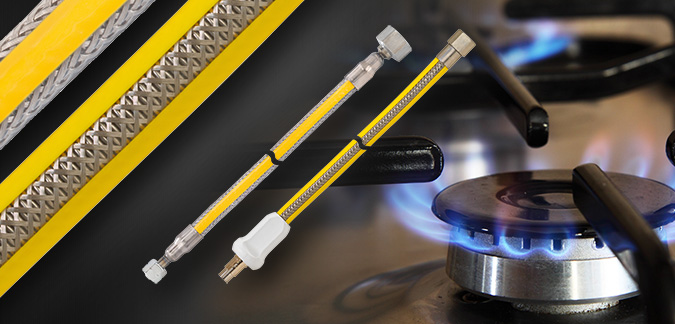
In addition to the well-known orange hose assemblies made of rubber or plastic for LPG systems, there are ones made of stainless steel or metal braided corrugated pipes.
Since the regulations stipulate a replacement period for the conventional gas hoses, the question arises whether this also applies to those made of stainless steel?
Post Views:171
In order to connect a gas stove in the household or in a large kitchen with a gas cylinder or a pressure reducer, hose assemblies made of stainless steel (metal corrugated hose, stainless steel corrugated tube) or metal braided corrugated pipes are used sometimes. This raises the question whether the usual replacement period also applies here.
As before, the orange gas hose is still dominating in LPG systems with propane, butane and mixtures of the two. These hose assemblies are either made of rubber or plastic and are generally very durable – despite very intensive and hard-wearing use in some cases.
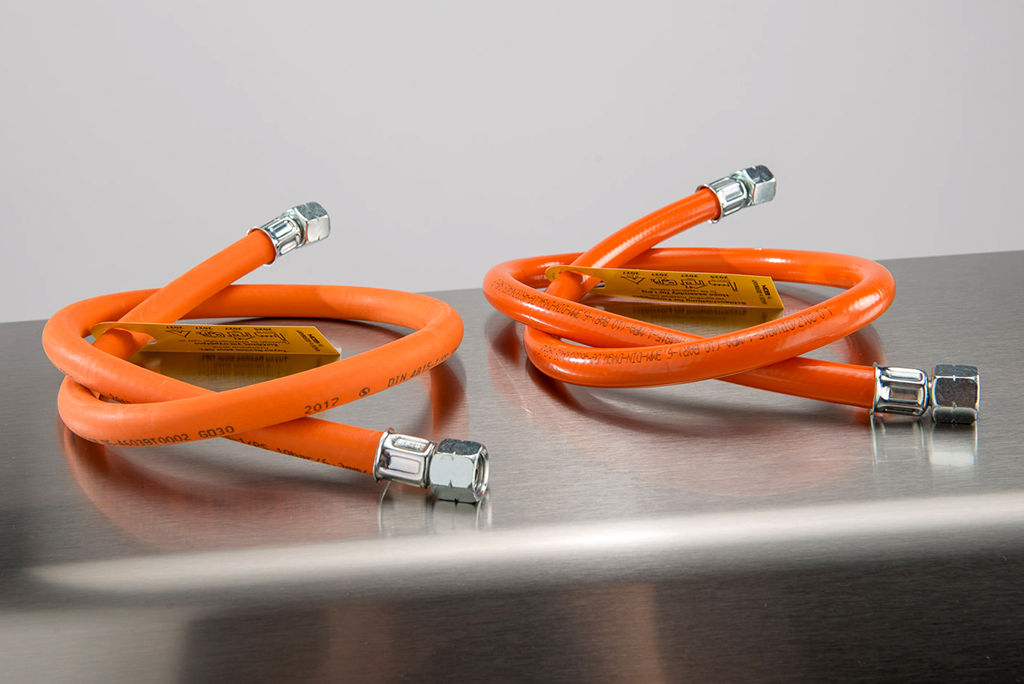
This is what the standard hose assemblies for propane and butane look like: on the left, the version made of rubber, on the right, the version made of plastic.
Replacement period conventional hoses
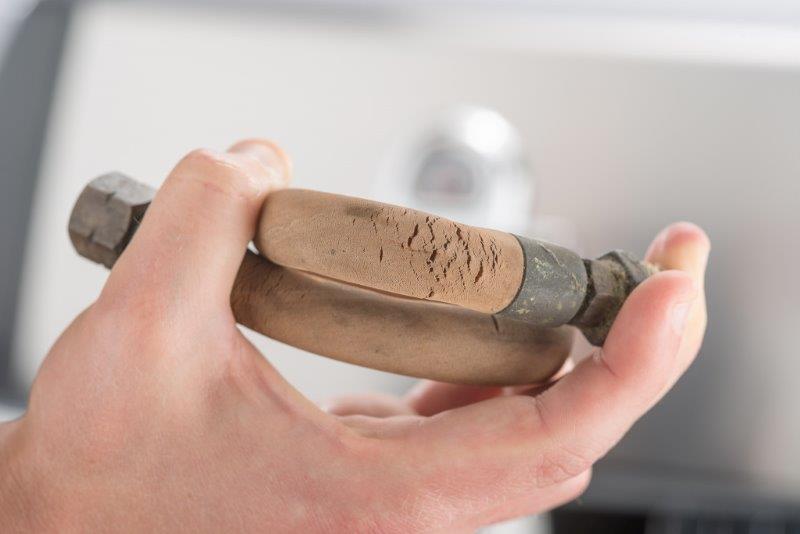
Nevertheless, they are wearing parts and are therefore subject to a certain degree of ageing. They must be replaced at regular intervals in order to minimise the potential hazard caused by gas leakage. For domestic applications, the Technical Rules for LPG (TRF) specify the replacement interval for gas hoses (hose assemblies). According to the TRF, the hoses must be replaced ten years after the date of manufacture (see imprint or hose tag). For commercial applications, the currently valid DGUV 110-010 stipulates a replacement interval of ten years.
In addition to the orange hose assemblies made of rubber and plastic, stainless steel hose assemblies are suitable and used for LPG systems. GOK offers them, among other things, as part of a kit to connect the gas stove or as a so-called all-gas hose for the gas socket. Of course, after ten years at the latest, the question arises whether the replacement periods from the TRF also apply to the stainless steel gas hoses. The short answer is: No!
Different standards
In a little more detail: The TRF require the hose assemblies which are manufactured in accordance with DIN 4815-2 or DIN 16436-2 to be replaced; in particular, these include the orange hoses made of rubber and plastic. Hose assemblies made of stainless steel, more precisely: metal braided corrugated pipes, are defined in DIN 3384 or DIN 14800. The TRFdo not stipulate a replacement period for this type of hose.
Of course, this also depends on the difference in the material. While materials such as rubber or plastic are subject to ageing and wear, stainless steel is not subject to ageing, or only subject to ageing to a certain degree. The specifications of the respective manufacturer are nevertheless binding and must be complied with, if there are any.
Such ageing does not occur in the case of a gas hose made of stainless steel or a metal braided corrugated pipe, of course. Therefore, there is no replacement period for such cables.
Summary – Conclusion
This means that, after ten years, the orange hose assemblies made of rubber or plastic must be removed from LPG systems used in household or commercial sector after ten years. Gas hoses made of stainless steel do not have a replacement period and therefore only have to be replaced if a user or specialist finds a defect.
As stainless steel itself is far more expensive as raw material and is more complex in processing than rubber or plastic, the sales prices of the individual products differ. Users now have the choice – GOK has both solutions in the range.
The articles are written by specialist authors in the fields of LPG, fuel oil, liquid media, tank management and safety engineering, who contribute their expertise from product management, development, technical customer support, training and standardisation activities.
The members of the editorial team have many years of practical experience in the planning, application and further development of technical solutions for the safe supply of LPG and liquid fuels. Several authors are actively involved in specialist committees and working groups of the DVGW, DVFG and figawa, as well as in national and European standardisation committees. The team includes, among others, experts certified in accordance with G 607 and G 608, competent persons in accordance with the TRF, and specialists who contribute to the development and evaluation of technical regulations and industry standards.
In addition to providing information about GOK products and solutions, the editorial team focuses on sharing knowledge relating to safety, regulations, maintenance, operation and future technologies in the field of LPG and liquid media.
Share this post
Related articles
What is better: the gas hose made of rubber or plastic?
Camping & Leisure, Grill & BBQ, Home & Commercial
Gas Cooker with Propane Indoors: Regulations, Connection & Safety
Home & Commercial, Safety
You might also find this interesting
How does a PRV pressure relief valve work?
Camping & Leisure, Home & Commercial, Safety
Which pressure regulator do I need for which output?
Camping & Leisure, Grill & BBQ, Home & Commercial
How do I know when I need to replace the components of my LPG system?
Camping & Leisure, Grill & BBQ, Home & Commercial
Where can I find operating manuals for GOK products?
Camping & Leisure, Grill & BBQ, Home & Commercial, Tank & Liquid Media
From what length of hose assembly do I need an excess flow device?
Camping & Leisure, Grill & BBQ, Home & Commercial
Which pressure regulator connections exist for LPG cylinders in Europe?
Camping & Leisure, Grill & BBQ, Home & Commercial
How can I release an OPSO (SAV)?
Home & Commercial
What is an OPSO (SAV) and how does it work?
Home & Commercial
Does the pressure regulator gauge show the filling level of the LPG cylinder?
Camping & Leisure, Grill & BBQ, Home & Commercial
Does the gas have to be discharged out of the line before releasing the OPSO (SAV)?
Home & Commercial
How do I carry out a simplified leak check on an LPG cylinder system?
Camping & Leisure, Grill & BBQ, Home & Commercial
What is the heating value of media such as fuel oil, LPG and natural gas?
Home & Commercial, Tank & Liquid Media
This blog will never ask members of the public or unqualified persons to make changes to or fiddle around with technical systems themselves.
In accordance with the Industrial Safety Regulation (BetrSichV), a qualified person must take care of a system which requires monitoring.
A qualified person is someone who has the specific specialist knowledge required. This knowledge is gained by way of a professional apprenticeship, corresponding professional experience or current occupational activity.
Please note that the texts are based on information, regulations and standards for Germany. Please always check the rules and regulations in the relevant country of destination and consult specialists if necessary.