How long does the gas last in my LPG cylinder? Do I still have enough for the next barbecue? These questions have probably been asked by everyone with a gas barbecue.
If the gas has already run out once before while you were preparing a steak, you now probably always have a replacement cylinder at the ready.
In this article, we have written down everything worth knowing on the subject, developed a simple calculation tool and will show you a digital alternative.
Enjoy reading…
Views:177
If you’re using a gas barbecue, sooner or later you will ask yourself: How long will the gas last, or how many times can I still barbecue with the gas that’s left? As is frequently the case, the answer is: It depends! In this article, we say at least what is important, provide you with a calculation tool and present a digital tool with a forecast function.
Which gas cylinder?
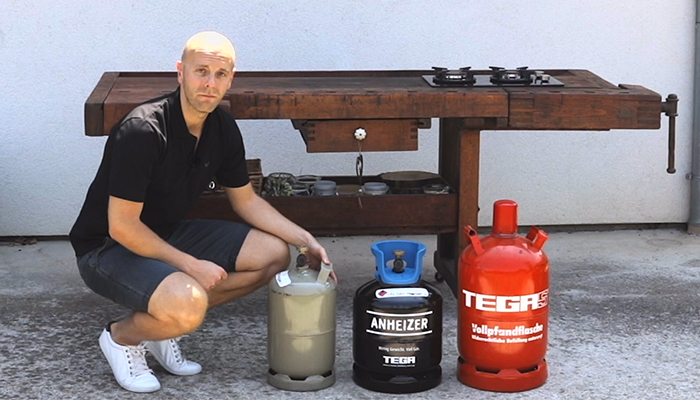
First of all, however, on the question which gas cylinders are even worth looking at, i.e. which gas cylinders are mainly used on gas barbecues. In the German-speaking countries, barbecues mainly use gas cylinders with the following filling weights:
5 kilograms
8 kilograms – also known as a BBQ gas cylinder or barbecue gas cylinder
11 kilograms
The image shows the common sizes of gas cylinders mentioned above (left to right): 5 kg, 8 kg and 11 kg.
Influencing factors
Of course, the length of time that the gas will last depends on various factors. Among other things, these are, of course (1) the current filling level of the gas cylinder, (2) the maximum output of the gas barbecue, (3) how many burners are actually on, (4) the outside temperature and (5) the quality processing of the gas barbecue. This will also be explained briefly:
How full the cylinder is at the time x, of course, is decisive when it comes to the question of how long it will last.
Gas barbecues consume different amounts of gas – ok, that’s not really new information. The maximum output is indicated on the type label of the barbecue.
An exciting question with regard to consumption: How many burners are on or at which level are they burning?
Of course, the consumption varies depending on whether you barbecue at 5 or 35 degrees Celsius. To reach the target temperature on or in the barbecue, more gas is required if the outside temperature is lower.
The better the lid of a gas barbecue is processed, the better it keeps the temperature and the less gas the barbecue expert needs.
Of course, the gas consumption depends on how many burners are running and at which heat level. Some type of preparation requires that all burners run at full power at the same time. Sometimes it is necessary to operate only one or two burners at a low level.
If all these aspects are taken into account, it is also clear that it’s difficult to make a general forecast of how long the gas will last. In addition, we have not yet mentioned that the withdrawal volume from a conventional gas cylinder varies greatly – depending on the filling quantity, temperature and capacity requirement.
Vorarbeit für die Berechnung
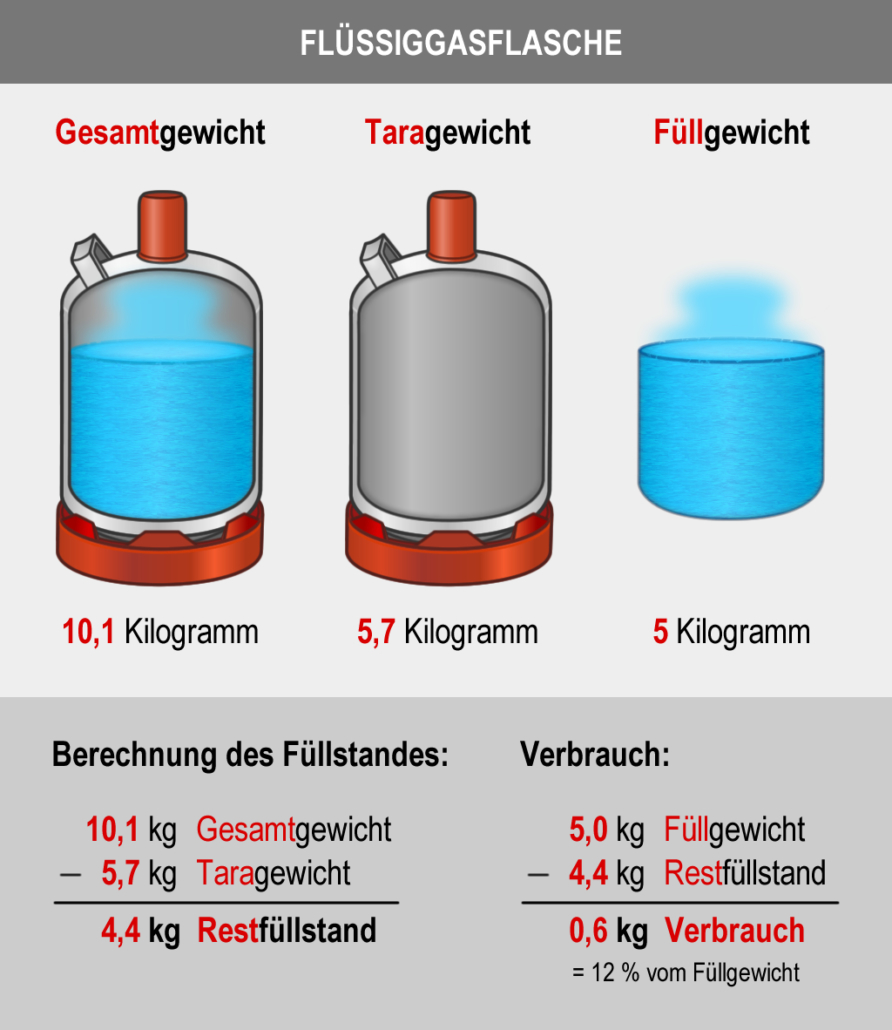
Filling level of the gas cylinder in kilograms
Procedure:
Weigh the gas cylinder with a set of commercially available (luggage) scales.
Subtract the tare weight (to be found on the gas cylinder label) from the determined value.
The result of subtraction is the current filling level in kilograms!
Performance of the gas barbecue in kilowatts
Procedure:
Search type label on gas barbecue
The value is generally given in kilowatts (kW)
The diagram shows an example calculation of the remaining filling level in a gas cylinder with a filling weight of 5 kg.
Use the calculation tool
If you have the two values, you can enter them in our calculation tool and we will make a simple forecast of how long the current filling level of the gas cylinder will last for.
In order to obtain the most accurate result possible, we have divided the calculation into two simple steps. In the first step, enter the values determined (see “Preparatory work for calculation”). The result states how many hours you could still barbecue if the gas barbecue was permanently running at full power.
As this only happens in rare cases, we have added a second part of the calculation. There, you can estimate for yourself the rough capacity stage that the gas barbecue is running at, on average.
As already mentioned, with the calculation tool, we only achieve an approximate indication. You get a much more precise result, and faster too, with the Senso4s. The digital tool can do the following:
Measuring the current filling level of the gas cylinder
Results are sent to the app on your smartphone or tablet via Bluetooth
Display in kilograms or percentage by volume
The app creates a consumption forecast on the basis of the collected values for how long the gas will last.
This video shows you how to quickly determine the filling level of the gas cylinder in both analogue and digital ways.
The articles are written by specialist authors in the fields of LPG, fuel oil, liquid media, tank management and safety engineering, who contribute their expertise from product management, development, technical customer support, training and standardisation activities.
The members of the editorial team have many years of practical experience in the planning, application and further development of technical solutions for the safe supply of LPG and liquid fuels. Several authors are actively involved in specialist committees and working groups of the DVGW, DVFG and figawa, as well as in national and European standardisation committees. The team includes, among others, experts certified in accordance with G 607 and G 608, competent persons in accordance with the TRF, and specialists who contribute to the development and evaluation of technical regulations and industry standards.
In addition to providing information about GOK products and solutions, the editorial team focuses on sharing knowledge relating to safety, regulations, maintenance, operation and future technologies in the field of LPG and liquid media.
Share this post
Related articles
How can I measure the filling level of a gas cylinder?
Camping & Leisure, Grill & BBQ, Home & Commercial
Senso4s – what do I need to consider when using it?
Grill & BBQ, Home & Commercial
What withdrawal volume do I get out of one gas cylinder?
Camping & Leisure, Grill & BBQ, Home & Commercial
You might also find this interesting
Which pressure regulator do I need for which output?
Camping & Leisure, Grill & BBQ, Home & Commercial
How do I know when I need to replace the components of my LPG system?
Camping & Leisure, Grill & BBQ, Home & Commercial
Where can I find operating manuals for GOK products?
Camping & Leisure, Grill & BBQ, Home & Commercial, Tank & Liquid Media
From what length of hose assembly do I need an excess flow device?
Camping & Leisure, Grill & BBQ, Home & Commercial
Which pressure regulator connections exist for LPG cylinders in Europe?
Camping & Leisure, Grill & BBQ, Home & Commercial
Does the pressure regulator gauge show the filling level of the LPG cylinder?
Camping & Leisure, Grill & BBQ, Home & Commercial
How do I carry out a simplified leak check on an LPG cylinder system?
Camping & Leisure, Grill & BBQ, Home & Commercial
How do commercial operation and private operation of a gas barbecue differ?
Grill & BBQ
How do I identify the year of manufacture of a pressure regulator from GOK?
Camping & Leisure, Grill & BBQ, Home & Commercial
How do I find out whether the nominal pressure on the pressure regulator and gas equipment match?
Camping & Leisure, Grill & BBQ, Home & Commercial
What spanner size do coupling nuts on pressure regulators have for connecting to LPG cylinders in Germany?
Camping & Leisure, Grill & BBQ, Home & Commercial
How can I operate gas cartridge devices via an LPG cylinder?
Camping & Leisure, Grill & BBQ
This blog will never ask members of the public or unqualified persons to make changes to or fiddle around with technical systems themselves.
In accordance with the Industrial Safety Regulation (BetrSichV), a qualified person must take care of a system which requires monitoring.
A qualified person is someone who has the specific specialist knowledge required. This knowledge is gained by way of a professional apprenticeship, corresponding professional experience or current occupational activity.
Please note that the texts are based on information, regulations and standards for Germany. Please always check the rules and regulations in the relevant country of destination and consult specialists if necessary.